Indigenous Education

Programs

Pathway to Engineering Technology Programs: A Rundown
March 12, 2024

Did you know that you can start a career in engineering at any level?

With an education in engineering, you can help plan the layouts of communities, design buildings to meet the needs of the people in them, and specialize in creating sustainable solutions for the construction industry.

If you’re a…

  • Big-picture thinker
  • Creative problem solver
  • Team player
  • Logical thinker
  • Hands-on learner

… The Pathway to Engineering Technology can help you build the foundation you need to launch your education in engineering. Whether you want to plan vast city architecture or develop infrastructure in smaller communities, engineering technology can get you there.

Committing to a full-time diploma program is a huge decision. You could spend a lot of time, money, and effort before even knowing what you want to do with your career. With Pathways, you can explore the different options in a specific industry while preparing for the overall dedication and hard work that come with college diploma programs.

Pathway to Engineering Technology prepares you for Civil Engineering Technology, Electrical Engineering Technology, Mechanical Engineering Technology, and Power Engineering Technology 4th Class, which are what we call “progression programs” because you progress into them following completion of the Pathway!

Prepare for an Education in Engineering Technology
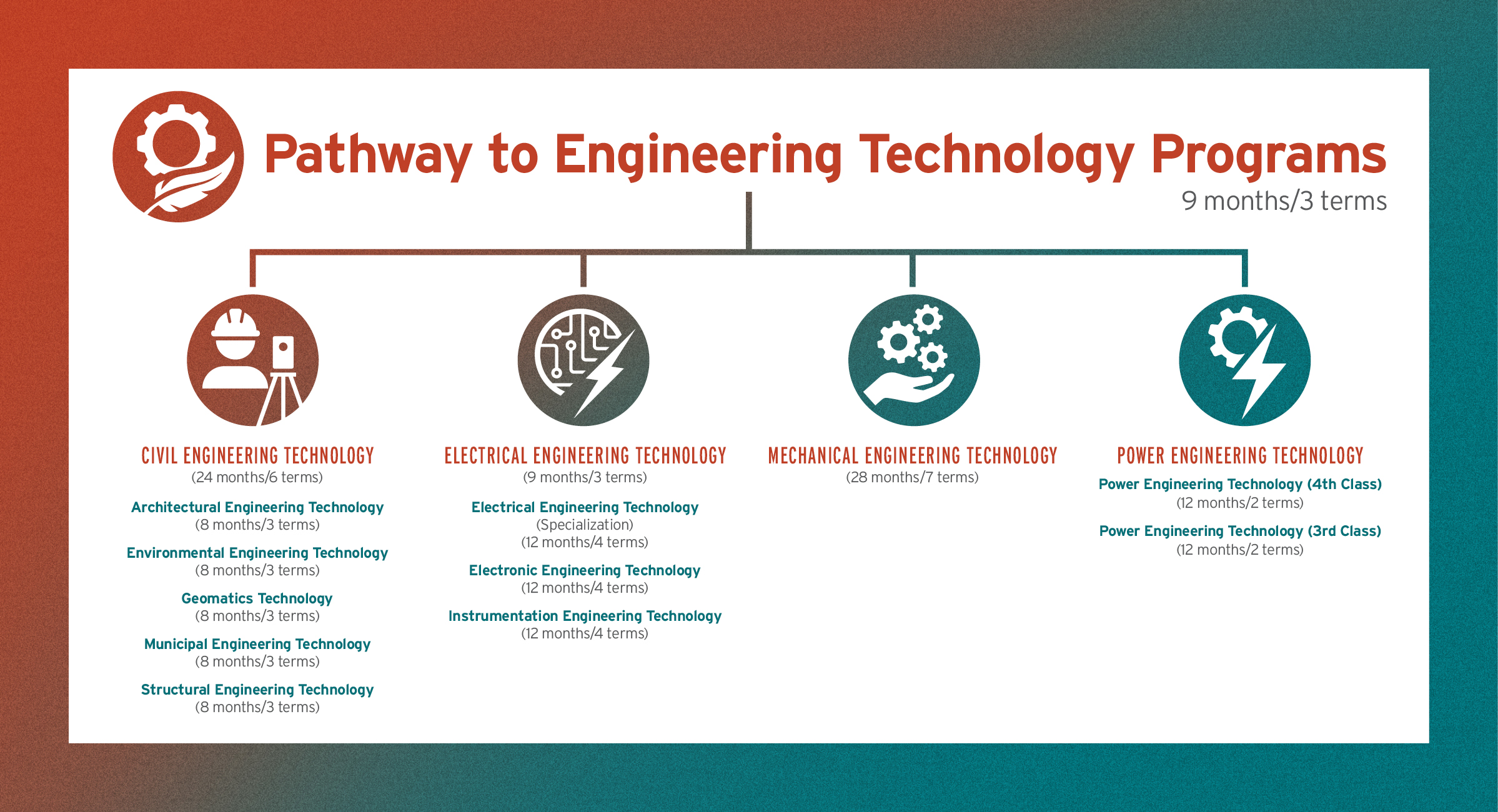
Each of the progression programs have wide applications and specializations which you will explore in-depth in the Pathway program.

Once you finish the Pathway Program, all students in the progression programs share a common first year in which they build fundamental skills, develop theoretical knowledge and use state-of-the-art software and equipment to explore different disciplines within engineering. Students then choose a specialization program to pursue until graduation.

Civil Engineering Technology

The Civil Engineering Technology program has the widest array of options in terms of specializations, allowing you to develop a diverse skillset that you can use in any number of potential careers, like:

  • Contractor
  • Project manager
  • Building and site inspector
  • Structural Designer
  • Construction/legal land surveyor

Students in the Civil Engineering Technology program explore the design, construction and maintenance of man-made and natural environments, including roads, water supplies, infrastructure projects and building systems.

Architectural Engineering Technology

You will develop your knowledge of engineering principles and construction practices to pursue careers in building system construction and design, computer-aided design and drafting, site inspection and supervision, construction project and administration management, technical sales and support, building sciences and environmental systems.

  • Building commissioning technician/technologist
  • Energy advisor
  • CAD technician
  • Architectural technologist
  • Contract administrator

Check out the Program Explorer page for more information.

Enviromental Engineering Technology

The Environmental Engineering Technology program focuses on the stewardship of environmental resources, including water resources management and protection, water supply and treatment, wastewater collection and treatment, soil remediation, solid waste management, air quality, Geographic Information Systems (GIS) and remote sensing, project management, environmental management and health and safety.

  • Environmental consultant 
  • Research and development specialist
  • Regulatory enforcer
  • Project manager
  • Water/wastewater operator

Check out the Program Explorer page for more information.

Geomatics Technology

Geomatics is the collection, analysis, management and application of geographical data in physical spaces. This data helps determine how humans interact with the land and shows impacts on residential and commercial property development, road construction and maintenance, and the use of public lands.

  • Control survey specialist 
  • Topographical mapping technologist
  • Remote sensing technologist
  • Land survey technologist
  • Municipal asset manager

Check out the Program Explorer page for more information.

Municipal Engineering Technology

You will study a broad range of content areas and develop a diverse skillset that you can bring to a wide variety of positions. You may find work in construction, design and supervision, highways and transportation engineering, water resources engineering, geotechnical engineering, and environmental engineering and protection.

  • Field technician
  • Materials testing technologist
  • Materials testing technician
  • Civil quality representative
  • Construction inspector

Check out the Program Explorer page for more information.

Structural Engineering Technology

Learn to work in teams to design, plan and build the buildings and infrastructure that make up our world. Through the Structural Engineering Technology program, you will develop the technical and practical skills you need for a successful career in consulting, contracting, designing, fabrication or project management, whether you’re working in Manitoba or abroad.

  • Estimator
  • Structural analyst
  • Contract administrator
  • Structural designer
  • Quality assurance inspector

Check out the Program Explorer page for more information.

Electrical Engineering Technology

The Electrical Engineering Technology (EET) program prepares you for employment as an engineering technologist in this rapidly evolving industry. You’ll develop in-depth knowledge and versatile skills in design, installation, maintenance, production, technical support and sales. You’ll build specialized skills and explore the electrification of new economic sectors such as transportation.

  • Designer, circuit – railway
  • Trouble-shooter, quality control
  • Technologist, design – electrical
  • Repairer, electrical production
  • Technologist, lines distribution design

The Electrical Engineering Technology program prepares you for entry-level employment as an engineering technologist in the electrical industry, with careers in electrical utility systems, consulting engineering and electrical manufacturing. RRC Polytech trains EET students to be highly skilled, safe and career ready as soon as they graduate.

Electrical Engineering Technology

You will continue with the Electrical Engineering stream and learn to harness high voltage and large currents to explore electrical generation, transmission and distribution technology. Gain experience with programmable logic controllers, motor drives, transformers and communication systems that drive manufacturing systems.

  • Technologist, transformers tester
  • Technologist, radio frequency
  • Technologist, production support 
  • Technologist, underground power distribution
  • Repairer, electrical production

Check out the Program Explorer page for more information.

Electronic Engineering Technology

You’ll develop in-depth electronics knowledge, build industry-standard technical skills and explore various digital and analog circuits applications, including amplifiers, industrial electronics, radio and wireless communications, microprocessor programming and interfacing, programmable logic and control systems. 

  • Technologist, radar / radar systems / sonar
  • Technologist, biomedical engineering
  • Repairer, research laboratory equipment
  • Technologist, fibre optics
  • Technologist, communications / telecom

Check out the Program Explorer page for more information.

Instrumentation Technology

You’ll explore data acquisition, networking, distributed control systems and remote terminal units. You’ll also learn the configuration/programming language of various microprocessor-based devices. As an Instrumentation and Control Engineering Technology graduate, you’re eligible for apprenticeship recognition under the Red Seal trade of Instrumentation and Control Technician. RRC Polytech’s experiential lab sessions provide credit hours for field experience requirements, and classes are recognized as equivalent to the four levels of apprenticeship schooling.

  • Technologist, production support 
  • Technologist, HVAC 
  • Technologist, QC (quality control)
  • Technologist, field service engineering
  • Technologist, tester, calibration 

Check out the Program Explorer page for more information.

Mechanical Engineering Technology

The Mechanical Engineering Technology program combines foundational knowledge with experiential projects and labs to prepare you for a career designing and producing high-quality manufactured goods. The skills and techniques you learn as a student can be applied immediately upon graduation and transferred across industries and organizations.

  • Mechanical designer
  • Design engineer / manufacturing technologist
  • Mechanical engineer, research and development
  • Product designer
  • Field test technician

As a co-op program, Mechanical Engineering Technology alternates between academic study and co-op employment terms, allowing you to build vital on-the-job experience and earn money while learning. Students study design, manufacturing methods, quality assurance, equipment selection, computer-aided engineering, building systems design and control, mechanical analysis, computer applications, communication and project management.

Power Engineering Technology (4th Class)

In this program, you’ll explore the operation and maintenance of power plants and build the skills needed to challenge Manitoba’s licensing exam and obtain a 4th Class Power Engineer’s certificate. As a 4th Class Power Engineer, you’ll be responsible for the safe and efficient operation of process equipment in residential, institutional, commercial and industrial establishments.

  • Power engineer (4th class)
  • Chief engineer
  • Building manager
  • Plant manager

Pathway to Engineering Technology Programs Courses

At-a-glance descriptions to help you know what to expect in the Pathway.

Term 1 (4 months)

  1. Science for Engineering Technology Programs: Chemistry: Introduces you to the use of different building materials and how energy is absorbed/released to heat/cool substances for practical application in designing infrastructure.
  2. Communication Skills for Engineering Technology 1: Prepares you to effectively communicate in an academic context. You will develop skills in reading comprehension, listening, oral presentation, and technical and academic writing.
  3. Computer Skills for Engineering Programs: Introduces you to the principles of software applications including Windows, Microsoft Word, PowerPoint and Excel. You will be able to graph data, create, edit and manipulate documents, spreadsheets, and other files to create a technical paper.
  4. Math for Engineering Technology 1: Equips you with a strong foundation in the basic mathematical concepts necessary to be successful in the technological fields. This is a hands-on course and a large portion of time will be invested in using and applying mathematical concepts, including arithmetic, measurement and algebra.
  5. Introduction to Professional Studies: Teaches you the necessary skills to be successful in college. Topics include goal setting, time management, study and test taking skills, self-assessment, reflective practice, critical thinking skills, stress management and developing strategies to become a more self-directed learner.
  6. WHMIS: The Workplace Hazardous Materials System (WHMIS) is a system for ensuring that important information about hazardous products is communicated where products are used, stored and handled. This course provides Information necessary to understand and interpret information about hazardous products, including pictograms (symbols), labels and Safety Data Sheets.
  7. General Safety Training: General Safety Training (GST) teaches basic general safety content to arm students with the core information necessary for them to protect themselves in workplaces on all descriptions. Although some examples may consider Manitoba legislation, this course has been developed by occupational safety and health professionals using generic information that is not provincially specific.

Term 2 (4 months)

  1. Communication Skills for Engineering Technology 2: Prepares you to effectively communicate in a technical environment. Course material will include basic technical communication, business correspondence, plain English, document design, reports, proposals and oral presentations. Students will also implement their research skills using Red River College’s online data base and the internet.
  2. Introduction to Engineering Technology Professions: Introduces you to a range of professions within Engineering Technology. You will learn about different career options in the technology industries through participation in a series of industry tours and seminars led by industry experts.
  3. Math for Engineering Technology 2: Builds on the skills developed in Math for Engineering Technology 1. This is a hands-on course; a large portion of the time will be invested in using and applying mathematical concepts.
  4. Science for Engineering Technology Programs: Physics: Introduces you to the basic concepts of physics required in the technology fields. Emphasis is on concepts and basic calculations in mechanics, electrostatics and magnetism.

Term 3

  1. Applied Learning Project: Engineering Technology: Introduces you to some of the technical skills required in the engineering technology professions. Working in a lab setting, students will learn the basic skills and apply principles of workplace safety. Students will also work in teams on an applied, industry-related project.

Frequently Asked Questions

How much does the Pathway to Engineering Programs cost?

The total cost of the Pathway to Engineering Technology is about $8,755. The prices are broken down into tuition ($6,250); books, laptop, and supplies ($2,250); and health and dental coverage ($255).

If you need help locating financial aid, you can connect with one of our Navigation Coaches or the Financial Aid Officer through the Indigenous Student Support Team. They can also help you navigate processes for awards, scholarships and bursaries, which you can start researching to help offset the cost of tuition.

Some Indigenous-specific and engineering-specific awards include:

  1. Accutech Engineering Resident of Nunavut Award ($3,000)
  2. Business Council of Manitoba Indigenous Education Awards ($2,000+)
  3. Indspire Post-Secondary Education Bursary Award (multiple)
  4. RRC Introduction or Pathway Program Indigenous Student Bursaries ($750)
  5. Viterra Inc. Scholarships for First Nations, Inuit, Metis Electrical Engineering ($500)
  6. Akman Construction Environmental Engineering Technology Award ($1500)
  7. American Concrete Institute (ACI) Manitoba Chapter Scholarship ($1,000+)
  8. Architectural Technology Achievement Award ($1,000)
  9. Bell MTS Academic Excellence Award for Electronic Engineering Technology ($500)
  10. Canadian Public Works Association (CPWA) Civil Engineering Tech Entrance Award ($1,000)

The Library and Academic Services have a laptop-loaning program for a period of 4 weeks in case you need more time to secure a reliable laptop. You can see the laptop specifications here if you’re not sure what you’re looking for.

When does the program start? Where is it?

The Pathway to Engineering Technology Programs starts on August 26, 2024, at the Notre Dame Campus in Winnipeg.

Is the program in-person?

Due to the hands-on learning needed for engineering, some courses will require you to be present in-person. Some courses will allow you to work remotely as part of the college’s current hybrid approach to content delivery.

What do I need to apply?

You’ll need to provide proof of graduation from or enrolment in high school, your academic history and to declare that you have Indigenous ancestry.

If you’ve been out of school for more than a year and are older than 19, you can apply as a mature student and just need to declare that you have Indigenous ancestry.

You’ll need a Future Student Account with RRC Polytech so you can keep track of any document submissions you make. You can sign up here and everything will be displayed on your account. You can submit documents via PDF files using a digital signature or you can scan your physical paper document using a scanner or a scanner on your phone. Linked here are tutorials on both creating a digital signature in Google Docs and using the scanner on iPhones in the Notes app.

You’ll need to provide proof of completion of the admission requirements within 15 days from when you applied.

If you apply after July 15, 2024, you’ll need to provide proof of completion of the admission requirements within 5 days of applying. So, for example: if you apply on July 14, 2024, you have until September 10, 2024, to submit proof of completion. If you apply on July 15, 2024, you’ll need to provide proof by July 20. Seems odd at first, but we need to make sure that we get in all applications in before the program starts and we don’t want to keep changing the deadline requirements every week of July and August, so we settled on 5 days for the proof submission within the last six weeks before the program starts.

How do I benefit from going into the Pathway?

Completing the Pathway to Engineering Technology will earn you a Statement of Achievement and eligibility for a reserved seat in any of RRC Polytech’s Engineering programs: Civil Engineering Technology, Electrical Engineering Technology, Mechanical Engineering Technology, and Power Engineering Technology 4th Class.

Completion of the Pathway can bypass some of the program entry requirements and fees for the progression programs. To learn more, connect with an Indigenous Student Recruiter at indigenous@rrc.ca.

Pathway to Engineering Technology will help you build connections at the college that will support you through your education—you’ll meet other students with common interests and goals, support staff eager to help you achieve your dreams, and instructors with real-world engineering experience to guide you into the industry.

Where can I find more information?

You can check out the program explorer page on our website for Pathway to Engineering Technology Programs as a source for accessing all the information you need. If you prefer to talk to a person, you can contact an Indigenous Student Recruiter at indigenous@rrc.ca.

If you’re ready to apply for the Pathway to Engineering Technology Programs, contact an Indigenous Student Recruiter at indigenous@rrc.ca, or you can fill out the PDF form and submit it to the Student Service Centre at documents@rrc.ca.

Wiisinin Diner opens next Tuesday

March 5, 2024

The Indigenous Culinary Skills students are putting their newly-acquired skills into action!

The annual pop-up Wiisinin Diner will be serving delicious breakfast and lunch for staff and students between Tuesday and Friday from March 12 until April 19 in Prairie Lights Dining Room at Notre Dame Campus. Pick up your vouchers from the Campus Store and check out the menu on our website.

Compass Skills – Apply today!

December 1, 2022

If you or someone you know someone is struggling to maintain steady work or stay in school, the Compass Skills Program can help.

Compass Skills is a free, paid 10-week course with potential for post-program financial assistance for education or employment.

Learners will gain the skills they need to enter post-secondary education or the workforce. They’ll learn how to manage their resources, self-reflect and plan for the future, and have access to culturally-inclusive supports for a holistic experience.

Compass Skills focuses on personal and professional growth. The program is not designed to put the pressure of grades or competition on learners. Compass Skills is designed with learners’ success in mind.

The Compass Skills program is delivered 25 hours a week, or five hours per day, Monday to Friday, which can be flexible based on learners’ needs. Childcare support options are available to help learners find the time to learn and grow.

Compass Skills participants will receive a living wage to support them while they learn. They’ll get training in first aid and mental health first aid, Manitoba Health Certified Food Handler Training, and Workplace Hazardous Materials Information System (WHMIS). Compass Skills will help learners access the class 5 learner’s driver’s license handbook, the Canadian Adult Achievement Test Level C (CAAT), the CliftonStrengths Test, and criminal record checks.

Compass Skills introduces participants to life skills that aren’t necessarily reflected in the standard education system and would otherwise be inaccessible without first having someone to show them how to nurture these skills.

When does Compass Skills start?

Compass Skills starts Monday, Jan. 9, 2023, and runs until Friday, March 17, 2023.

Who can apply?

Compass Skills is offered to learners ages 18 – 30, who are Indigenous (First Nations status, First Nations non-status, Inuit, Métis), and not already in education or employment. Access to a laptop or computer is required to participate fully.

Transcripts, textbooks, references, and payments are not required.

If you have any questions, contact Monica Morin, Program Manager, at momorin@rrc.ca.

Pathway to IT Programs proof of submission requirements deadline change

November 28, 2022

Pathway to IT Programs is still accepting applications all December long!

When you submit your application, remember that you also need to provide proof that you have submitted all the required documents:

  • High school transcript, or proof of enrolment in high school
  • Transcripts from any other post-secondary you may have attended
  • The application

The enrolment fee is waived until the second semester, so you don’t need to include any proof of payment in your proof of submission.

From today, proof of submission is required within 5 days of submitting your application.

If you submitted your application before November 28, you still have 30 days to submit your proof of submission.

If you need assistance with organizing your proof of submission, talk to Marshall Richard, Indigenous Liaison Advisor at indigenous@rrc.ca and he can help you out.

Check out this blog post for supplemental information and a tutorial to fill out the application, or visit the Program Information page directly to get started on your application!

Pathway to IT Programs Information Session – On-Demand

November 25, 2022

Register now for an on-demand Information Session presented by Jamie Chahine, Manager, Access Pathway Programs and Marshall Richard, Indigenous Liaison Advisor.

If you have any questions, you can contact Marshall at indigenous@rrc.ca.

We are currently accepting applications for the Pathway to IT Programs for the Winter term that starts on Monday, January 3, 2023. You can access the application on the Pathway to IT Programs webpage when you’re ready to apply!

Pathway to IT Programs – A Rundown

November 16, 2022

If you’re into tech and wondering if a career in IT would be a good fit for you, try answering these questions:

  • Are you curious?
  • Do you think of creative solutions to problems in your everyday life?
  • Does your family ask you to troubleshoot their electronics for them?
  • Do you enjoy collaborating with others and working in a team?
  • Do you like playing video games and want to know how they work?
  • Are you interested in having your own online store?
  • Do you want to start an online business?
  • Do you have great ideas for telling stories through digital mediums?
  • Do you see websites or online services and think, “I can do this better”?

If you answered “Yes!” to any of the above questions, Pathway to IT Programs can help you find the best program to achieve your career goals and develop your tech skills! You could literally get a job and get paid for doing the above, and we want to help get you there!

Committing to a full-time diploma program is a huge decision. You could spend a lot of time, money, and effort before even knowing what you want to do with your career. With Pathways, you can explore the different options in a specific industry while preparing for the overall dedication and hard work that come with college diploma programs.

It’s like taking a dip in the shallow end of the education pool to adjust to the temperature, stretch your muscles, and get warmed up. When you’re finished, you’ll be ready to jump off the diving board into the deep end of college, where you’ll get the qualifications and confidence you need to land a fulfilling, profitable career in information technology.

Pathway to IT Programs preps you for Business Information Technology, Information Security, and/or IT Operations and makes you eligible for one of five reserved seats in each of these programs so you don’t have to sit on a waitlist.

We’re offering individual courses to high school students as a trial for the Pathway and to help build an understanding of how Pathways can help you get the experience you need to succeed in college.

Sign up here to receive an on-demand Information Session for the Pathway to IT Programs.

How much is the Pathway to IT Programs?

Tuition is free thanks to RBC covering the cost, so students only have to pay a one-time enrolment fee of $500.00. You can enroll now without any upfront costs, as the enrolment fee is waived until the second term. If you need additional financial help, Indigenous Liaison Advisor Marshall Richard can help you navigate the hundreds of scholarships and bursaries that are available to RRC Polytech students.

No books are required so you don’t have to worry about paying for and lugging around textbooks. The Library and Academic Services have a laptop-loaning program for a period of 4 weeks in case you need more time to secure a reliable laptop. You can see the laptop specifications here if you’re not sure what you’re looking for. Right now, we’re working on establishing a laptop-loaning program for Pathway students to use for the duration of the program, which is 8 months.

When does the program start? Where is it?

The Pathway to IT Programs starts on January 3, 2023, at the Exchange District Campus in downtown Winnipeg.

Is the program in person?

You can choose to come in person or do the program entirely online, or a blend of in-person and online learning! It’s entirely up to you—we’ll always have space for you on campus regardless.

What do I need to apply?

You’ll need to provide proof of graduation from or enrolment in high school and to declare that you have Indigenous ancestry.

If you’ve been out of school for more than a year and are older than 19, you can apply as a mature student and just need to declare that you have Indigenous ancestry.

You’ll need a Future Student Account with RRC Polytech so you can keep track of any document submissions you make. You can sign up here and everything will be displayed on your account. You can submit documents via PDF files using a digital signature or you can scan your physical paper document using a scanner or a scanner on your phone. Linked here are tutorials on both creating a digital signature in Google Docs and using the scanner on iPhones in the Notes app.

You’ll need to provide proof of completion of the admission requirements within 30 days from when you applied. If you apply after November 29, 2022, you’ll need to provide proof of completion of the admission requirements within 5 days of applying. So, for example: if you apply on November 28, 2022, you have until December 28, 2022, to submit proof of completion. If you apply on November 30, 2022, you’ll need to provide proof by December 5, 2022. Seems odd at first, but we need to make sure that we get in all applications in before the program starts and we don’t want to keep changing the deadline requirements every week of December, so we settled on 5 days for the proof submission within the last month before the program starts.

Thanks to RBC, students of the Pathway won’t have to pay the $500.00 until the second term, so you have extra time to locate finances. Indigenous Liaison Advisor Marshall Richard can help you navigate financial aid.

How do I benefit from going into the Pathway?

Completing the Pathway to IT will earn you a Statement of Achievement and eligibility for a reserved seat in any of these RRC Polytech IT programs: Business Information Technology, Information Security, and/or IT Operations. Completion of the Pathway can bypass some of the program entry requirements and fees. To learn more, connect with our Indigenous Liaison Advisor Marshall Richard at marichard@rrc.ca or indigenous@rrc.ca.

Pathway to IT will help you build connections at the college that will support you through your education—you’ll meet other students with common interests and goals, support staff eager to help you achieve your dreams, and instructors with real-world IT experience to guide you into the industry.

Where can I find more information?

You can check out the program explorer page on our website for Pathway to IT Programs as a source for accessing all the information you need. If you prefer to talk to a person, you can email Indigenous Liaison Advisor Marshall Richard at marichard@rrc.ca or indigenous@rrc.ca. Keep reading this post for a rundown of the courses and a tutorial on filling out and submitting the PDF application.

Pathway to IT Courses

First term (4 months)

  • Communication Strategies: Improves your person-to-person communication by teaching strategic communication practices like: knowing what you want to say, how to say it, and the best way to get someone to understand you.
  • Introduction to Business Computing: Shows you how to use Microsoft Windows, Word, Excel, and PowerPoint and how you can use these for work.
  • IT Service Management: Teaches you how to meet the needs of a business, how to train customers on using new technology, and how to troubleshoot common IT problems.
  • IT Foundations: Introduces you to typical IT departments and the roles of various IT professionals. You’ll also learn things like software and app development, installing additional devices to computers like printers, and how computers physically operate.
  • Introduction to Professional Studies: Teaches you everything you need to know for college that no one ever thinks to teach, like setting goals, improving time management, developing studying and test-taking skills, understanding self-assessment and reflective practice, and developing critical thinking.

Second term (4 months)

  • Introduction to Program Logic: Introduces you to programming and Boolean operations.
  • Customer Experience: teaches you the “value delivery model”, prepares you for scenarios with customers through role playing and simulations, and introduces you to conflict management techniques.
  • Security Foundations: Shows you how to assess digital security, monitor digital threats, and respond to specific events.
  • Sprint to Innovate: This is a work-integrated learning experience where you can apply everything you learned in your other courses to develop solutions for clients’ IT challenges.
  • Introduction to Computer Technology Professions: Introduces you to a range of professions within IT and you can learn about different career options.

If you’re ready to apply for the Pathway to IT Programs, email Indigenous Liaison Advisor Marshall Richard at marichard@rrc.ca or indigenous@rrc.ca. Or you can fill out the PDF form and submit it to the Student Service Centre at documents@rrc.ca.

Application Tutorial

Apply to the Pathway to IT Programs in 20 minutes!

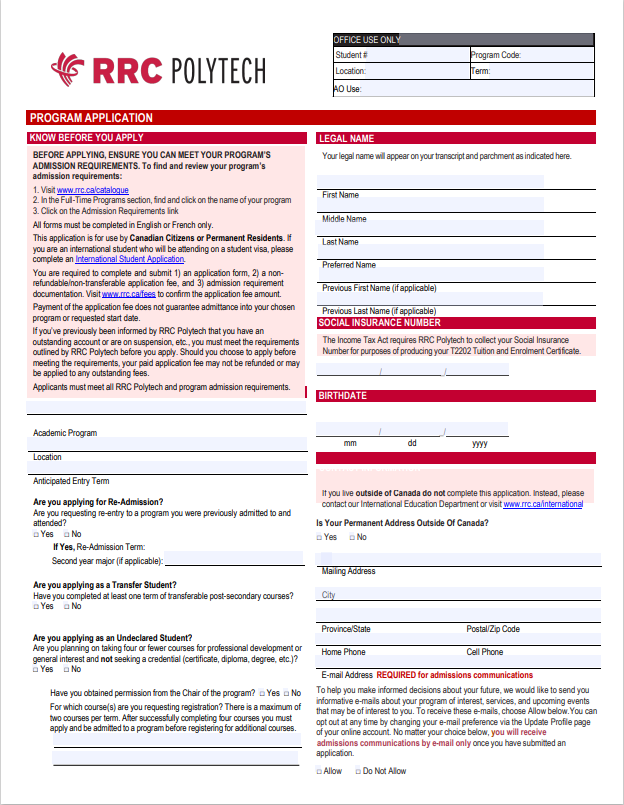
Step 1: You can view the PDF Application here and follow along. You can fill it out in the browser or download it and fill it out in an application like Adobe Acrobat.

This is what the first page looks like. There are four pages in total and we’ll go through one by one.

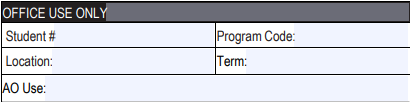
Step 2: The box at the top labelled “OFFICE USE ONLY” you don’t need to fill out.

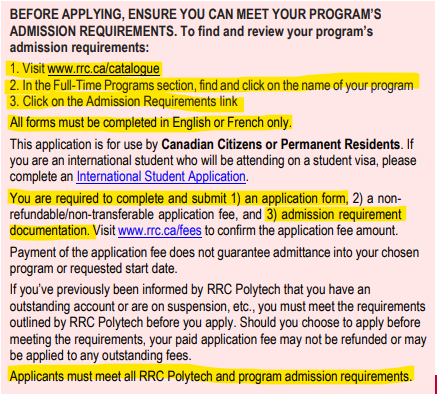
Step 3: Read the text in the light red box on the left. Not everything will apply to this program, but make sure you understand the parts that apply to you:

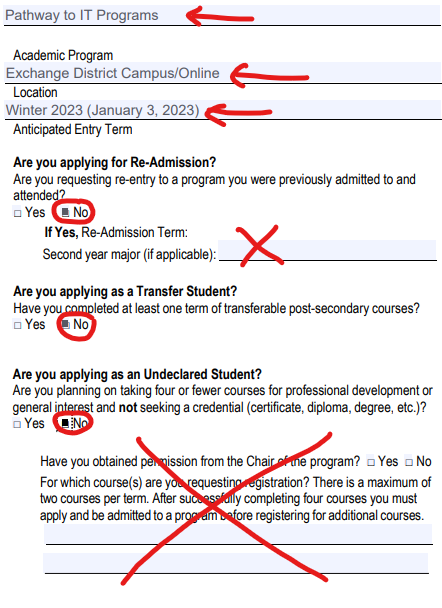
Step 4: Below the red box, indicate that you are applying for the Pathway to IT Programs.

Note: this is the first time we are doing this program, so you won’t need the re-admission field. You can apply the Transfer Student field if you are switching programs, but if you aren’t already in a college program, don’t worry about it. Finally, the Pathway to IT is a full-time program and you will get a Certificate of Completion when you finish that will qualify you for one of the reserved seats in an IT Program, so you don’t want to be an Undeclared Student.

Anything that doesn’t apply to you, you can leave blank.

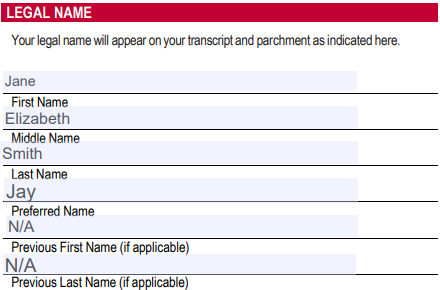
Step 5: Next to the light red box on the right will be the section for your legal name. Enter all that applies. If something doesn’t apply, you can leave it blank or N/A for “not applicable”.

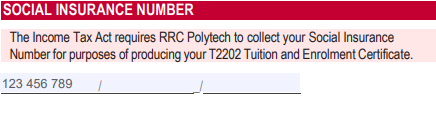
Step 6: The next section will be your Social Insurance Number (SIN). Make sure you don’t leave your computer unattended while you are filling this section out. Don’t worry about the spacing in the form; as long as the information is accurate, it doesn’t need to fill the whole line.

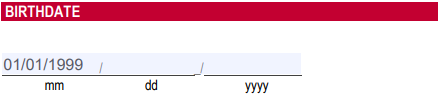
Step 7: The next section is your birthdate. Use the month/day/year format. Jane here was born on January 1, 1999.

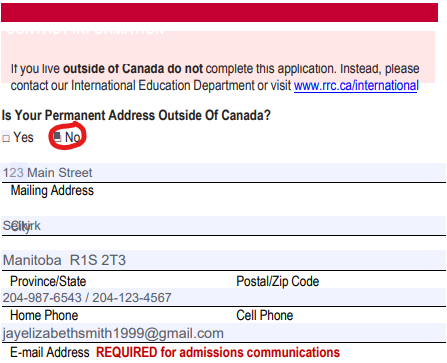
Step 8: The next section is your home address. A reminder that this program is only open to Indigenous People from Canada. Please indicate where in Manitoba you are from.

Note: the “city” field is a little wonky. Don’t worry, we’ll still be able to understand the community name! Jane here is from Selkirk. Again, don’t worry about the spacing in the field, as long as the information is accurate, we’ll understand.

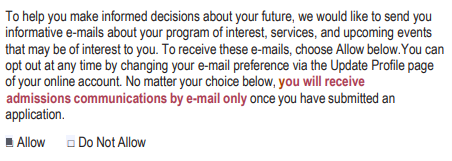
Step 9: The final section of the first page is giving us permission to send you emails. This is the most efficient way of getting information to you since it’s instantaneous and we don’t have to play phone tag in your busy schedule!

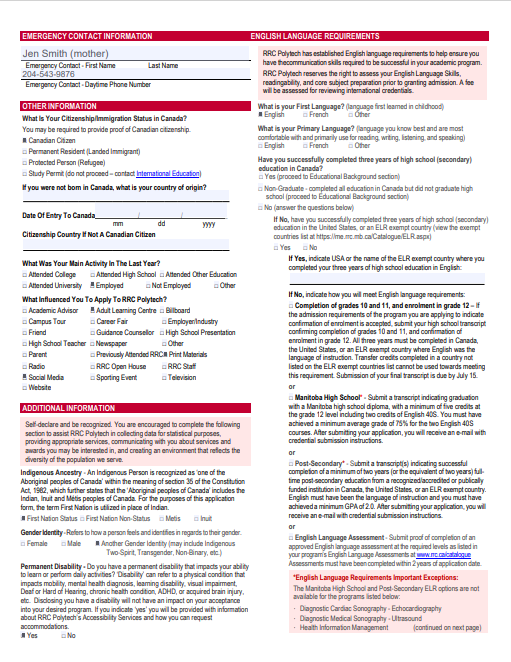
Step 10: Onto page two! Here’s what it looks like.

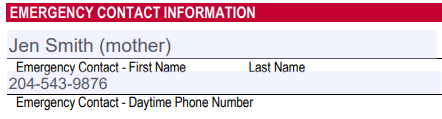
Step 11: On page two, the first section on the left is Emergency Contact information. This is the person we will contact if you’re involved in an emergency.

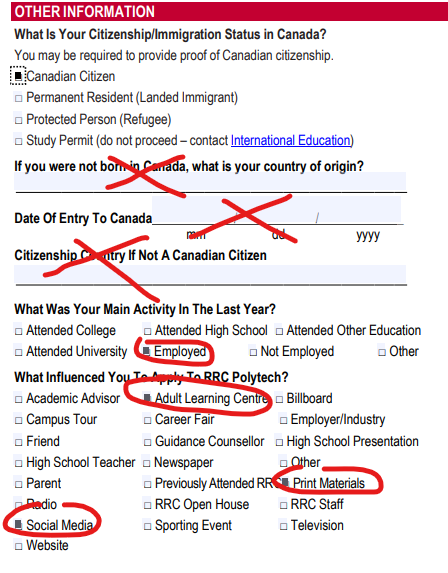
Step 12: The next section below is “Other information”. It’s a rundown of your citizenship, what you did in the past year, and why you want to attend RRC Polytech.

Since Pathway programs are only open to people of Canadian Indigenous ancestry, don’t worry about filling out the part about country of origin/date of entry/other citizenship. Indicate that you have Canadian citizenship. You can choose multiple options for “What influenced you to apply to RRC Polytech?”

The answers for “What was your main activity in the last year?” and “What influenced you to apply to RRC Polytech?” won’t influence your acceptance into the program.

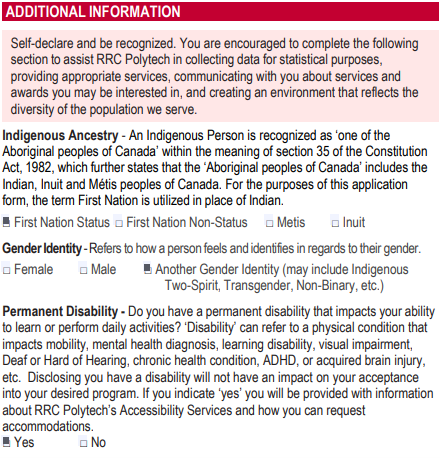
Step 13: The next section is Additional Information. This is where you declare that you are of Indigenous ancestry: First Nations status, First Nations non-status, Metis, or Inuit. You also may indicate your gender: female, male, or another gender identity, which encompasses Two Spirit, nonbinary, transgender, etc.

You may indicate if you have a disability that can be accommodated through Accessibility Services to ensure that you have the opportunity to participate in class at the same capacity as your peers.

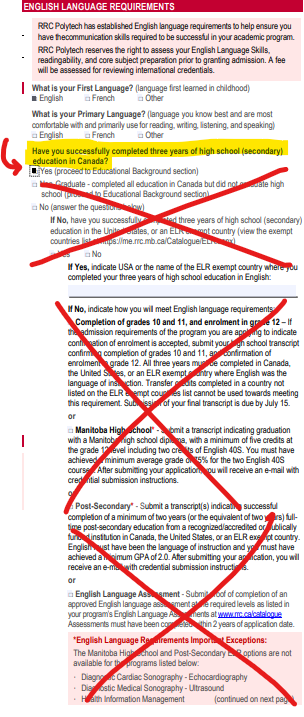
Step 14: The next section, at the top of page two on the right, is the English Language Requirements. Indicate if English is the first language you learned and what language is the language you use in everyday life.

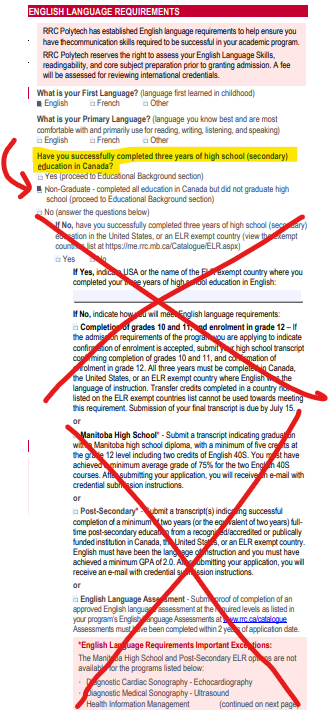
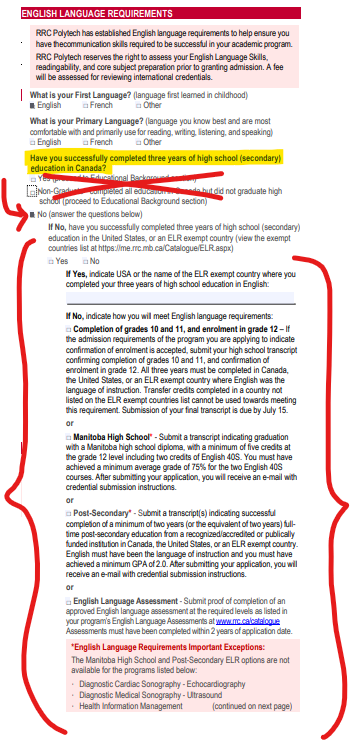
In the next part of this section, indicate if you have finished high school.

If you completed high school in Manitoba, say “yes” and move to the next page.

If you went to school in Manitoba/Canada but didn’t graduate, select the second option and move to the next page.

If you didn’t complete high school in Manitoba, indicate “No” and answer the questions to the best of your ability in the next part.

If you graduated high school in the US, indicate which school you went to.

If you went to school in Manitoba but did not graduate, indicate the extent to which you completed your education or if you have an English Language Assessment.

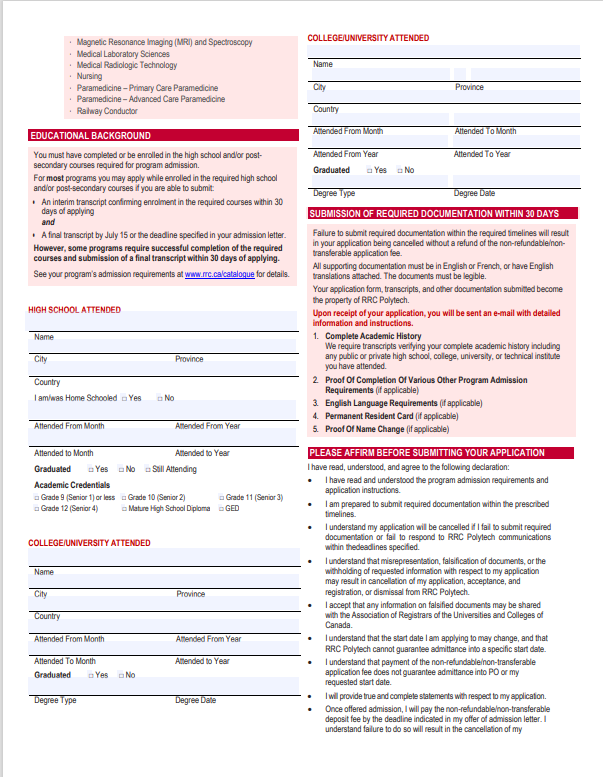
Step 15: On to page three! We are halfway done. Here’s what page three looks like.

Step 16: The light red box on the top left is a continuation from the previous page’s section “English Language Requirements Important Exceptions”, which is a list of programs that are not eligible for the Manitoba High School and Post-Secondary English Language Requirements options. No action is needed here.

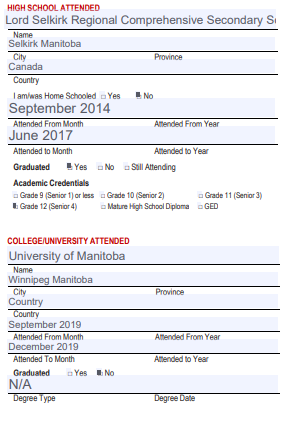
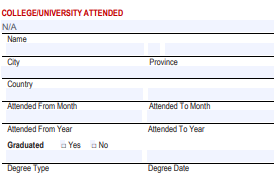
The first section on page three that you need to fill out is Educational Background. This is where you indicate what high school and/or any post-secondaries you attended. There are two sections for post-secondaries in case you attended more than one.

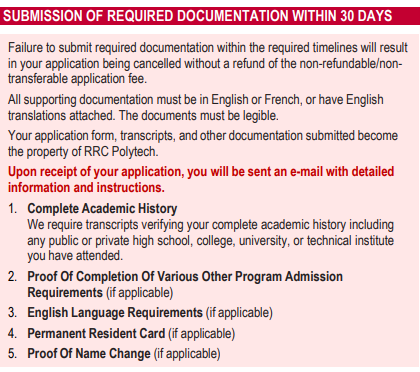
Step 17: The next section is on the right, just below the second “College/University Attended” in a light red box. You don’t need to fill out anything here, just make sure you read and understand the submission of required documentation.

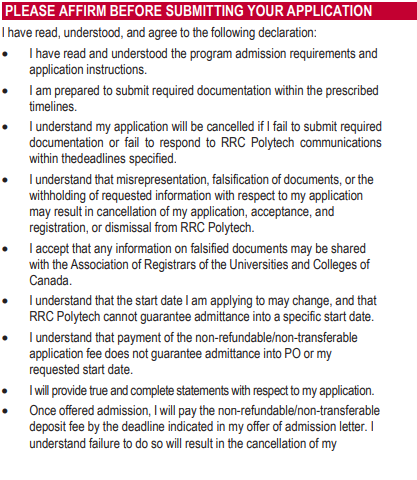
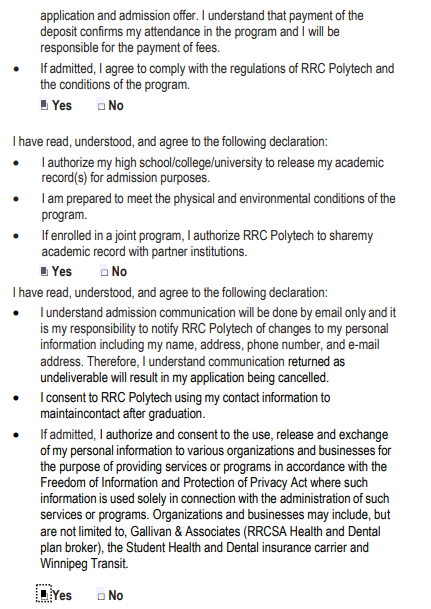
Step 18: The next section is an agreement that you understand the conditions of the application. Read over it carefully then check “Yes” in the boxes throughout the section on page 4.

(This is where it continues onto page four.)

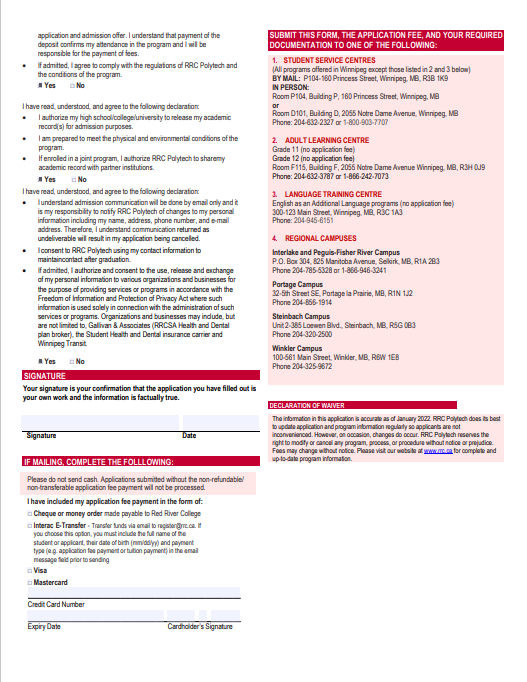
Step 19: On to page four!

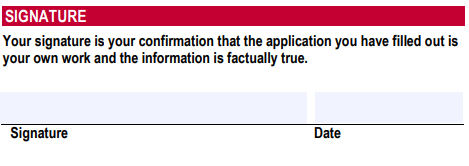
Now that you have checked the “Yes” boxes in the “Please affirm before submitting your application” section, you can sign the form with your signature.

Do not type in your name. Please either print the sheets to sign then scan them and upload to your computer, scan your signature and paste it into the document, or create a digital signature in Google Docs or Adobe Acrobat. Linked here are tutorials on both creating a digital signature in Google Docs and using the scanner on iPhones in the Notes app.

Step 20: The next section is the information for the application fee. Since Pathway to IT has had its fees waived, you don’t need to worry about this section.

Step 21: Now you submit your application and documentation!

Download your application and save it to your computer so you have a digital copy.

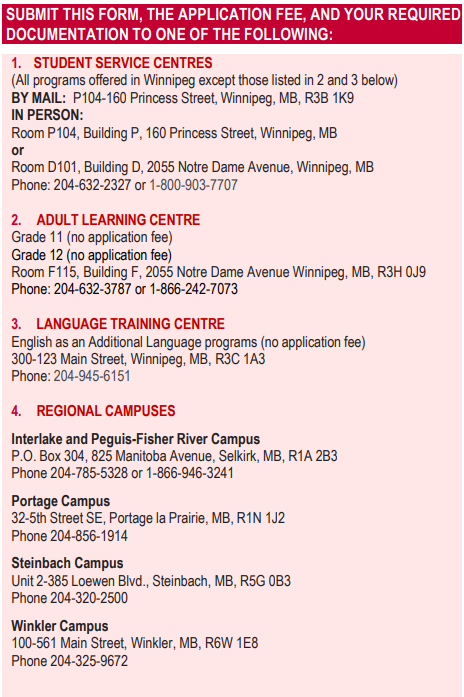
If you want to submit this application in person, you can print at home and bring it to any of the locations listed in this section.

You can also email your application to documents@rrc.ca. If you need any help with the application or locating financial aid, you can always email Indigenous Liaison Advisor Marshall Richard at marichard@rrc.ca or indigenous@rrc.ca.
And that’s it! Remember to submit the documentation within the timeframe indicated, for example: if you apply on November 28, 2022, you have until December 28, 2022 to submit proof of completion. If you apply on November 30, 2022, you’ll need to provide proof by December 5, 2022.

We can’t wait to see you in January!

RRC Polytech campuses are located on the lands of the Anishinaabeg, Ininiwak, Anishininwak, Dakota Oyate, and Denésuline, and the National Homeland of the Red River Métis.

We recognize and honour Treaty 3 Territory Shoal Lake 40 First Nation, the source of Winnipeg’s clean drinking water. In addition, we acknowledge Treaty Territories which provide us with access to electricity we use in both our personal and professional lives.