Library

Library and Academic Services

News

Exploring the AI Research Tool: Your New Ally in Academic Searching

September 10, 2025

There are numerous new tools that can improve and streamline the search process in the rapidly changing field of academic research. Built into the OneSearch page at RRC Polytech’s Library and Academic Services, we now have an “AI Research Tool.”

By using artificial intelligence to process natural language queries, this cutting-edge feature provides brief summaries and pertinent sources from a huge library of books, journals, DVDs, databases, and media.

Guide Page: AI Research Tool

What Is the AI Research Tool and How Does It Work?

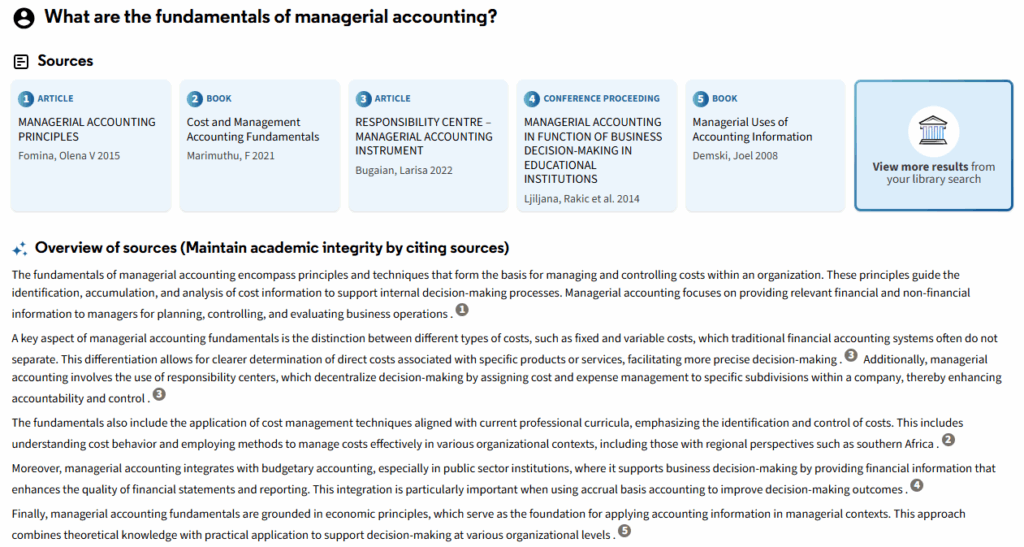
At its core, the AI Research Tool is an AI-powered enhancement to OneSearch, RRC Polytech Library’s primary search platform. It allows you to pose questions in everyday language. You may provide a search query such as “What are the fundamentals of managerial accounting?” and you will receive five curated academic results complete with summaries and direct links to the source articles.

The tool works best when asking it to provide a high-level overview to kickstart your research, with strength in helping you to explore topics and refine ideas. It can even generate complex search strings to aid in further research.

Under the hood, the “AI Research Tool” uses a simple yet powerful process. Your natural language query is sent to a Large Language Model (LLM), which translates it into an optimized search string (often connected by “OR” operators for broad coverage). This string queries OneSearch’s index, retrieves and re-ranks the top 30 results to select the best five and then feeds them back to the LLM. The AI generates a concise overview with inline references based on the results’ descriptions, presenting everything in an intuitive interface.

Privacy is a top priority here. According to the tool’s guidelines, your interactions aren’t stored, used for AI training, or shared with third parties. Data is handled securely in line with the provider’s policy (from Clarivate, the parent company).

Key Highlights for Effective Use

To make the most out of the AI Research Tool:

  • Be specific: Vague queries like “Find information on substance abuse” might yield broad results. Instead, add details like time frames, locations, or scholarly focus to sharpen outcomes.
  • Natural language is key: There is no need for complex Boolean syntax. The AI takes care of that for you.
  • Expand as needed: Use the “View More Results” option to transition into traditional OneSearch searches, where you can tweak terms, filter by date or type, and explore beyond the initial five hits.
  • Double-check: Be sure to double-check your sources for accuracy and to maintain academic integrity.
  • Remember the limitations: This tool isn’t a replacement for manual searching but a smart starting point that saves time and sparks ideas.

Why You Should Try the AI Research Tool Today

In an era where information overload is the norm, tools like the AI Research Tool democratize access to academic resources, making research more approachable and efficient. It’s particularly great for students at RRC Polytech navigating interdisciplinary topics or those new to library databases.

Head over to OneSearch and look for the “AI Research Tool” link in the top menu. It will ask you to sign in, and then you can test it out with a specific query and see how it transforms your process.

For more tips, including advanced search links, visit the OneSearch guide on on RRC Library’s web pages, or ask us, either in person at the Library Service Desk or using the “Ask Us” chat on the library web site.

(Posted by Mark Nelson, RRC Polytech Library Systems Specialist)

Know your resources – Accuris Engineering Workbench

August 27, 2025

In the library we’re committed to providing our students, staff, and community with the best resources to achieve success within the classroom and beyond. A big part of what makes RRC Polytechnic in front of what’s ahead is our vast program coverage for trades.

With technology progressing more each day, one thing is clear, trades will always be relevant to society. Trades people literally build society. They construct our homes, our workplaces, they build the roads we drive, and much more.

With any kind of project there are codes and standards that must be adhered to, which is why we are happy to announce our new database, Accuris Engineering Workbench.

Getting Started

Before you start searching, you’ll need to create an account. Instructions on how to do so can be found here https://library.rrc.ca/accuris

Once your account is created, you’re able to start searching the database.

The Homepage

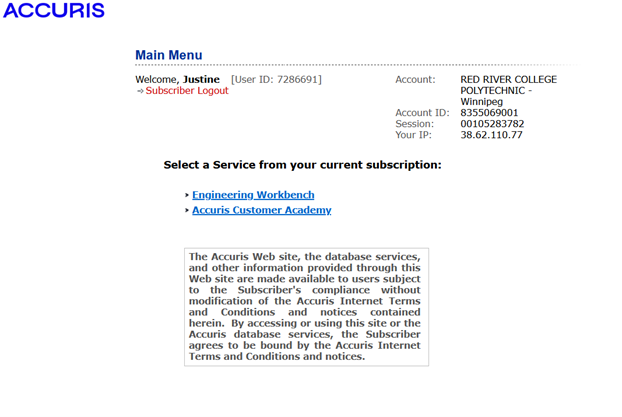
When you first log into Accuris, you’ll be taken to this homepage; to access the database, click on “Engineering Workbench”:

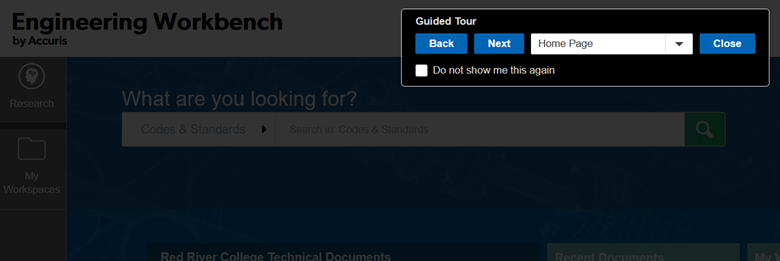
If you are a visual learner, it may be helpful to use the guided tour function upon entering.

This function will highlight different areas of the homepage and direct you to different features within the database.

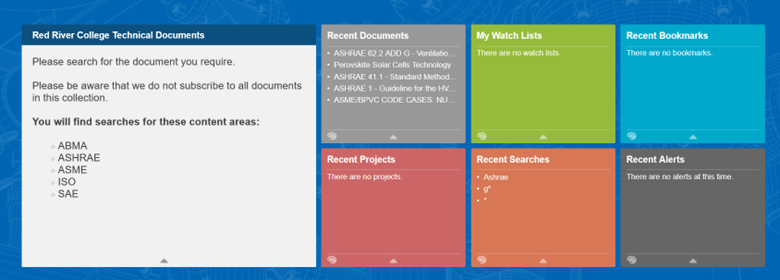
On the homepage, you find customizable widgets and a note about the subscription.

As stated on the note, we do not have a subscription to all documents, which will be important when you start searching.

Basic Search

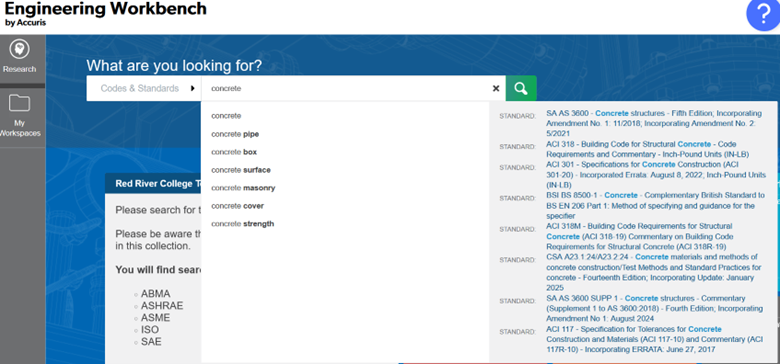
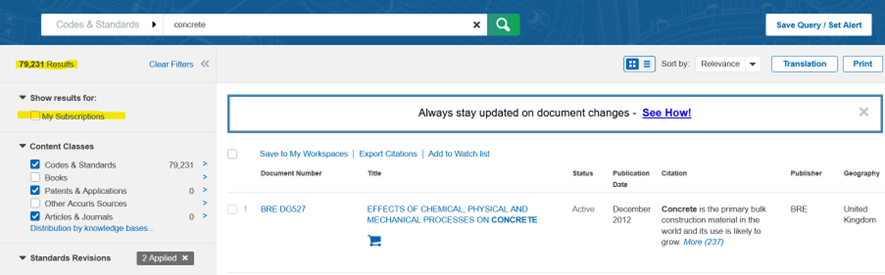
When you begin typing into the search bar, a list of options will appear as well as the codes/standards that go along with what you’re searching.

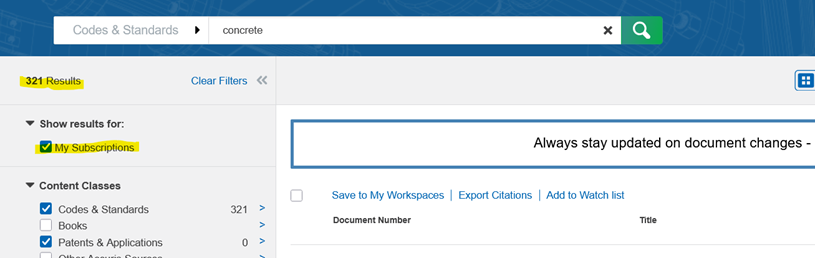
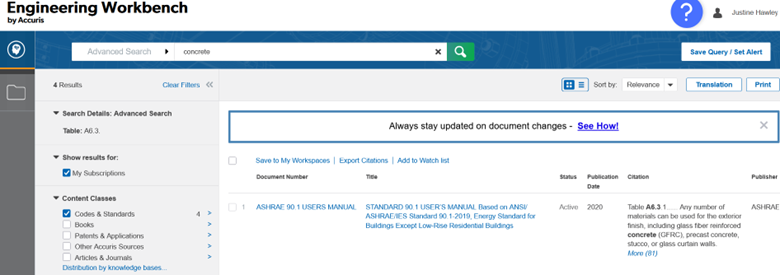
After searching, you will find thousands of results. It is imperative that you filter by “My Subscriptions” on the top left of the filter menu.

Filtering the results to subscriptions in the catalogue greatly reduces the number of results which will help you further narrow down what you’re looking for.

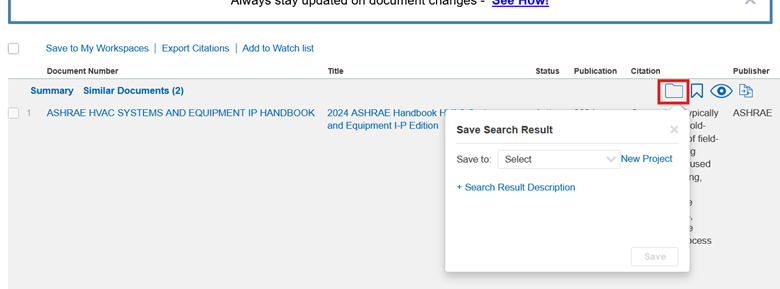
Once you find the resource you need, you are able to do a few things with it. First of all, you can save the ones you’d like to look at further by clicking the folder icon.

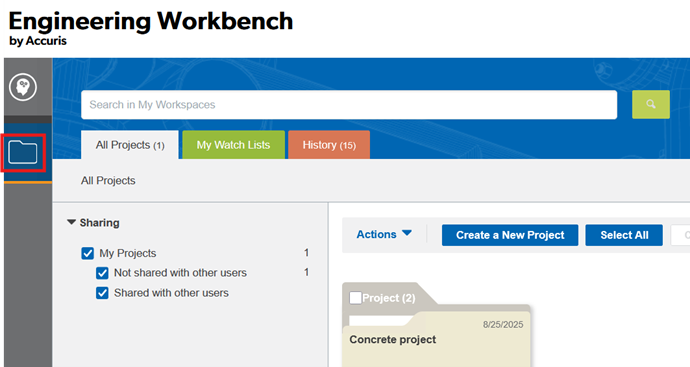
Saved projects can be found by clicking the folder icon on the left side of the screen. This feature is really helpful when you require multiple standards for a project. Within your project folder, you will see all the items saved within.

Advanced search

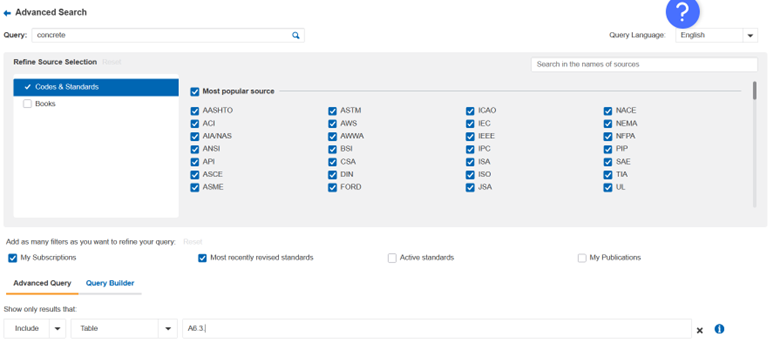
Back to searching features, just like most databases, Accuris offers advanced searching features. This extensive option allows you to really narrow down to what you’re specifically searching for. Users can find things by title, authors, manufacturers, footnotes within a document, or even a specific table.

Please note: The advanced search engine can be finicky, every time you make a change to the filtered information, make sure to clear the previous filters or it can skew your results.

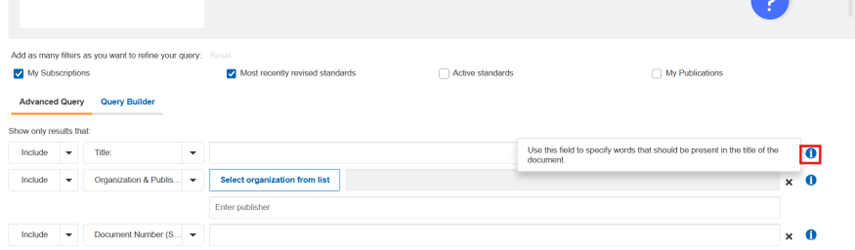
If you are unsure about what kind of information goes into each field, you can hover your mouse over the information button. It will give you a blurb on what you should be typing in.

Using additional filters properly in advanced search will greatly narrow your results.

Now, you’re ready to start searching on your own! While the library provides these step-by step instructions, we recognize that each learner is unique and has an individual approach to understanding new concepts. Please come and visit us at any time and we will be happy to walk you through it in person. You can also reach out to us for further information by phone, email, or through library chat.

(Written by Justine Hawley, Resource Management Technician)
Introducing the Sidney Fadl Forzley Memorial Collection

June 3, 2025

In partnership with the Early Childhood Education (ECE) program, Library and Academic Services is proud to announce our newest addition: the Sidney Fadl Forzley Memorial Collection.

Who was Sidney Fadl Forzley?

Sidney Fadl Forzley took a leap of faith when he and his soon-to-be wife, Soria, immigrated to Canada from Lebanon in the 1950s. With an entrepreneurial spirit, Sidney began his working life in downtown Winnipeg, shining shoes at City Hat Works. Surrounded by the energy of a bustling city and the warmth of new acquaintances, he quickly built many friendships.

He later ventured into business, co-owning Davis Drycleaners and Tailors with his cousin George. After several years, they transformed the shop into a Lebanese bakery and grocery store—Cedar Bread Factory—introducing Winnipeggers to the deliciousness of pita bread for the first time. (Thanks, Sidney!)

Sidney’s home, business, and every space he occupied were filled with friends, family, laughter, and heartfelt conversation. Despite struggling with Crohn’s Disease and gradually losing his vision, he persevered, demonstrating immense strength and resilience throughout his life.

Sidney passed away on August 12, 2022, remembered as a devoted husband, father, grandfather, and businessman. His legacy lives on in his values—family, friendship, and hard work.

What is the Sidney Fadl Forzley Memorial Collection?

Thanks to a generous $500 donation made in memory of Sidney Fadl Forzley, a special collection has been established at the RRC Polytech Main Library to support the Early Childhood Education program. This contribution allows for the annual purchase of new books, directly enhancing the curriculum and supporting the academic and professional development of future educators.

The collection celebrates Sidney’s legacy by emphasizing the power of reading and the essential role of family in a child’s early development—values he held dear. It stands as a testament to his belief in community, education, and entrepreneurship.

What kind of books are in this collection?

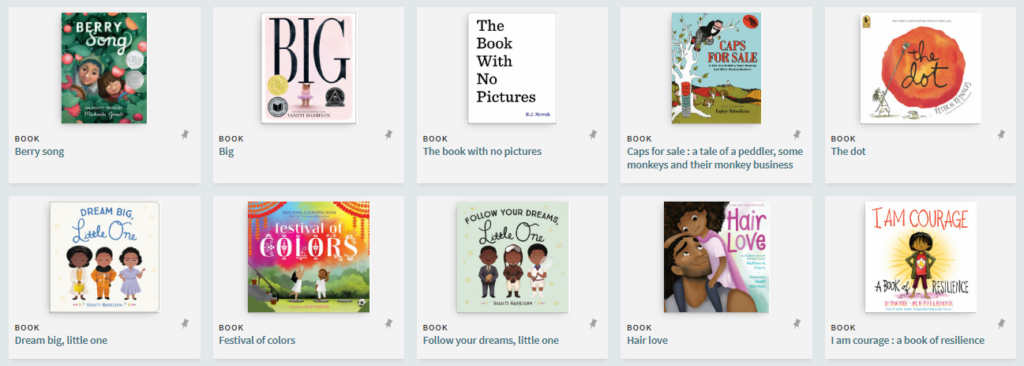
The books purchased for this collection are picture and board books ideal for ages 2-5. They will be featuring Canadian Authors and Publishers. The purpose is to support the staff and students in ECE and the children that they work with every day. The titles selected are ones that enrich young minds by teaching them vocabulary and language, strengthen listening skills, convey messages such as caring about others, and more.

Where can I find these books?

The Sidney Fadl Forzley Memorial Collection is housed at the Notre Dame Campus Library, located in the juvenile section. Each book has a SFFM sticker on its spine to indicate that it is part of the collection.  

A full list of titles is available on our website:

Early Childhood Education (ECE) Sidney Fadl Forzley Memorial Book Collection.  

News provided by Justine Hawley, Resource Management Technician, Red River College Polytech

Celebrating Our Library & Academic Services Staff

October 18, 2024

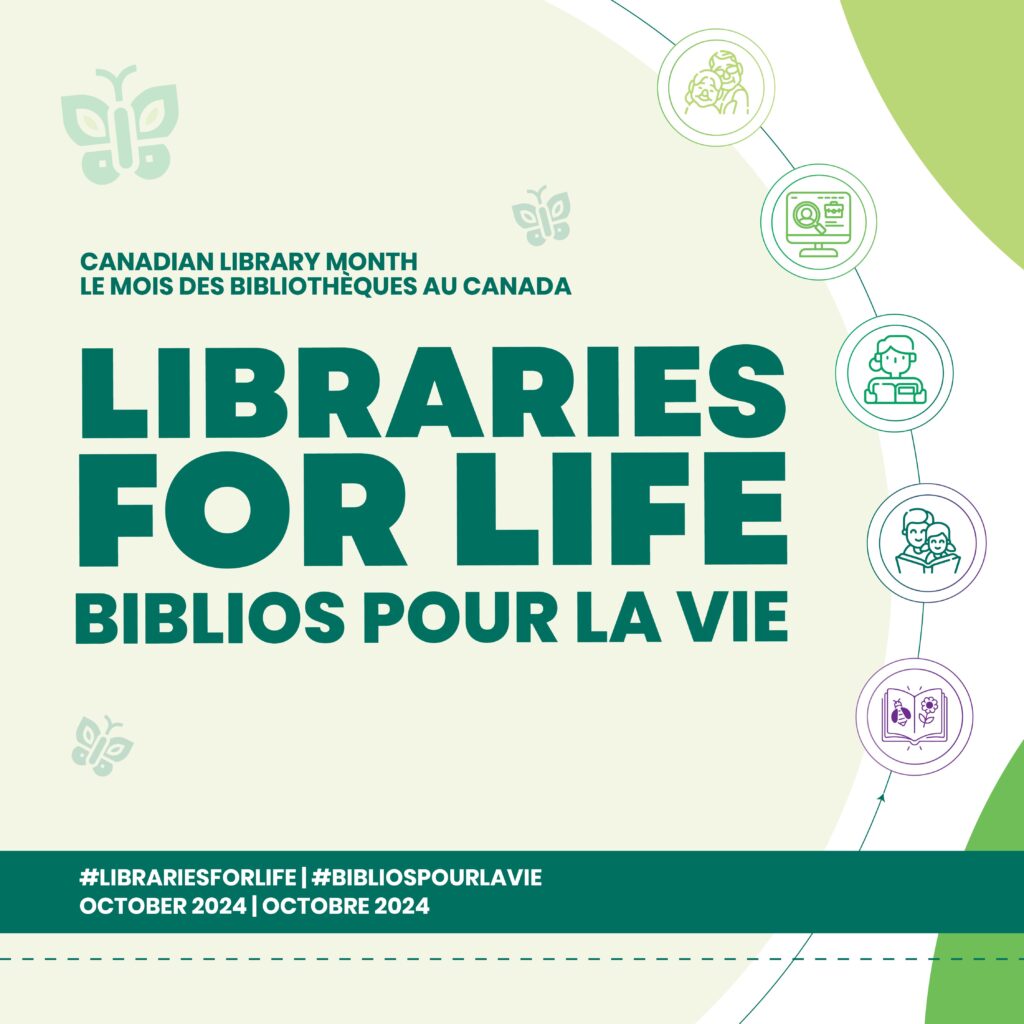
Canadian Library Month image

October brings Canadian Library Month, an annual celebration of the critical role libraries and library workers play in our communities. Libraries are at the heart of knowledge, community engagement, and social awareness.

The Canadian Federation of Library Associations has designated the third Friday in October as Canadian Library Workers Day. This year, we recognize the valuable contributions made by all those who work in and for libraries in Canada on Friday, October 18. This year’s theme, “Libraries for Life | Biblios pour la Vie”, highlights the lasting impact libraries have in promoting education, cultural understanding, and fostering lifelong learning. This special day allows us to express our gratitude for the passion and dedication of the library staff who work tirelessly at both the NDC and EDC campuses of Red River College Polytechnic. Their efforts to support students, staff, and faculty make our libraries the dynamic and supportive spaces they are.

Of course, these essential services are only possible because of the dedicated individuals who work in libraries. Libraries have evolved into vibrant community hubs that offer much more than just books—they provide educational programs, research support, collaborative spaces, and so much more. Libraries also champion freedom of expression and inclusivity, playing a vital role in connecting people across all walks of life.

Whether you’re visiting the library or sending a note, please take a moment to thank our library workers for the hard work they put in every day to enhance the experience of our college community.

Celebrating Our Tutors

October is also the time to recognize our dedicated tutors, as Tutor Appreciation Week was celebrated earlier in the month. Tutors are essential to the academic success of our students, providing not only subject-specific guidance but also fostering confidence, resilience, and a passion for learning. Their patience and expertise help create an environment where students feel supported and empowered to overcome academic challenges.

Tutors often work behind the scenes, yet their impact is profound. They are mentors, motivators, and sometimes the key to a student realizing their full potential. Their ability to connect with students on a personal level and offer tailored support makes a lasting difference in both academic performance and personal growth.

We are deeply grateful for their unwavering commitment to helping students succeed. Tutors are not just academic guides—they are champions of student success, contributing to the overall strength and vibrancy of our learning community. As we continue to celebrate this month, we recognize that the positive ripple effect of their work extends far beyond the classroom, shaping the futures of our students and enriching the entire college experience.

At the heart of our Library & Academic Services department is the shared commitment to fostering growth, connection, and success within our community. We extend our heartfelt thanks to all of our library staff and tutors for the exceptional work they do every day in supporting and enriching the lives of our students, faculty, and staff.

Living Libraries at the Library!

September 18, 2024

For the upcoming Truth and Reconciliation Commission Engagement Week, Library and Academic Services and Career Services are holding two Living Library events. Living Libraries are experiences that allow people to listen and learn from a person in real time, mimicking the setup of libraires and physical books.

Participants will hear from Indigenous storytellers what the Truth and Reconciliation Commission’s Calls to Action mean to them and how they incorporate Indigenous teachings and principles into the workplace. The Living Library format is interactive by nature, involving small-group discussions between a storyteller and participants in a safe and supportive environment. Groups of 5-6 participants will spend 15 minutes with a speaker, rotating through different storytellers.

Event Details and Registration

Notre Dame Campus

Monday, September 23rd at NDC 11:00-1:00 in CM27 in the Library. Register here.

Storytellers include Jamie Wilson, Michael Lachance, Jessica Bloomfield, Corey Whitford, and Rebecca LaRiviere.

Exchange District Campus

Tuesday, September 24th 12:00-2:00 in the Library P214. Register here.

Storytellers include Jamie Wilson, Jessica Bloomfield, Zach Unrau, Brittany Ross, and Sharon Bear.

Artificial Intelligence Campus MB Interview

September 13, 2024

Artificial Intelligence (AI) has become a hot topic in education, sparking debates about its impact on both teaching and learning. While many discussions focus on the risks associated with AI, especially in terms of academic integrity, there’s a growing need to explore its potential for enhancing educational practices. Troy Heaps, a communication instructor at Red River College Polytechnic, recently developed an open-education resource that aims to do just that. His resource, Generative Artificial Intelligence: Practical Uses in Education, offers practical insights into how AI can be used productively in academia.

In a recent interview with Campus Manitoba, Troy shared his journey in creating this resource, his insights on AI, and how educators can effectively integrate AI into their work.

AI: A Tool for Enhancing, Not Replacing, Educators

One of the key takeaways from Troy’s perspective is that AI is a tool that can enhance teaching but should not be viewed as a replacement for the human elements of education. He points out that AI can assist with tasks like generating lesson plans, offering activity suggestions, and helping with rubric creation. However, it’s crucial to always maintain a human touch in these processes.

Troy shared that AI helps him “get out of a rut” by offering fresh perspectives on lesson planning and activity creation. He emphasizes that while AI may not always get things exactly right, it’s a fantastic starting point for ideas and structure.

Why an Open Educational Resource?

Over 30 RRC Polytech staff members helped with the production of the Generative Artificial Intelligence: Practical Uses in Education, Open Educational Resource (OER) by sharing ideas in focus groups, reviewing, and helping to create examples. Staff and Faculty contributions added an incredible amount of depth and richness to the resource.

At RRC Polytech, faculty and staff have begun using existing OERs to support their teaching and instruction with students. Savings to RRC Polytech students in course material costs from the use of OER has exceeded $678 000 at the start of the 2024 year. These savings to students are made possible by instructors taking the initiative to use OER as part of their course materials as an alternative to course materials students are required to purchase.

Learn More

If you’re looking to explore the productive uses of AI in your work as an educator, Troy Heaps’ interview offers insights into practical applications and ethical considerations. His open textbook, Generative Artificial Intelligence: Practical Uses in Education, is a valuable resource for educators who want to stay ahead of the curve and integrate AI into their teaching in a responsible, informed way and is available freely online as an OER.

To read the full interview and gain a deeper understanding of how AI can transform your teaching practice, check out the full interview here. You’ll find specific examples, tips, and advice that can help you make the most of AI in your educational environment.

OER Release Spotlight – Generative Artificial Intelligence: Practical Uses in Education

April 16, 2024

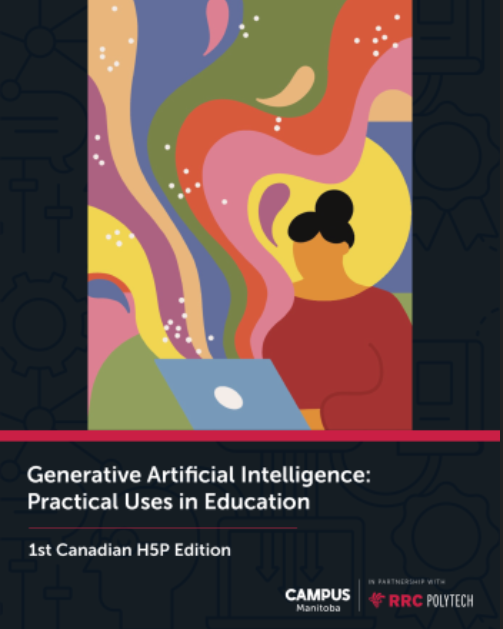
Library and Academic Services is excited to announce the release of an RRC Polytech-created Open Educational Resource (OER)  titled Generative Artificial Intelligence: Practical Uses in Education. Written by Communication Instructor Troy Heaps, this resource is focused on how AI tools can be used in polytechnic education and was produced for educators who wish to find positive and productive ways to incorporate generative artificial intelligence (AI) tools into their work. This includes:

  • using AI tools to develop courses, lesson plans, activities, assessments, and rubrics;
  • leveraging AI tools to enhance existing in-class activities and assignments;
  • teaching students how to engage with AI effectively, ethically, and responsibly;
  • utilizing AI tools to efficiently complete administrative tasks.

We hope you will check out this very exciting open resource and also share it with colleagues at RRC Polytech and beyond.

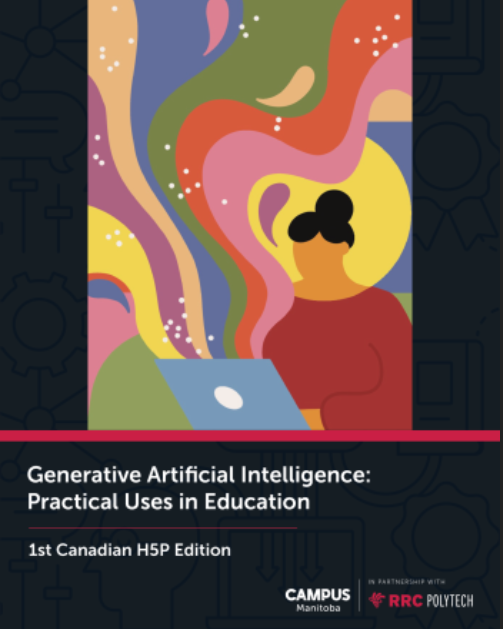
Cover art title Generative Artificial Intelligence: Practical Uses in Education

Over 30 RRC Polytech staff members helped with the production of this OER by sharing ideas in focus groups, reviewing, and helping to create examples. Staff and Faculty contributions added an incredible amount of depth and richness to the resource.

At RRC Polytech, faculty and staff have begun using existing OERs to support their teaching and instruction with students. Savings to RRC Polytech students in course material costs from the use of OER has exceeded $678 000 at the start of the 2024 year. These savings to students are made possible by instructors taking the initiative to use OER as part of their course materials as an alternative to course materials students are required to purchase.

Now RRC Polytech faculty and staff are taking supported steps toward creating custom Open Educational Resources for students with funding from RRC Polytech’s Strategic Transformation and Applied Research Fund and the Campus Manitoba & Manitoba Open Education Initiative OER Grant for Manitoba OER adaptation/creation projects. Support for Copyright compliance and sourcing open content is provided for projects by Library and Academic Services (LAS) through the Copyright Officer. The LAS website also provides helpful resources for getting started with OER on the faculty support OER Page.

The release of Generative Artificial Intelligence: Practical Uses in Education follows the 2023 release of Rebecca Molly Hiebert and Emilie Jackson’s, adapted compilation of OE resources College Success for Newcomers. This OER takes the form of an e-book that is designed to provide newcomer students with the skills and strategies they will need to adapt successfully and fully integrate into the Canadian college system.

College Success for Newcomers Cover art

We hope you will consider using and promoting these resources for teaching and instruction at RRC Polytech and beyond. OERs can benefit multiple departments, schools, and educators as the resources are openly licensed, they can be easily shared without preventative restrictions to instructors who want to use and modify the resources. They can also be shared without cost to students which makes them valuable and effective resources for the college setting.

Research Services Librarian Joins Library and Academic Services Team

December 4, 2023

Close-up view of two people discussing their research while using tablet and books open on the table.
Image source: Adobe Stock

Introducing Atreya Madrone, Research Services Librarian

Library and Academic Services is excited to welcome the new Research Services Librarian, Atreya Madrone! Atreya joined Library and Academic Services at the beginning of October from the University of British Columbia, where they received their Master of Library and Information Studies.

Range of Supports Offered

As the Research Services Librarian, Atreya will be supporting student, faculty, and applied research across the College. Research Services encompasses a range of areas, including:

  • Research data management (data management plans, adhering to funding policies, Indigenous Data Sovereignty)
  • The scholarly communication lifecycle (publishing, author rights, Open Access)
  • Understanding research ethics
  • Learning about different research methodologies, such as Community-Based research, Anti-Oppressive research methods, and Indigenous Research methodologies
  • Support in finding materials both in and outside of the Library collection
  • Developing search strategies for researching

Learn about these topics by visiting the Research Services page on the Library and Academic Services website.

Book a Research Consultation

You can book a consultation with Atreya to discuss your research needs and questions. Consultations can be done in-person at NDC or EDC and online via Teams. To book a research consultation, please fill out the Research Services Consultation form.

Written by Atreya Madrone – Research Services Librarian (Library and Academic Services)

Open Educational Resource Built at RRC Polytech Recognized at OE Global 2023

November 14, 2023

This post is an adaptation of a story that appeared on May 25, 2023: Red Forum Spotlight! Building and Using Open Educational Resources.

At RRC Polytech, faculty and staff have begun using existing Open Educational Resources (OERs) to support their work with students. This past year, Rebecca Hiebert and Emilie Jackson, while working in the Academic Success Centre (Library and Academic Services), adapted a compilation of OE resources to create College Success for Newcomers, an OER in the form of an e-book.

A Brief Introduction to Open Educational Resources

What are Open Educational Resources (OERs)?

OERs can come in many different formats. In general, OERs are educational materials such as textbooks, problem sets, assessments, slide decks, videos, lesson plans, study guides, handouts, infographics, and other educational content that can be used for free and without permission.  

OERs are resources published under an open license, such as Creative Commons allowing these resources to be freely adapted. Under an open license instructors and students can retain, revise, remix, reuse and redistribute these educational resources. 

OER Guidance and Information

Open Educational Resources are accessible online and free to share and use in any educational setting. There are already many existing OERs available. If you are looking for a resource to support students, Library staff can help you search for an OER to meet your needs.

If you have an idea for a resource that would benefit others, you may want to consider adapting it into an OER to make it available to everyone. Reach out to the Copyright Officer to learn more.

Additional information is available on the Library’s Faculty Support page.

How Rebecca and Emilie Began Building an OER

At the start of the pandemic, Rebecca struck on a brilliant idea to help students learn how to write outlines when taking notes in class or brainstorming to write reports. Rebecca hoped to create a video of herself using PowerPoint slides with a TED Talk clips to inform a step-by-step guide that demonstrated how to listen to content in a video, analyze the main ideas, and capture these in an outline. Being proactive and respectful of copyright concerns, she reached out to the TED Talks people to request permission to use their video in this way. After a long month of waiting, she received an answer, but not the one she was hoping for. 

This led to a conversation with RRC Polytech’s Copyright Officer, Ebony Novakowski, who introduced Rebecca to an online repository of open videos that she could use in the resource she wanted to create. With the new resource under her belt, Rebecca was intrigued by the possibility of creating additional OER. A few months later, with help from Emilie Jackson, and funding support for the Campus Manitoba PressbooksEDU Network grant they were on their way to creating a localized version of College Success for Newcomers: a guide to provide language and academic supports for new students in Manitoba.

Read more about Emilie and Rebecca’s story as featured on the Campus Manitoba Open Education blog: Representing Manitoba on the Open Education Global Stage.

About College Success for Newcomers

This OER resource supports newcomer students and can be used by anyone in North American (or anywhere really!) The goal is to reduce duplication where instructors and support staff are all trying to create and recreate similar resources to help international students adapt to the Canadian college setting. This resource is free to be used and adapted further by instructors and support staff worldwide. Additionally, the resource provides multiple perspectives so that international students can learn about Canadian culture and the diverse experiences of the people who live here.    

The OER is available online (worldwide) through the platform Pressbooks. The OER can be downloaded into a variety of formats including PDF which could be printed out or viewed offline as well as Pressbooks XML which can be used to adapt the content into future OERs. The OER can be used by anyone, anywhere without permission. It is entirely open and free to access.

Click on the button to view the OER:

How is this OER being used at RRC Polytech?  

One perk of Open Educational Resources is that they benefit multiple departments, schools, and educators. and by creating resources under open licenses, they can be easily shared without preventative restrictions to instructors who want to use and modify the resource. They can also be shared without cost to students.

College Success for Newcomers will be used in the following departments and programs: 

  • The Academic Success Centre will use College Success for Newcomers OER when working with international students both in 1:1 tutoring and when leading workshops. 
  • The Social Innovation and Community Development department will use the OER in courses that are blended with international students, Canadian-born students of diverse (European) ancestry, and Indigenous students.  
  • Communications instructors will be implementing the OER into the fall version of COMM 1173, Communication Strategies, which will reach over 1,200 students at RRC Polytech.  
  • Instructors will be using the OER in the Department of LINC English Language Learning and Newcomer Integration (previously the Language Training Centre) IRCC English Language Programming. 

Originally submitted by Ebony Novakowski and adapted by Linda Fox.

We Remember Indigenous Veterans

November 7, 2023

Indigenous Veterans’ Day was first observed in 1994 in Winnipeg and has since spread nationally.  It honours Indigenous contributions to service in the First and Second World Wars, the Korean War, and all military service. It is observed on November 8 each year

Selected Resources

Learn about Indigenous Veterans through the following suggestions from the Library.

Forgotten Warriors

VIDEO – NATIONAL FILM BOARD

Although they could not be conscripted, when World War II was declared, thousands of Indigenous Canadian men and women enlisted and fought alongside their non-Indigenous countrymen.

With narrator Gordon Tootoosis providing a historical overview, Indigenous veterans poignantly share their unforgettable war memories and their healing process. We join them as they travel back to Europe to perform a sacred circle for friends left behind, but not forgotten, in foreign grave sites.

Bernie Francis reads “In Flanders Fields” in Mi’kmaq

VIDEO – CBC CURIO

For Remembrance Day, Mi’kmaw linguist Bernie Francis reads his translation of John McCrae’s war poem “In Flanders Fields.”

Indigenous soldiers, foreign battlefields

ONLINE PUBLICATION – VETERANS AFFAIRS CANADA

Generations of Canadians have served our country and the world during times of war, military conflict and peace. Through their courage and sacrifice, these men and women have helped to ensure that we live in freedom and peace, while also fostering freedom and peace around the world.

Pegahmagabow : life-long warrior

PRINT BOOK

Francis Pegahmagabow was a remarkable Indigenous leader who served his nation in time of war and his people in time of peace — fighting all the way. In wartime he volunteered to be a warrior. In peacetime he had no option. His life reveals how uncaring Canada was about those to whom this land had always been home.

Questions or Comments?

Connect with a Library staff member in person at the Notre Dame and Exchange District Campus Libraries or through Ask Us Chat at library.rrc.ca. We’d love to assist you!

By Linda Fox – Program Support and Promotion, Library and Academic Services

RRC Polytech campuses are located on the lands of the Anishinaabeg, Ininiwak, Anishininwak, Dakota Oyate, and Denésuline, and the National Homeland of the Red River Métis.

We recognize and honour Treaty 3 Territory Shoal Lake 40 First Nation, the source of Winnipeg’s clean drinking water. In addition, we acknowledge Treaty Territories which provide us with access to electricity we use in both our personal and professional lives.