Skilled Trades and Technology Awards Recipients: Fall 2020

Congratulations to all of our Skilled Trades and Technology Awards recipients!

Congratulations to all of our Skilled Trades and Technology Awards recipients!
You are invited to the 2020 Bachelor of Nursing Program Pinning Ceremony!
The 2020 graduates of the Red River College Baccalaureate Nursing Program will be celebrated in a virtual Pinning Ceremony today at noon.
Grab your 2020 Pinning Ceremony Program, and join us for this meaningful Nursing tradition on The College’s Facebook page.
The link to the ceremony will be available at noon. Join us then to leave live comments for the graduates!
The recording will remain on the RRC Facebook page for later viewing as well.
We look forward to “seeing” you there!
Post by The Pinning Ceremony Committee
I asked my students at the end of their 1820 clinical rotation to share some tips and tricks with their fellow students heading into clinical next term. I also asked them to share some challenges they have come across in clinical during COVID, and how they were able to overcome these challenges. They were excited to share their thoughts and knowledge, even at the end of a long clinical term, and at the end of our last day! Since these students had been through 1810 pre-COVID, they have a unique perspective to share.
This is what they said:
-Ask questions when you are unsure
-Remember to breathe
-Get to know your patients and tasks will become easier
-Trust your assessment skills
-Prepare by researching your skills ahead of time that you know you will be doing. For example, if you know your patient uses the Sara lift to transfer, go over that skill. Utilize your techniques knowledge; remember your steps.
-Make clinical fun: look for learning opportunities; enjoy what you are doing.
-Always but especially during COVID: remember to wash your hands. “If you think you have washed them enough, you haven’t”.
-Masks and eye protection make connecting with your patients more challenging, since your patient is not able to see your face or facial expressions. Enhance your communication; use more non-verbal techniques such as therapeutic touch, massage. For example, apply lotion to your patient’s feet in order to spend more time with them and provide therapeutic touch.
-Because you are not able to see your patient when you come for research, there is more of the unknown on your clinical day. So rely more on interprofessional communication, and talk with the nurse or health care aid caring for the patient that day. Also, this means it is even more important to complete a thorough assessment on your clinical day.
-Things can become stressful, so try to go with the flow, and practice self care.
Post by Kirsten Loewen – Nursing Instructor
This year, because of COVID-19, instead of supporting one large family with food and gifts, the Students’ Association is purchasing and distributing food vouchers to RRC students in need. Your support is even more important at this time, as they expect an increase in hamper needs.
The Christmas hamper program helped more than 100 students and their families last year thanks to the generous staff and departments at RRC. Our goal again this year is to provide as many students in need with hamper food vouchers.

Please consider making a financial donation to the Students’ Association to help support our students in need this holiday season. With everything going on, everyone, especially our students, need our support and love now more than ever!
Online donations can be made at www.rrcsa.ca
If you have any trouble or questions, please reach out to Jennifer Johnson (jljohnson@rrc.ca) or Meagen Chorney (machorney@rrc.ca), and we’ll be more than happy to help you contribute this year.
Let’s make this year just as great as our past years for our students in need!

Written by:
Jennifer Johnson – Nursing Lab Manager
Adapted from the RRC Students’ Association (www.rrcsa.ca)
Images from Pixabay:
Polar Bear
Puppy
This news release originally appeared in RRC’s PR newsletter, November 5, 2020. Web version published here.
Red River College is now one of the fastest growing research colleges in Canada thanks to two new grants totaling $300,000 awarded by Mitacs earlier last month.
“Red River College is proud to be a leading Canadian institution in applied research,” said Fred Meier, RRC President and CEO. “We continue to expand our research efforts into new and emerging areas of technology – such as AI and machine learning – and through collaboration with businesses across Manitoba and our ACE Project Space.”
Read More →Hiring a student to work for your organization can help you launch your startup or validate your business ideas, and the Information and Communications Technology Council (ICTC-CTIC) of Canada wants to help you do it. The ICTC-CTIC’s Work Integrated Learning (WIL Digital) program can cover the up to 75% of wages to hire a student, up to $7,500, over a four month term or longer if need be.
ICTC-CTIC’s WIL Digital is an innovative Work Integrated Learning program that helps employers grow their businesses by providing financial assistance for hiring post-secondary students.
This time last year, one of our student teams at the ACE Project Space were busy developing a solution for GFIT Wellness in their first project term with us.
Fast-forward to Summer 2020, GFIT Wellness had recently completed their second term with us at the ACE Project Space. Our client, Arturo Orellana of GFIT Wellness, was looking for funding to hire our students. Arturo reached out to Cheryl Serpanchy, ICTC-CTIC’s Regional Coordinator for Western Canada, who was able to connect him to WIL Digital funding and to our ACE department chair, Karen Kabel.
WIL Digital is designed to connect employers with funding to employ post-secondary students. In GFIT Wellness’ case, they were able to access $7,500 in funding to pay their first student-employee. The funding from ICTC-CTIC made it possible for GFIT Wellness to hire one of our project students from the ACE Project Space. Since their first student-hire, GFIT has hired 8 students using WIL Digital funding, $7,500 per student, to work for their company. They plan to employ more students in 2021 using WIL Digital funding.
GFIT’s story is one of many success stories from the ACE Project Space, as we encourage new clients to take advantage of sponsoring a project at the ACE Project Space and accessing funding opportunities.
Here at the Applied Computer Education (ACE) department at RRC, hiring students typically happens in one of three ways: Co-op Education, Industry Project at the ACE Project Space, or post-project to the ACE Project Space.
Hiring a student to work on your product is a practical and financially viable way to test business ideas or launch your start-up. When our students work for you, not only is it an opportunity to access technical skills to build your product, it is also a way for students to build up expertise and business knowledge that brings value to your organization. In a world where it can be challenging for students to build up work experience, hiring a student to your organization is a way for them to gain valuable work experience and potential references.
Colleges and Universities across Canada have accessed ICTC-CTIC’s WIL funding to create employment opportunities for students. The program is only applicable to Canadian and Permanent-Resident students.
• The University of Alberta hired 30 students to help create an online curriculum
• The University of Manitoba actively uses this program
• Atlantic Colleges Atlantique (ACA), with 7 post-secondary institution members, have a partnership with ICTC-CTIC’s WIL Digital program
ICTC-CTIC partners with educational institutions on programs that offer dual credits, and micro-credentials.
Apply for funding through WIL Digital and consider hiring a student from one of the Applied Computer Education (ACE) department’s programs.
Contact ICTC-CTIC’s Western Canada’s Regional Coordinator:
Cheryl Serpanchy
Phone: 204-808-1167 ext. 833
Email: c.serpanchy@ictc-ctic.ca
Or, apply online:
Apply for ICTC-CTIC’s WIL Digital Subsidy
Considering hiring a student for co-op from one of our ACE programs?
Contact our co-op coordinator:
Dan Greenberg
Phone: 204-949-8382
Email: dgreenberg@rrc.ca
Do you have an idea you want to bring to life? Discuss opportunities to bring your project to be developed at the ACE Project Space.
Contact our ACE Project Space coordinator:
Ralph Dueck Email: rwdueck@rrc.ca
Or, apply to have your project developed with us:
Apply to the ACE Project Space
Read about GFIT Wellness’ story at ICTC-CTIC
Read about gfit’s first project term with the ACE Project Space
In a season like no other, the Fall of 2020 will be remembered for many things, including how the COVID pandemic has been impacting our lives. People are experiencing additional stress and anxiety, which directly impacts their health, and not just physically speaking.
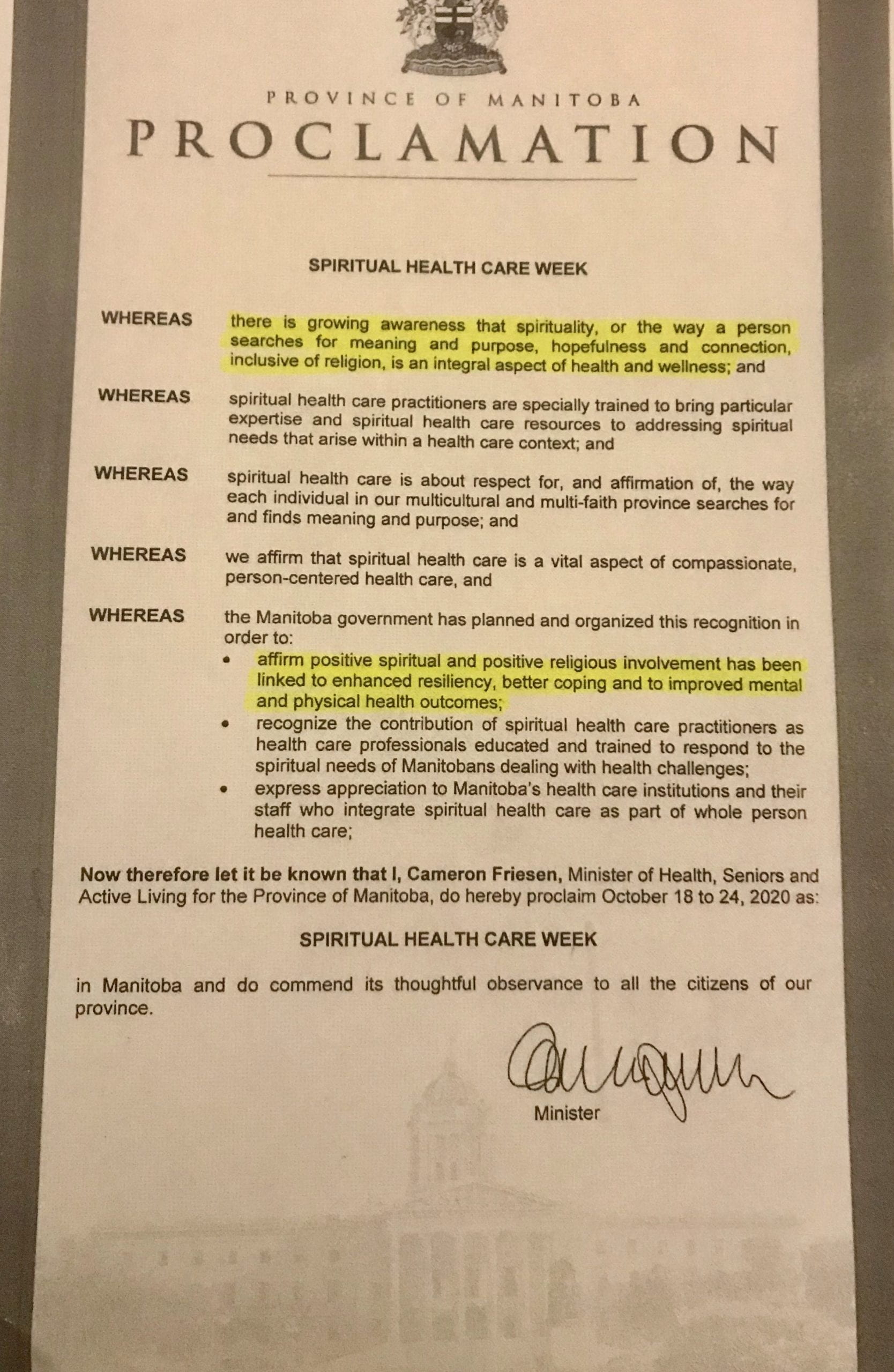
So, it seems very timely that the Government of Manitoba has proclaimed October 19 – 23, 2020 as “Spiritual Health Awareness Week.”
They are recognizing the spiritual health of people and those who make efforts to promote it… as it is “linked to… better coping and to improved mental and physical health outcomes”.
See more info here.
As nurses, we recognize the importance of health prevention and promotion as a holistic endeavor. Depression, hopelessness, and self-worth are aspects of human health we can’t ignore. I’d like to share a favourite article that I have used to educate students over the years when learning how to assess and implement spiritual care with clients. Very practical and relevant, the author in this article talks about the “5 R’s of Spirituality” to assist the nurse in providing effective spiritual care (Govier, 2000): Reason, Reflection, Religion, Relationships, and Restoration.
I encourage you to reflect on how you could or would promote your own patients’ spiritual health. Unsure? Take time to reflect on your OWN spiritual health first, and then take a peek at Govier’s (2000) article.
Happy “Spiritual Health Awareness Week”!
Post by:
Tanya Cole, RRC Nursing Instructor, Community & Mental Health
Check out Nursing grad Jaime Manness’ book Hike Manitoba, which is coming out with a second volume in November.
To learn more, read the RRC Alumni Engagement blog post.
Online and distance education create opportunities for students around Manitoba, which can be seen in the experience of Suzy Dueck, a Nursing student at our Winkler Campus.
Check out Suzy’s story on the Red Blog.
Welcome back! We hope everyone had a break this summer and had a chance to get some rest in preparation for the resumption of studies.
Despite all of our hopes, there won’t be a return to what was “normal”. Instead, we will continue to adapt to the new reality of learning in midst of a global pandemic. Our focus for the year will be continued teaching excellence in this new environment, supporting each other as we adapt and learn, and finally, supporting our students.
Red River College is taking a consolidated approach to managing our response to the COVID pandemic. Important information will be shared via Staff News and on the following web pages:
https://www.rrc.ca/coronavirus/
https://www.rrc.ca/coronavirus/faq/
https://www.rrc.ca/coronavirus/return-to-campus/
We are in Phase three of the College’s COVID plan, which means we will have more staff returning to campus. Some staff have already returned from working from home, and more will return gradually to support the increased learning activities. As College faculty, staff, and leadership, building our presence on campus will demonstrate to our students that we are open, available to support their learning, and that our facilities are ready to gradually welcome back on-campus activity.
In accordance with the latest public health advice, the most important action we can collectively take is to ensure anyone who is feeling ill in any way stay home.
Safety and Health Services has implemented and tested extensive measures over the summer to ensure staff and students are safe on our campuses. These measures include physical barriers, occupancy and traffic flow assessments, reduced class sizes, hygiene stations, and markers to ensure physical distancing. Staff and students will be required to self-screen for COVID-19 symptoms every day before coming to any campus. All staff and students will be required to wear a non-medical mask while on campus.
As the College welcomes students back, much work has occurred in the background. Our plans for this fall are:
To facilitate required remediation labs for students and to help us get back in “sync”, we have deferred the fall intake for Nursing and will increase the winter and spring intakes to 75 per cohort. The HCA and BPIEN program will continue with regular intakes.
Theory courses or components of courses will remain online for the foreseeable future due to space limitations and the College’s ongoing commitment to blended learning, unless there are some necessary hands-on activities that are embedded within a theory course.
Clinical courses will resume. This activity is dependent on the ability of the industry / employer to meet all the necessary safety and health regulations. Most of our Health Care Partners are open to the return of students and instructors. Regrettably, a few settings cannot accommodate us, but we have found ways to offer the experiences via simulation or using new settings. We are also looking at opportunities for offering clinical courses so students can catch-up and get back into sync with theory and to avoid delays in graduation dates.
Last spring, we lost the opportunity to access the skills and simulation labs. While we found some innovative ways to teach skills online, nothing is a substitute for hands on practice. To help catch up, we will be scheduling remediation sessions for students, allowing a chance to practice existing skills and to learn new ones.
Skills labs will resume. There a number of safety precautions we will have in place to be able to teach in the labs for essential learning activities such as the need for masks at all times, limitations on the number of students in the lab at any one time, and hand-washing. We are looking for chances to have increased open labs as well.
The pandemic has extended the length of the program, delayed graduation, and is requiring students to learn in new and innovative ways. This all contributes to the stress students may be experiencing. Red River College is acutely aware of this and has increased resources for students. Each Course Outline has information about mental health and well-being with links to resources that may be helpful.
Red River College is taking a global approach to managing our path forward. Major initiatives, news, and changes will be communicated via Student News.
Finally, we want to acknowledge that change will be a constant for all of us going forward. As the old expression goes, the best-laid plans often go awry. While students and the faculty have been working hard to adapt to our new reality, in all likelihood more changes will arrive in the days to come. This will no doubt be frustrating; our best course of action will be to work collaboratively to find solutions. Together, students, faculty, the management team, and student association can identify challenges and issues, find a way forward, and work toward our collective goal of student success.
All the best for the new Academic year!
Patrick Griffith, Chair, Nursing
Cindy Boughen, Manager, Theory
Sandra Holben, Manager, Clinical
RRC Polytech campuses are located on the lands of the Anishinaabeg, Ininiwak, Anishininwak, Dakota Oyate, and Denésuline, and the National Homeland of the Red River Métis.
We recognize and honour Treaty 3 Territory Shoal Lake 40 First Nation, the source of Winnipeg’s clean drinking water. In addition, we acknowledge Treaty Territories which provide us with access to electricity we use in both our personal and professional lives.