Research Partnerships and Innovation

Research Partnerships & Innovation

News and Events

Anna Borys wins CEM Co-op Student of the Year Award for placement with Prairie Research Kitchen

January 31, 2020

When Anna Borys signed up for the Culinary Arts program at Red River College’s School of Hospitality, she wasn’t sure where it would take her – she just knew she didn’t want to work in a restaurant.

“I went into culinary school knowing I didn’t want to work in food services,” she says. “But I didn’t know what else was out there.”

Having worked for her family’s glass business for 10 years before going back to school, Anna had developed a taste for the nine-to-five lifestyle – a schedule the fast-paced service industry doesn’t always allow.

This confusion about her future left her in a bit of a pickle, until she started her co-op work placement with RRC’s Culinary Research team, which operates out of the Prairie Research Kitchen on the 11th floor of the Paterson GlobalFoods Institute (PGI). Anna credits her co-op placement with determining her career path.

Anna first encountered the Culinary Research team while cooking her way through Culinary School. The team would often pop up in her labs and classrooms – working with instructors and making presentations to students about the work they do with clients in the food development industry.

“When they told us they work on developing recipes and that they were looking for co-op students, I knew right away that’s what I wanted to do,” says Anna.

Now, after successfully completing her co-op placement, Anna has started working full-time with the Research team.

One of her first projects was working on a new consumer food product called Bump – a ground beef/plant protein blend aimed at the flexitarian market – with James Battershill from Juno Food Labs. Anna developed a delicious Bump kofta kebab recipe that’s a hit with the client (and everyone else who’s tasted it).

“Working on the Bump kofta is definitely a highlight for me,” says Anna. “It’s one of the first recipes I worked on, and the client now uses it as a sample. It’s quick, delicious, and shows how versatile the product is.”

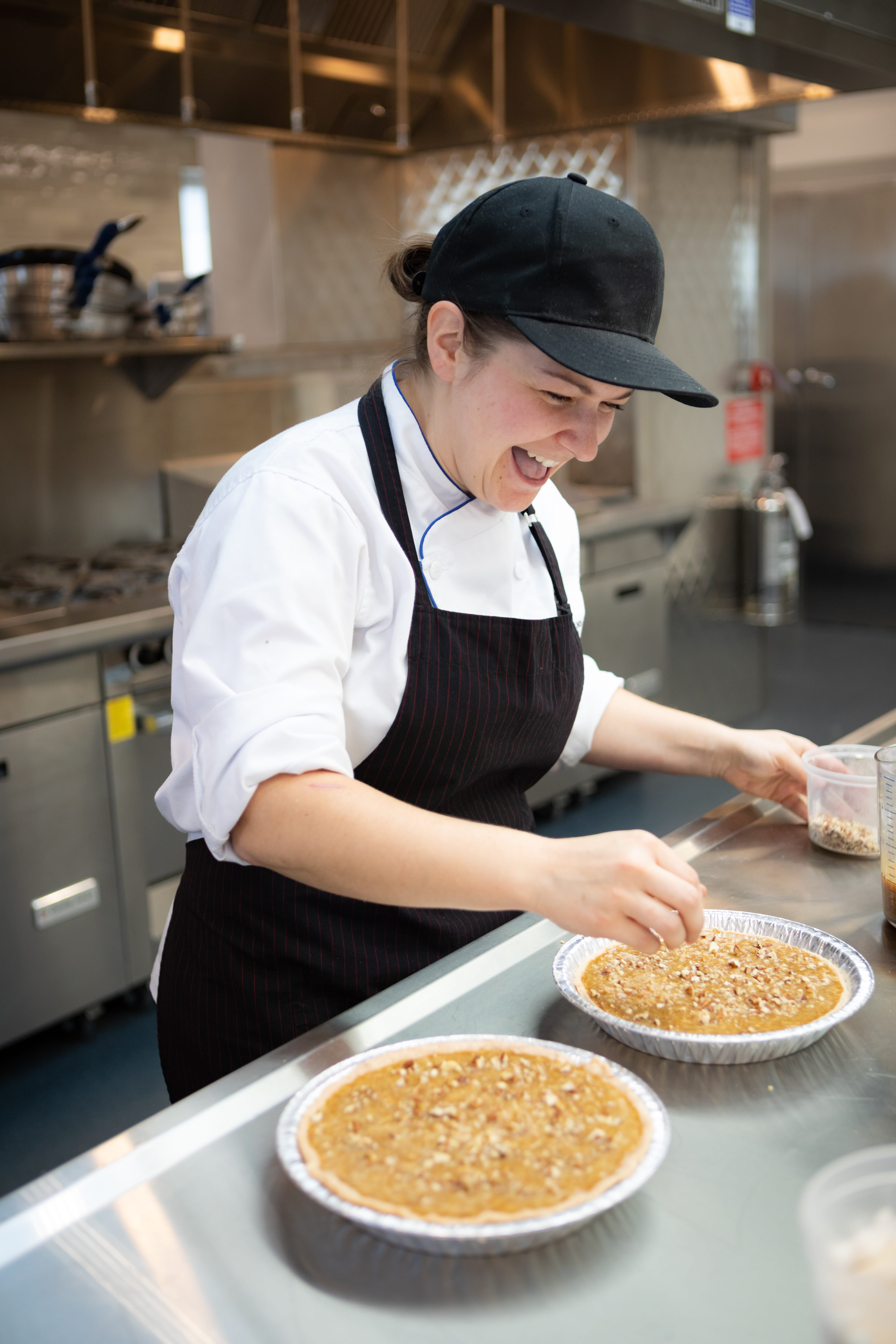
Anna’s food photography highlights a pie whipped up in the Prairie Research Kitchen

An avid photographer, Anna started an Instagram account to document what two years of the RRC Culinary Arts program is like. She says one of the most rewarding aspects of her co-op is taking food photos for clients like James, who often end up using them for their own marketing purposes.

Anna’s hard work is now being rewarded, as she was recently named the Co-operative Education Manitoba (CEM) Co-op Student of the Year Award for 2019.

“This award shows how important this industry is,” she says. “It’s up and coming. The Culinary Research program is pretty new at Red River College, so this recognition is huge for the research program.”

She’s also no stranger to winning awards – Anna took home the second-place prize at last year’s Applied Research & Innovation Day for her soy-free tempeh project, which she developed alongside the Culinary Research team. She’ll also graduate at the top of her class at next week’s convocation ceremony and is preparing to apply for the National Co-Op Student Award.

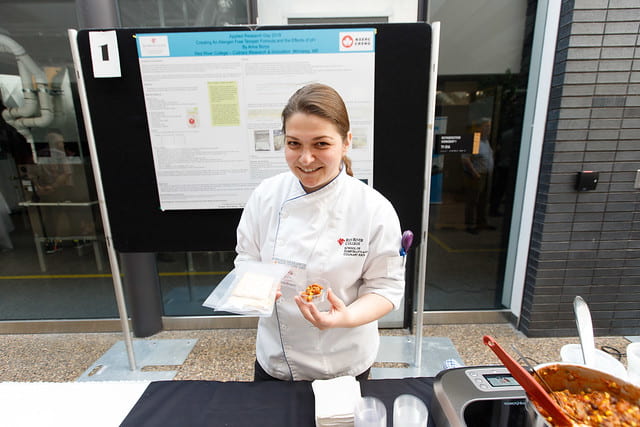
Anna at Applied Research & Innovation Day 2019

Despite her success, Anna is quick to credit the amazing team she worked with for helping her get where she is.

“I really don’t feel like this is my award,” she says. “It’s our award. This wouldn’t have happened without Mavis, Heather, and Kyle from Culinary Research – this showcases our teamwork. I don’t want to take credit, it’s our credit.”

Now her co-op experience has come full circle, as she’s helping to mentor the next wave of Culinary Arts students who are working in the Prairie Research Kitchen. She continues to be an advocate of the co-op process and shares her experience regularly with students.

“The co-op program is the reason for my career path,” she says. “This award, my success – this all has to do with my co-op and working with Culinary Research.”

CANARIE Launches Call to Fund Software Development Teams at Canadian Higher-ed Institutions

January 30, 2020

Up to $3.6M available to institutions to develop local software teams dedicated to equipping researchers with powerful software tools

CANARIE, a vital component of Canada’s digital research infrastructure (DRI) ecosystem supporting research, education and innovation, has announced a Call for Proposals to fund local teams at Canadian higher-ed institutions to help accelerate scientific discoveries by simplifying researchers’ access to world-class software for research.

Research increasingly relies on purpose-built software. However, many researchers don’t have the resources to manage software development teams and are unaware of research software that already exists and could be easily adapted to meet their needs. In response to this challenge and with the goal of maximizing the impact of public investments in research, CANARIE launched a pilot in 2018 to fund local, expert software teams at institutions to work directly with researchers.

Following the success of this pilot and similar efforts deployed in European countries, CANARIE’s Local Research Software Support call will fund teams of three dedicated, full-time research software developers at a target of six (6) participating institutions. These teams will be available to support all researchers at each of the participating institutions, regardless of discipline, and will provide guidance, training, expertise, and software development specific to advancing research projects.

Detailed information on this call including eligibility requirements, project milestones, and application resources can be found at: canarie.ca/software/lrss-call1.


From Bright Idea to Research Plan in Four Easy Steps

January 28, 2020

Save the date! The Research and Scholarship Committee from Red River College’s Nursing Department has organized a research workshop that is open to Chairs and Faculty: “From Bright Idea to Research Plan in Four Easy Steps.”

When: March 12, 9:00 a.m. – 12:00 p.m.

Where: Library Classroom, Notre Dame Campus.

Please join RRC’s Kim Mitchell, Deb Gural, and library staff in an interactive session that will outline four basic steps to help you move from research idea to action plan.

Step 1: What do you want to know?

Step 2: Who are your participants?

Step 3: What do you want to change?

Step 4: What is realistic?

Please RSVP or send your questions to kmmitchell@rrc.ca.

NSERC announces funding for science communications skills

January 27, 2020

The Natural Sciences and Engineering Research Council of Canada (NSERC) is launching a pilot funding opportunity to enhance the communications skills of students and researchers in the natural sciences and engineering. Such skills will contribute to science literacy, help counter science-related misinformation, and foster a role for science in evidence-based decision making.

The new pilot program, Science Communication Skills grant (pilot), is targeted at organizations that provide science communication skills training to STEM (science, technology, engineering and math) students, fellows, and faculty from Canadian post-secondary institutions. The training should have as its goal the effective communication of science to the general public. Organizations may request up to $20,000 in funding for a one year period.

NSERC encourages organizations to consider the needs of official language minority communities in their area while developing their proposed  activities and to have official documentation and promotional material in both official languages.

Applications must be submitted by May 15.

Program contact: promoscience@nserc-crsng.gc.ca

AquaHacking Lake Winnipeg 2020 Challenge Lunch and Learn

January 24, 2020

Calling all scientists, entrepreneurs, environmental activists, developers, sustainability experts, engineers, and people who want to change the world!

AquaHacking is an 8-month startup competition where innovative youth from across the disciplines team up to tackle urgent freshwater issues with sustainable tech solutions.

Students, recent grads, and young professionals of all skill levels are welcome to participate!

Bring your lunch and join us for an info session on February 7th.

When: Friday, February 7, 12:00 – 1:00 p.m.

Where: Skilled Trades & Technology Centre galleria (main floor), Notre Dame Campus, Red River College

Register now!

AquaHacking is proudly presented by the International Institute for Sustainable Development (IISD).

Get hands-on with innovative building envelope research and tools from BETAC this Thursday, January 23

January 22, 2020

Don’t miss the Building Forensics Night, hosted by the Canada Green Building Council – an evening of engaging activity and discussion around building envelope diagnostics and forensic troubleshooting.

Participants are invited to tour BETAC’s testing laboratory at Red River College’s Notre Dame Campus. Learn about equipment and procedures for testing building envelope performance and diagnosing potential problems, get hands-on experience with thermographic imaging equipment and observe demonstrations of air tightness testing equipment.

Immediately after the event, there will be a debriefing and networking session at One Great City Brewing (1596 Ness Ave.) One drink and appetizers are included with the event registration cost.

When: Thursday, January 23, 2020, 5:45 – 7:45 p.m.
Where: Red River College Notre Dame Campus
Building Efficiency Technology Access Centre
2055 Notre Dame Ave.
Winnipeg, MB

Register now!

Prairie Research Kitchen featured in the Winnipeg Free Press

January 15, 2020

Red River College’s new Prairie Research Kitchen was featured in the Winnipeg Free Press with a full-page spread and interviews with research professionals Mavis McRae and Heather Hill.

The article highlighted the Kitchen’s modern, beautiful workspace and the innovative work our research chefs and scientists are doing alongside Culinary Arts instructors and students, with clients from across Manitoba.

Here’s an excerpt from the article:

“Complete with a board room with an amazing view for tasting and focus groups, Mavis McRae, the research professional for culinary research & innovation and head of the lab, said culinary arts students will get a whole new training opportunity in the science of food that was not previously available.

Already the lab is working on about 10 projects at a time with new a couple of new ones being pitched every week by industry partners and research scientists.”

Please click here to read the full article.

Attention researchers! New Innovation Proof-of-Concept Grant available from Research Manitoba

January 14, 2020

Research Manitoba has launched a new Innovation Proof-of-Concept Grant that aims to strengthen Manitoba-based research innovation and development projects by filling a funding gap in the Manitoba innovation ecosystem. Through two independent streams, this program provides support for innovation and commercialization research that is not otherwise accessible. This program helps fund activities directly related to process validation and proof-of-concept research. The program is targeted towards research in: Bioscience, ICT, Advanced Manufacturing, and Infrastructure and Transportation Industries and Technologies.

The two funding streams are:

Stream 1: Manitoba-Based Consortium supports local collaboration that is addressing a company specific discovery or innovation towards market usability. This stream allows academics to use their world-class knowledge, facilities, and highly qualified personnel (HQP) to close the knowledge gaps identified during the industry partner’s innovation development.

Stream 2: Manitoba Post-Secondary Researchers supports the advancement of discoveries or innovations within an academic setting, which may result in products or technologies, towards market usability.

More information on the grant can be found in the Program Guide or on the Research Manitoba Innovation and Strategic Partnerships website. The application form is also now available on Research Manitoba’s Grants Management System (GMS). The 2020 competition will be open until March 31, 2021.

Read about the Smart Factory in Polytechnic Canada’s Applied Research Compendium

November 26, 2019

Polytechnics Canada has recently published a compendium on Applied Research: Building a Stronger Canada, and Red River College’s Smart Factory gets a mention for its value in emerging technologies in metal additive manufacturing, collaborative robotics, autonomous factory vehicles, flexible robotic work cells, industrial automation and networking, and high-speed 3D laser metrology.

View the entire compendium here, and see page 3 for more on Red River College and the Smart Factory.

Prairie Fava: Small business with a big idea wins big at the Manitoba Business Awards

November 21, 2019

Like many big ideas, Prairie Fava started with a seed.

In this case however, it was a whole seed farm.

Hailey and Cale Jefferies

Hailey and Cale Jefferies are two self-described “entrepreneurial spirits” who moved back to rural Manitoba after going to university in Ontario. Cale’s family business was calling – having grown up on a fifth-generation seed farm in Glenboro, Manitoba, he made the choice to take over Jefferies Seeds.

But the seed to start their own business was officially planted when Hailey’s mom was diagnosed with cancer.

“My mom’s sickness really inspired my passion for health,” says Hailey. “My husband was selling fava seeds to farmers, but there was no market to sell it to. I saw lots of opportunity with fava and took it upon myself to leverage my passion for sales with making food healthier.”

Fava flour, flakes and grit can be used as ingredients in new and current food products to enhance the fibre and protein content. Fava flour is a gluten-free alternative that can be used in baking and conventional recipes. Combining pulse flours with grain flour creates a complete protein source, as the amino acid profiles are complementary. Rice flour is often used as a gluten-free alternative, though the protein quotient isn’t as high as in fava.

Prairie Fava operates out of Jefferies Seeds and the businesses work well with each other; as more fava beans are sold to farmers, that means there are more fava beans to process – and better nutrition in our food.

While starting their own business was a natural fit, Hailey says that being a small start-up meant they didn’t have the time or resources to dedicate to trial and error and market research. The duo co-founded Prairie Fava in 2015 and started officially processing fava beans two years later. After connecting with Red River College’s Culinary Research team – now known as the Prairie Research Kitchen – Prairie Fava soon got to work conducting basic research on their fava flour.

And the seed that first inspired their business has now blossomed into an award-winning company: Prairie Fava was recently awarded the Start-Up of the Year Award at the 2019 Manitoba Chambers of Commerce Business Awards.

Hailey Jefferies is presented with the Start-up of the Year Award at the Manitoba Chambers of Commerce Business Awards

“RRC was the first to bring a chef’s perspective and experience to applied research,” says Hailey. “The input of a chef has expediated our product development and provided us with valuable information as to the direction we should take in R&D. Our product development has been strengthened by the connection of culinary and food sciences that RRC provides.”

One of the first projects Prairie Fava and the Prairie Research Kitchen worked on together was a fava flour crouton. They initially started testing with whole beans and flour, which wasn’t really working at first. It was a trial and error period of finding fava’s strengths.

Eventually they got to work on muffins and cookies – beloved family recipes, revamped with a healthy, fava-infused twist. Hailey says she took some samples home to family for a blind taste test, and that everyone picked the cookie with 50% fava as their favourite.

Hailey Jefferies speaks at the grand opening of the Prairie Research Kitchen, as RRC Interim President Darin Brecht and Minister of Economic Development and Training Ralph Eichler look on.
Photo by Jason Halstead


With the help of the Prairie Research Kitchen, Prairie Fava was able to demonstrate that fava doesn’t compromise flavour and has the added benefit of injecting an alternative form of protein to new and existing recipes.

“I can’t emphasize enough how valuable Red River College is for a company like ours,” says Hailey. “They have provided access to College-specific expertise and funding ​that has helped propel our company into the market. We have appreciated being able to leverage the creative talents of RRC students to do market research, recipe development and great food photography. We have not been able find this kind of diverse food research elsewhere on a limited R&D budget.”

So what’s next for Prairie Fava?

“We are very excited to report that we anticipate the launch of a fava-based ‘better for you’ product into the consumer market in 2020,” says Hailey. “With the new Prairie Research Kitchen officially open, we can’t wait to do even more with RRC on a different scale. They’ve been an integral part of our growth.”

To learn more about Prairie Fava, please visit their website.

Want to know how to cook with fava? Check out some of our delicious recipes:

Tortillas


Crepes


Spaetzle


Spicy Fried Chicken


Pork Schnitzel


Tempura

RRC Polytech campuses are located on the lands of the Anishinaabeg, Ininiwak, Anishininwak, Dakota Oyate, and Denésuline, and the National Homeland of the Red River Métis.

We recognize and honour Treaty 3 Territory Shoal Lake 40 First Nation, the source of Winnipeg’s clean drinking water. In addition, we acknowledge Treaty Territories which provide us with access to electricity we use in both our personal and professional lives.