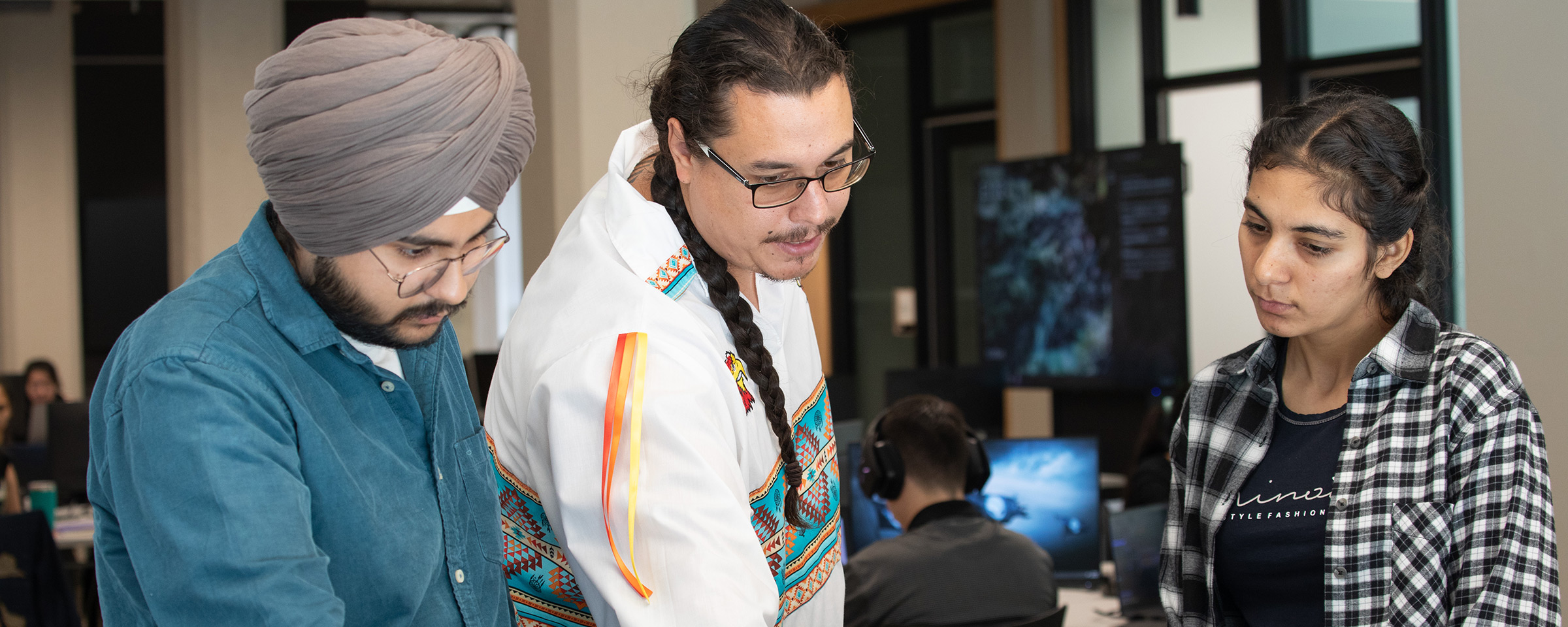
Three students looking at something in a classroom

Work-Integrated Learning

News and Events

A culinary journey at the Embassy of Canada to Japan

December 10, 2025

Our 2025 RRC Polytech Culinary Arts graduate Stan Fry had the extraordinary opportunity to cook for royalty — preparing a meal for the Imperial Princess of Japan — during his co-op placement at the Embassy of Canada to Japan in Tokyo.

Read all about how Stan represented both RRC Polytech and Canada on the international stage — and how his “Work-Integrated Learning” experience turned into a once-in-a-lifetime culinary adventure.

Click here to read the full story

Geomatics Technology grad taps into co-op experience for rapid expansion at RivaCore

December 8, 2025

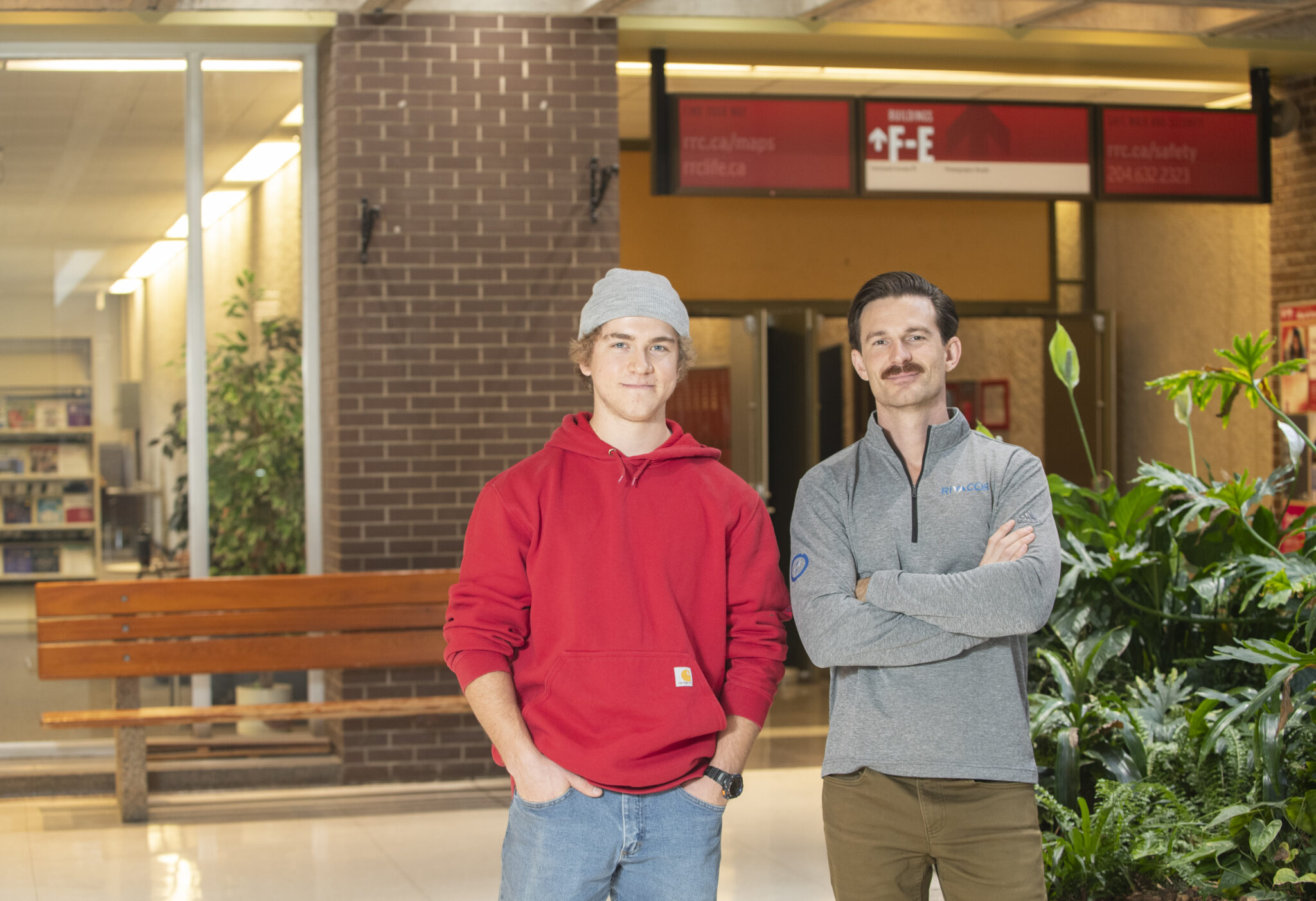
Two men stand in a hallway at the Notre Dame campus of RRC Polytech. They are both smiling.

A career in surveying can take someone to an exciting variety of job sites — from rural to urban, populated to remote.

That’s where Colin Rivard started after graduating from the Civil Engineering Technology program, specializing in Geomatics, at RRC Polytech in 2012. With an entrepreneurial background, though, there was always a desire to build something of his own.

“My dad and his dad started a small business together. I saw how they got to see the tangible efforts of what you put into owning a business. There’s a direct correlation to the harder you work, the more benefit there is. I’ve always liked that.”

In 2018, Rivard founded RivaCore Surveys and Locates as a one-person operation, and since then he’s adapted his focus to building the ideal team and overseeing a period of fast expansion.

“Starting in the field, you just get a love for surveying and being by yourself with an instrument,” said Rivard. “The biggest thing that drives me now, though, is being able to work with a team that we’ve really developed over the years.”

Just last year, RivaCore had a small team of eight — today, they’ve grown to a staff of 23, with at least five more coming on for long-term projects before the end of 2025.

RivaCore, which provides services including pipeline, construction, topographic, heavy civil surveys and beyond, hasn’t just grown in numbers — it’s grown in reputation as well. The organization has clients across multiple provinces and its reputation for inclusion as a member of the Manitoba Métis Federation, as well as teamwork and community, have been at the core of their growth and success.

“I come from a soccer background,” said Rivard. “It’s a team sport, and now I’m sitting here with work and I really enjoy it because I’m with this great team where everyone has each other’s back and tries to make it the best they can.”

One of the key aspects to the company’s growth has been bringing on students new to the world of surveying. Many of these students come from RRC Polytech.

“This was actually our first year hiring a Civil Engineering Technology summer student and it’s already become a company model for us,” said Rivard.

“We had an opportunity with the Alamos Gold project in Lynn Lake where we could have multiple surveyors on site, which was the perfect chance to bring in juniors and grow our team for the next few years.”

By bringing in students, Rivard is looking to provide a work environment that can inspire them to stay on board with RivaCore and support a positive cycle of learning.

“We can pour into these students… and build a loyal, knowledgeable surveyor base. Then, we continue to develop people from within, get them into higher positions, and we know what we’re getting. The RRC Polytech program is a huge resource for that.”

One of the students who joined the team this summer was Aidan Pacey, who is entering his second year in Civil Engineering Technology. His co-op at RivaCore saw him build experience as a survey assistant across Manitoba.

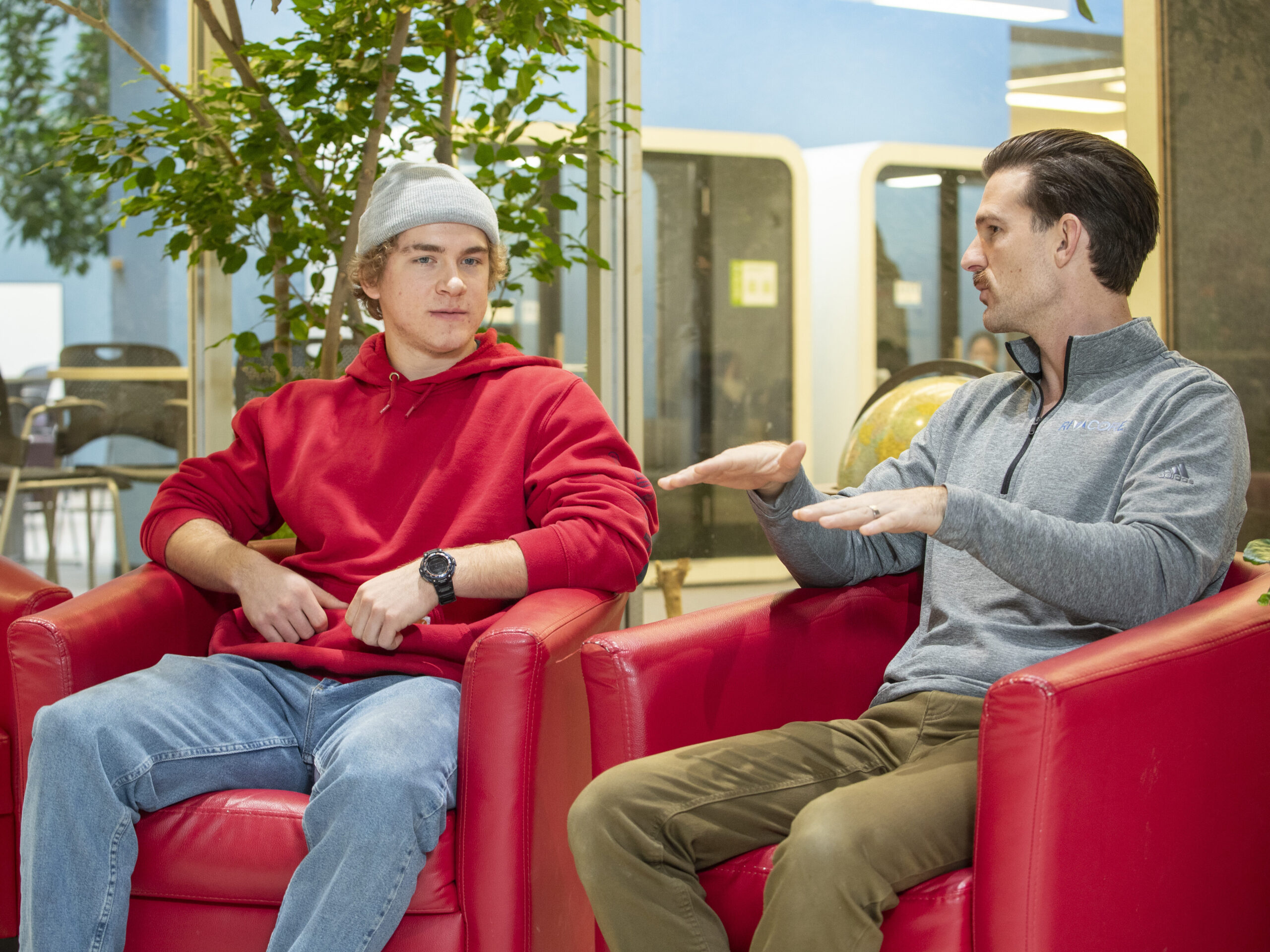
Geomatics Technology grad Colin Rivard (right) connects with co-op student Aidan Pacey (left) at the Polytech’s Notre Dame Campus.

“I’ve been all over,” said Pacey. “Working in Lynn Lake on the gold mine project, back to the city to do model layouts, and out to Gillam to do a job there.”

Pacey’s long-term goal is to be in construction project management and, while he was new to surveying when he started at RivaCore, he’s found the time spent to be of tremendous value.

“I’m confident in it now. There are great teachers, great colleagues here.”

“Aidan is an absolute superstar,” said Rivard. “I’ve probably heard from four different senior staff members on different occasions come to me, by themselves and say ‘Colin, make sure you don’t lose that guy.’”

Pacey’s quick learning skills have helped him get out into the field solo, a rare opportunity for someone so green in their career. A willingness to learn has been present too, which is one of the key skills that Rivard looks for when hiring students.

“We want someone who will go somewhere, enjoy what they do, and work hard at it. We are looking for that willingness to learn and develop, and help out your coworkers in any way you can.”

Rivard remembers a day where he went into the RivaCore office in Dugald to clean things out of the storage room and Aidan was the first one to come up and ask if he needed a hand.

“There’s just an absolute willingness to help out the team in any way he can.”

It’s a culture that Rivard has been driving since he started his business.

“I recently took a leadership training program and the guy leading it used an analogy that really stuck with me: before you can paint an old tractor, you have to scrape the old paint before you can put a new coat on.

It dawned on me that we’re naturally good at training and making sure our people know the way that we do things. Rather than scrape off an old coat of paint, we’d rather grab new guys, give them an opportunity and let them run with it.”

It’s why the company will keep coming back to co-op students for future projects, creating a mutually beneficial relationship with the program Rivard graduated from 13 years ago.

“We’ve had one student say that he’s learned more in the first four days of his co-op than his entire last co-op. That gets me really excited.”

Profile by John Gaudes (Creative Communications, 2012).


Work-Integrated Learning at RRC Polytech

Work-integrated learning opportunities, including co-ops like Pacey’s at RivaCore, allow students to gain practical work experience while also providing industry with enthusiastic, skilled workers. A meaningful way to give back and mentor students, many alumni are employer partners. Learn more about work-integrated learning at RRC Polytech and how to become an employer partner here.

Spring 2026 IT Co-ops

November 24, 2025

Students from 5 of RRC Polytech’s IT programs are seeking 15–16-week full-time employer-paid co-op opportunities starting May 4, 2026. These programs are:

Students have the skills and job readiness to act as: software developers, front- and back-end web developers, web designers or developers, full stack developers, Java developers, web application business analysts, IT services support, help desk associates, network administration, and more.

Game Development programmers and artists have a strong foundation in Unreal Engine and Unity, and work frequently in VR. Programmers use C#, C++, Blueprint and JavaScript to build game mechanics, user interfaces, and game AI. Artists have a strong foundation in all disciplines of 3D production art, and are proficient in Maya, ZBrush, and Substance Painter. They excel in asset creation, basic rigging and animation, material and look development, and integrating assets into  game engines.

If you’re interested in hiring a co-op student or exploring if co-op is a fit for your organization, please reach out to our Industry Liaison Consultant today: you can reach Katie at ACEwil@rrc.ca

Important Dates

Work term start date: May 4, 2026

Post to Career Bridge: early January – early April

Deadline to extend an offer to students: April 10, 2026*

* The deadline aligns with the ACE Project Space industry project deadline. Most students will not be available for co-op jobs after this deadline

Potential Funding Opportunities

Employers may be eligible for wage funding or subsidies through Student Work Placement Program (SWPP) (domestic/permanent resident students only) or Manitoba Work Experience Tax Credits (all students). College staff are happy to discuss these options with you.

New to co-ops?

Co-ops are a form of work-integrated learning that integrates academic studies with quality experiences. They are an engaged partnership between RRC Polytech, an employer-organization, and a student.

The process of hiring a co-op student mirrors a regular job search with added support from College staff and potential funding opportunities to assist with paying students a fair wage (an average of $18-$22/hour for IT programs). Job postings, aligned to the program requirements, are posted on Career Bridge typically up to four months prior to the start of the work term. By indicating that the role is for a particular co-op term, only students who are approved for the work term will see your job posting.

More information on co-ops can be found through the following links:

Employer information

Safety Terms and Conditions for Work-Integrated Learning Employers

Student responsibilities and supports

How to post on Career Bridge

More than 700 Nursing and Dental Assisting Students Gifted Bursaries from CEWIL Canada iHUB Ahead of Clinical Practicums

October 31, 2025

For Kiara Carpenter, nursing was never just an option – it was a calling. When she enrolled in the Bachelor of Nursing program at RRC Polytech she knew she wanted a career where she could make a meaningful difference in people’s lives – and now in her senior practicum, she describes her education as a transformative experience.

“Through my training, I’ve learned that I am more resilient and adaptable than I thought. Nursing school challenged me academically, emotionally, and personally, but I discovered I can thrive under pressure, think critically in fast-paced environments, and grow from every experience,” she said. “The program has pushed me out of my comfort zone and prepared me to work in diverse clinical areas, from medical-surgical to pediatrics and palliative care. The instructors and preceptors have been supportive mentors, and I’ve developed lifelong friendships with classmates who share the same passion for nursing.”

A pivotal moment in Carpenter’s journey at RRC Polytech was when she received a bursary from the Co-operative Education and Work-Integrated Learning Canada (CEWIL Canada) iHUB.

“Receiving a bursary eased the financial stress that often comes with being a full-time student. It allowed me to focus more on my studies and clinical learning rather than worrying about balancing extra work hours. This support gave me the peace of mind to fully commit myself to my training and clinical experiences,” said Carpenter. “I felt incredibly grateful and relieved when I learned I was a recipient. It was encouraging to know that others believed in my potential as a future nurse and were willing to support me in achieving my goals.”

Carpenter was one of more than 700 students from the Nursing and Dental assisting programs who have received a bursary from the CEWIL Canada iHUB since the Fall 2024 term, after a pilot program provided 60 recipients in senior practicums with bursaries last year.

“These opportunities for on-the-job learning are invaluable to students, and this support from CEWIL Canada allows them to focus more fully on getting the most out of their practicums as they prepare the enter their fields after graduation,” said Fred Meier, President and CEO, RRC Polytech. “RRC Polytech is proud to be the largest trainer of health-care professionals, and these hands-on opportunities are an important part of the training that ensures graduates are well-prepared and confident from day one.”

The senior practicum marks the culmination of nursing students’ academic journey however it can be expensive with financial demands extending beyond the classroom. Nursing and Dental Assisting students have a rigorous practicum schedule that leaves little room for part-time employment, amplifying this financial strain. The bursaries from CEWIL are aimed at helping to alleviate that financial burden in the final stretch of their program.

“CEWIL Canada is pleased to support innovative WIL experiences for students at RRC Polytech where students are able to receive financial support and recognition for their WIL experience,” says Charlene Marion, Executive Director at CEWIL Canada. “Funds such as these aim to eliminate barriers to WIL and increase access for all post-secondary students.”

The $620,000 of support for nursing and dental assisting students at RRC Polytech comes from CEWIL Canada’s iHUB grant, funded in part by the Government of Canada’s Innovative Work-Integrated Learning Initiative , and funds various work-integrated learning opportunities for post-secondary students in Canada, including unpaid clinical practicums. The bursary was tiered and the amount determined by the number of hours spent in clinical practicum.

Joshua Salisi, who was a recipient of one of the first bursaries in 2024, said the support was appreciated and would help him stay focused on his training before he entered the workforce.

“The bursary from CEWIL Canada helps alleviate the added stressors during our senior practicum experience,” said Salisi. “In addition to tuition, many of us must cover the cost of extra scrubs, parking, and other miscellaneous expenses. Parking around hospitals is often expensive, and with us being there full-time, the costs quickly add up. This bursary gives us more breathing room to better focus on ensuring we have a successful senior practicum experience and help as many patients as we can!”

RRC Polytech establishes long-standing partnerships with industry and community partners in Work-Integrated Learning (WIL) initiatives, such as practicum experiences, which rely on an engaged partnership between RRC Polytech, a host organization, and a student. These opportunities integrate academic studies with quality experiences within a workplace or practice setting and focus on the development of student learning objectives and outcomes related to employability and life-long learning.

For Carpenter, she is looking forward to continuing her journey and completing her senior practicum ready to transition into career.

“I’ve not only developed the skills and knowledge to begin my career, but I’ve also grown personally. Nursing school has taught me resilience, compassion, and the importance of lifelong learning. I’m excited to take everything I’ve gained at RRC Polytech and begin my career as a nurse, carrying forward the values and experiences that shaped me here,” she said.

2026 Co-op Partnership Information: Civil Engineering Technologies Department

September 17, 2025

Architectural Technology, Civil Engineering Technology and Construction Management Degree Programs

Students enrolled in the above programs will be seeking full-time, paid co-op employment opportunities for the Spring 2026 work term.

Employers are invited to post co-op job opportunities as early as November 1, 2025. If you are a previous employer partner, please post your position(s) directly to the co-op module of Career Bridge (see below for more information). If you are a new employer partner interested in learning more, please arrange a meeting or phone call for more information by emailing civilco-op@rrc.ca.

Work Integrated Learning with RRC Polytech 

Co-ops are a form of work-integrated learning that integrates academic studies with quality experiences. They are an engaged partnership between RRC Polytech, an employer-organization, and a student. For more information see: 

Spring 2026 Co-op Work Term Dates and Program Information 

Career Bridge

  • All co-op opportunities are advertised through the co-op module of Career Bridge (viewable only by eligible co-op students, targeted by program area). Career bridge can also be used to post career opportunities (viewable by all students from all programs, new graduates, and alumni). Ensure you create your co-op posting in the co-op module.   


Potential Funding Opportunities 

Employers may be eligible for wage funding or subsidies through: 

  • Student Work Placement Program (SWPP) (domestic/permanent resident students only). Many of our industry employers have had success applying through Magnet and ECO Canada: Environment Careers Organization of Canada. 

Suggested Timelines: Posting/Hiring 

Postings open Nov 1, 2025.  

Many of our employer partners provide student offers in Jan/Feb (some earlier, some later). 

We recommend all job offers be made before mid-April. Sooner is better! 

  • Post your position in the co-op module of Career Bridge as early as Nov 1.  
    • A WIL Coordinator will review your posting within 1-3 business days. 
    • Once approved by the WIL Coordinator, all eligible students in the targeted program(s) will be able to view your posting and apply. 
  • Set a closing date that suits your needs. 
    • A closing date of approx. 3 weeks from the date of posting is recommended. 
    • Upon closing, you will receive an email including a link, code and instructions to view all applications.  
  • Contact any suitable candidates to arrange interviews. 
    • Whenever possible, please work with the student to determine an interview time which will be least disruptive to the students’ academic courses.  
  • Provide a suitable candidate with a job offer.  
    • Provide a short window of time for the student to accept (as necessary, and to suit your needs).  
    • If a student accepts your offer, email civilco-op@rrc.ca to inform us, or update the student’s application status in Career Bridge to “position accepted.” 
  • Once all positions have been filled or if you are no longer seeking applications, please expire your posting on Career Bridge. 
  • If no suitable applications are submitted by your first posting deadline, please email civilco-op@rrc.ca to request the posting be extended.  
    • Do not re-post your position. We will extend your posting deadline as many times as necessary until you find the right fit.  

Questions? 

Please contact civilco-op@rrc.ca for more information. 

Winter 2026 Applied Computer Education Co-ops!

August 11, 2025

Post now for the upcoming Winter Term!

the Winter 2026 term is now open to post

RRC Polytech’s IT students are looking for 15–16-week full-time employer-paid co-op opportunities starting January 5, 2026. These programs are:

Students have the skills and job readiness to act as: software developers, front- and back-end web developers, web designers or developers, full stack developers, Java developers, web application business analysts, IT services support, help desk associates, network administration, information security consultant/risk manager/officer/risk analyst/auditor, and more.

If you’re interested in hiring a co-op student or exploring if co-op is a fit for your organization, please reach out to our Industry Liaison Consultant today: you can reach Katie at ACEwil@rrc.ca

Important Dates

Work term: January 5 – April 24 or May 1, 2026

Post to Career Bridge: starting September 1, 2025

First deadline to extend an offer to students: November 21, 2025*

Final deadline to extend an offer to students: November 28, 2025

* The first deadline aligns with the ACE Project Space industry project deadline. Most students will not be available for co-op jobs after this deadline

Potential Funding Opportunities

Employers may be eligible for wage funding or subsidies through Student Work Placement Program (SWPP) (domestic/permanent resident students only) or Manitoba Work Experience Tax Credits (all students). College staff are happy to discuss these options with you.

New to co-ops?

Co-ops are a form of work-integrated learning that integrates academic studies with quality experiences. They are an engaged partnership between RRC Polytech, an employer-organization, and a student.

The process of hiring a co-op student mirrors a regular job search with added support from College staff and potential funding opportunities to assist with paying students a fair wage (an average of $18-$22/hour for IT programs). Job postings, aligned to the program requirements, are posted on Career Bridge up to four months prior to the start of the work term. By indicating that the role is for a particular co-op term, only students who are approved for the work term will see your job posting.

More information on co-ops can be found through the following links:

Employer information

Safety Terms and Conditions for Work-Integrated Learning Employers

Student responsibilities and supports

How to post on Career Bridge

Fall 2025 IT Co-ops

April 25, 2025

RRC Polytech’s IT students are looking for 15–16-week full-time employer-paid co-op opportunities from August 25 to December 12, 2025. These programs are:

Students have the skills and job readiness to act as: software developers, front- and back-end web developers, web designers or developers, full stack developers, Java developers, web application business analysts, IT services support, help desk associates, network administration, and more.

If you’re interested in hiring a co-op student or exploring if co-op is a fit for your organization, please reach out to our Industry Liaison Consultant today: you can reach Katie at ACEwil@rrc.ca

Important Dates

Work term: August 25 – December 12, 2025

Post to Career Bridge: starting May 5, 2025

First deadline to extend an offer to students: August 1, 2025*

Final deadline to extend an offer to students: August 15, 2025

* The first deadline aligns with the ACE Project Space industry project deadline. Most students will not be available for co-op jobs after this deadline

Potential Funding Opportunities

Employers may be eligible for wage funding or subsidies through Student Work Placement Program (SWPP) (domestic/permanent resident students only) or Manitoba Work Experience Tax Credits (all students). College staff are happy to discuss these options with you.

New to co-ops?

Co-ops are a form of work-integrated learning that integrates academic studies with quality experiences. They are an engaged partnership between RRC Polytech, an employer-organization, and a student.

The process of hiring a co-op student mirrors a regular job search with added support from College staff and potential funding opportunities to assist with paying students a fair wage (an average of $18-$22/hour for IT programs). Job postings, aligned to the program requirements, are posted on Career Bridge up to four months prior to the start of the work term. By indicating that the role is for a particular co-op term, only students who are approved for the work term will see your job posting.

More information on co-ops can be found through the following links:

Employer information

Safety Terms and Conditions for Work-Integrated Learning Employers

Student responsibilities and supports

How to post on Career Bridge

RRC Polytech Student takes mechanical engineering skills Down Under

April 25, 2025

A man stands in an agriculture field with a combine.

Outstanding co-op experience at MacDon takes Brandon Doucet to the fields in Australia

It took Mechanical Engineering Technology student Brandon Doucet approximately ten seconds to say ‘yes’ to an opportunity that would take him across the world to Australia for six months.

While on a co-operative work placement with MacDon Industries, Brandon was working on a prototype for a new combine header that was completely new to the agriculture industry. When it came time to test the product in the field, his supervisors noticed the interest he had taken and asked if he would be willing to conduct the testing with Australian farmers.

“It was a big leap, I learned a lot about who I am and what kind of worker I am and what kind of work that I enjoy,” says Brandon, who was 19 years old at the time of his co-op. “All in all I travelled every state and drove more than 30,000 kilometres – on the other side of the road. I got to see a lot of the country and met locals who had so many stories about farming and life.”

The product Brandon was testing is the MacDon FD261 FlexDraper, which is now available publicly to farmers worldwide. The header is 61-feet long, which about ten feet more than the previous FD2 design and about double the length of a standard combine header used to harvest crops. The header also flexes to cover the ground better and produce a better yield.

The six months of field testing entailed working directly with Australian farmers, using their combines with the MacDon prototype header. Brandon would perform regular inspections, maintenance, upgrades, and operation of the prototype equipment in the field. He would also collect data from the hydraulic and electrical systems, which would then be relayed back to the engineering team in Winnipeg for further analysis. 

“I really enjoy all the nitty gritty details of engineering testing, laying out what’s being tested, why it’s being tested and how the improvement can make a better product,” says Brandon. “During this experience I really grew to respect how much documentation plays a role in engineering. Keeping things organized so it can be looked back on after each change, and using what was learned to continuously improve.”

When Brandon first started his co-op with MacDon he had one more term left in the Mechanical Engineering Technology program before graduating. On top of the stint in Australia, he also had the opportunity to work on projects in cities across North America and decided to take a total of 16 months off from the program to gain the real-world experience.

Part of the reason he felt comfortable and confident in that decision was the reassurance from his instructor, Doris Peloquin, that the program would still be there for him to complete. She emphasized that having the diploma completed would help him in his career, but that there is value to taking on practical experiences when they present themselves.

“Co-op or internships give the students the ability to apply what they’ve learned during classwork in a real-world scenario. At RRC Polytech we do a good job of providing hands-on learning scenarios in class but it’s not quite the same experience of what you gain from a real-world experience,” says Doris. “There’s networking and professionalism and learning their soft skills – especially that ability to communicate at different levels; with leaders and those on the shop floor, and interdepartmentally.”

After graduating from RRC Polytech this June, Brandon plans to attend Lakehead University to obtain his Engineering Degree and aspires to work in Motorsport Engineering.

“Before my co-op with MacDon, I remember thinking there’s no way I’d leave Manitoba. But now I know I can always travel, learn from different parts of the world, and then come home with new ideas or ways of doing things,” says Brandon.

For more information about the Mechanical Engineering Technology program visit RRC Polytech’s Program Explorer page.

Overhead view of a combine tractor harvesting crops in a field.

WIL Power: Electronic Engineering Technology student goes above and beyond, is named RRC Polytech Work-Integrated Learning Co-op Student of the Year 

March 26, 2025

Gurman Ubhi has made significant impacts throughout their time at RRC Polytech – for themself, for fellow students, and – through their co-op placement at Environment and Climate Change Canada (ECCC) – for the environment. Their commitment to going the extra mile has recently earned Gurman the title of RRC Polytech’s Work-Integrated Learning (WIL) Co-op Student of the Year. 

As a student in the Electronic Engineering Technology program, Gurman not only excels academically, but volunteers their time to serve as the Chair of the Institute of Electrical and Electronics Engineers (IEEE) student branch at RRC Polytech.  

It was during Gurman’s co-op placement with ECCC where their skills, passion, and initiative truly shone. Gurman worked for the Atmospheric Monitoring Division of the Meteorological Service of Canada, and traveled throughout Manitoba, Saskatchewan and Nunavut during their four-month placement. 

This work saw them assisting senior technologists during weather station verification inspections – learning and working on complicated weather station systems that involved high-powered electrical components and complex instrumentation. These are the systems that generate the climate data that the ECCC uses to provide weather forecasts to Canadians across the country. 

“Gurman’s work in assisting the senior technologists during site inspections directly contributed to the safety of the Canadian public,” noted Michael Maurice, Supervisor/Expert Technologist, Monitoring and Data Collection, Prairie Northern Operations – East at ECCC. 

Gurman credited their education at RRC Polytech with preparing them for the complex work at ECCC. 

“One of the most technically challenging yet rewarding aspects of my role was working on radar systems. This included inspections and testing of critical components such as antennas, power delivery systems, and safety equipment,” said Gurman. “These experiences required me to draw upon my coursework in circuits, signal processing, and measurements, demonstrating the real-world applicability of my academic studies.  

“Through these tasks, I developed a strong understanding of high-powered electrical systems and advanced instrumentation, further enhancing my technical expertise and critical thinking skills.” 

On top of their regular duties, Gurman developed and implemented a new online fleet vehicle tracker – a project that was so successful, it was eventually adopted by the division and is still used to this day. 

“Gurman demonstrated outstanding problem-solving skills, adapting to feedback from multiple departments and ultimately delivering a valuable tool that streamlined fleet monitoring,” said Maurice. “This project showcases Gurman’s ability to think beyond assigned tasks and actively contribute to our team’s objectives.” 

Gurman’s contributions during their co-op placement have reinforced ECCC’s commitment to RRC Polytech’s WIL co-op program, as their high performance and proactive approach demonstrates the value of working with emerging talent. 

“Co-operative education has been pivotal in shaping me into a well-rounded professional,” said Gurman. “It has provided me with the skills, experiences, and network to excel in my career while reinforcing the importance of giving back to the student community. This experience has not only prepared me for my future career but has also inspired me to advocate for the expansion of WIL opportunities, ensuring that more students benefit from such transformative learning experiences.” 

Co-operative education plays a vital role in RRC Polytech’s commitment to delivering high-quality education and training. Learn more about Co-operative Education and other types of Work-Integrated Learning at RRC Polytech.   

Business Management Student Success!

March 24, 2025

Student Profile: Raquel Dayrit

Business Management Co-op Profile

Raquel Dayrit, Client Advisor, RBC

Raquel with supervisors Lisa and Nicole at the Regent and Rougeau branch

With over 18 years of progressive banking experience with focus on treasury operations and credit evaluation, Raquel was eager to connect with a banking institution in Winnipeg, so she was ecstatic when RBC selected her for a placement as a Canadian Banking Operations Officer Summer Student in May 2024. In this role, Raquel was able to diversify her portfolio of skills to include client relations and sales:

The Business Management co-op has provided me with true Canadian work experience. For my case, I am glad that I landed in a well-established company that provides excellent training and hands-on experience. RBC has a well-organized 6-week training plan to ensure that interns are properly equipped prior actual work. Aside from this, my Community Manager Laurie and Manager Lisa organized a visit with other Winnipeg East RBC Branches for us to be able to know and meet other RBC personnel. Such a privilege to have that opportunity to be able to differentiate each branch’s target market and specialty. They also let us expose and participate in RBC events such as Mortgage Intro to newcomers and homebuyers. My 15-week co-op was indeed full of new learnings and experiences. 

My Banking Advisor Intern experience was my very first as my previous background was not client-facing and sales-focused. It was a breakthrough for me and truly my skills in selling and advising were unlocked. This made my experience even more noteworthy.”

With a Bachelors of Science in Mathematics degree from one of the top universities in the Philippines and her Business Management advance diploma, Raquel was prepared to contribute to a Canadian workplace:

“RRC Polytech’s work integrated learning program has enabled us to meet talented individuals who share our passion for financial services and helping clients.  Not only do the students provide additional support to meet the needs for our clients, they also help upskill our own employees and their own coaching skills when supporting the students.  It builds team morale as we come together to support the immediate and long-term success of the students” 

Nicole Waschuk, RBC Assistant Branch Manager

“The co-op program is a true partnership between RBC, RRC Polytech, and the students.   It provides us with access to motivated and skilled interns who are excited to learn and share their ideas. Because of this program and the opportunities, upon completion of the internship we hosted, we hired our intern as a full-time employee and into the RBC family”

Lisa Tremblay, RBC Assistant Branch Manager

Business Management provides a unique opportunity for professionals who want to advance their careers through the development of leadership and management knowledge and skills. 

Students possess diverse education, experience and skill sets to offer organizations. Ideal areas or departments for students to contribute include:

  • Business Development           
  • Accounting
  • Procurement and Logistics      
  • Human Resources
  • Operations      
  • Financial Services
  • Project Management   
  • Administration
  • Sales and Marketing   
  • Client Relations

The combination of core and elective courses and culminating with intensive work experience will prepare students for progression into career opportunities requiring strong leadership and management skills.

After her co-op, Raquel was offered a position as a Client Advisor responsible for resolving customer inquiries, providing assistance to client’s day to day banking transactions such as bill payments, deposits, withdrawals, foreign exchange requests, bank drafts, local and international wire transfers. As the client’s initial point of contact, the Client Advisor should have general knowledge of all the products and services of the bank.

“My experience has seen three students hosted at our branch and all three were offered positions because of their skills and contributions.  Real world experience is key for the students and their career path while also providing potential employers the opportunity to see how individuals thrive in the workplace.   Once hired permanently, these students already have a strong foundation in both our culture and skillsets and upskill that much faster.  It’s a great partnership that showcases our commitment to our local community and RRC Polytech’s commitment to the futures of their students.”

Nicole Waschuk, RBC Assistant Branch Manager

“The co-op process has really worked well. Our intern came to RBC with banking experience from her home country and was looking to transfer her skills, experience, and knowledge to the Canadian banking industry. We had regular connections with the RRC Polytech program coordinator throughout ensuring a positive, coordinated, and connected experience for everyone.”

Lisa Tremblay, RBC Assistant Branch Manager

For more information on the Business Management co-op program, please contact WIL@rrc.ca to learn more. We hope to hear from you!

RRC Polytech campuses are located on the lands of the Anishinaabeg, Ininiwak, Anishininwak, Dakota Oyate, and Denésuline, and the National Homeland of the Red River Métis.

We recognize and honour Treaty 3 Territory Shoal Lake 40 First Nation, the source of Winnipeg’s clean drinking water. In addition, we acknowledge Treaty Territories which provide us with access to electricity we use in both our personal and professional lives.