2013/14 Events Recap
Check out this video recap of the mental health events Mind it! held on campus during the 2013/14 academic year.

Check out this video recap of the mental health events Mind it! held on campus during the 2013/14 academic year.
Dependent Children Eligibility
If you have children who are unmarried, natural, adopted or a step child who is under the age of 22 and not working more than 30 hours a week unless a full-time student, they are eligible for coverage through your group benefits plan with Great-West Life. If your child is age 22 or over, they must be a full-time student to maintain coverage until age 25.
A child is considered a full-time student if they have registered in an educational institution for 15 hours a week or more; sometime in the last 6 months. If your child is being paid to attend an educational institution, they are no longer deemed a dependent.
Dependent Children, age 22 to 25 – Don’t forget to reconfirm Student Status
It is important for employees with overage dependent children (over age 22) to remember to update their student status to ensure over-age student dependents continue to receive uninterrupted Health and Dental coverage for the duration of their formal education, or until age 25.
Watch for the student re-certification from Great-West Life each year!
 Is your child covered while away at school?
The Out-Of-Country Emergency Care (OOC) provided through your Great-West Life plan only covers emergency medical situations while outside of Canada. An emergency is described as a sudden, unexpected injury or an acute episode of disease. Dependents attending school out-of-country will remain on your Health and Dental plan for the duration of their education, or until they reach age 25.
There are no pre-existing conditions on the OOC coverage; however, if the insured individual does have a medical issue, the condition must be stable and controlled for 3 months prior to their departure from Canada. If you are unsure, you should check with your doctor and Great-West Life.
So what does this mean for your child going out-of-country for school?
If your child is considered an eligible dependent, they will be covered for unexpected emergency medical while out-of-country. For a dependent who is not a student, no benefits will be paid for expenses incurred more than 90 days after the date of departure from Canada in the event of a medical emergency.
For a dependent who is attending school out-of-country, benefits will be extended if approval is given by the student’s provincial health plan. For more information on your provincial health plan, visit http://www.gov.mb.ca/health/mhsip/index.html.
Be aware that any routine or non-emergency services or expenses such as chiropractic care or prescription drugs incurred out-of-country will be reimbursed at the reasonable and customary amount charged in your home province of residence.
If you review your dependent’s coverage needs and require purchasing individual coverage, plans purchased in Canada for students abroad can be significantly less expensive compared to plans available through the school. Red River College employees have access to HUB International STRATA Benefits Consulting Individual Health Dental and Travel service which provides information and assistance in obtaining individual coverage. Contact HUB STRATA at 1-866-787-2826 for more information.
Did you know?
Ceridian Lifeworks has on-line resources that can help you and your child with their transition into post secondary education including articles:
For more information or to access these and more on-line resources visit www.lifeworks.com.
 The goal of National Immunization Awareness Month is to increase awareness about immunizations across the lifespan, from infants to the elderly.
During the month of August, take the time to make sure that you and your loved ones have received all of the vaccinations you need. By making sure your vaccinations are up to date, you can help prevent harmful diseases from affecting you and your family.
Getting vaccinated is an easy way to stay healthy all year round!
From Health Services

In November 2013, Mind it! partnered with St. John Ambulance to put on two dog therapy events at Red River College.
Our first event was held in the Library Hallway at the Notre Dame Campus. Five certified therapy dogs and their handlers were on hand to help more than 80 people take a break from school and work. The day was a big success that saw students and staff leaving with smiles on their faces and a better idea of how taking care of our mental health can be simple, fun and as easy as petting a cute animal!
Our second dog therapy event was held in the Atrium at the Exchange District Campus. Approximately 100 people stopped by over the course of the two-hour event to meet the pups and many more people stuck around to ask questions and find out more about mind it! and how animals can play a role in maintaining our mental health.



As many RRC Wellness Blog readers will know, Mike Krywy, Senior Research and Planning Analyst, has been the Chair of the Wellness Committee for the past several years. Under his leadership, the College has seen a number of fabulous wellness-related initiatives take hold or grow in popularity! Mike will not take credit for any of these but we all know that he has had a hand in them! In no particular order:

Mike up to his usual wellness antics at work.
Mike has determined that it is time to hang up his hat and become the “Past President” of the Wellness Committee. We applaud his hard work, we look forward to his continued participation as a committee member, and we are all wondering what he will be doing with all of his spare time now.

One month from today, your intrepid Red River Rebel Riders will be back in Riding Mountain National Park with a goal of raising $5,000 for MS in this, their 11th year! The only change in the team for 2014 is the addition of Deron Warkentin from the Roblin Campus, replacing Wayne Ferguson who is recovering from hip surgery.
Yes, 2014 marks 11 years! How can you help to make it a perfect ride?
Together we can end MS. Help make 2014 a perfect ride!

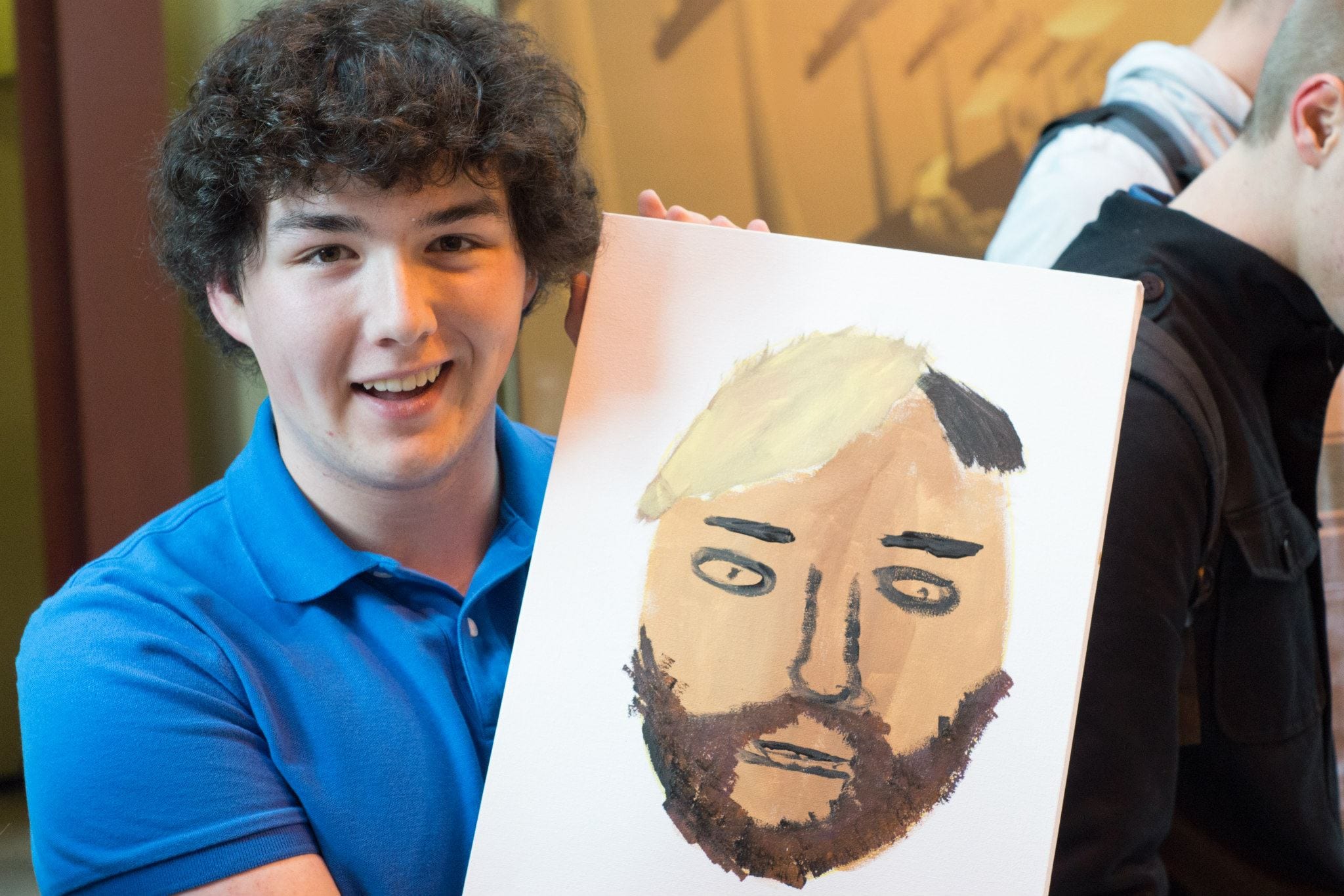
In October 2013, Mind It! partnered with the Canadian Mental Health Association Winnipeg to bring two art therapy-inspired events to students at Red River College.
On two different days, tables in the hallways at the Notre Dame Campus and Exchange District Campus were stocked with blank canvases, paint of every colour, decorating supplies such as glitter and plastic gloves for students who felt like finger painting.
From landscapes to abstract shapes to portraits of pets and people, students spent more than two hours painting whatever they desired and chatting with friends.
Overall, it was a great way to break up the day and help everyone de-stress. After the two events were said and done, 105 blank canvases had been transformed by students, staff and others from the community who stopped by!




There’s good reason the saying, ’laughter is the best medicine’ exists. It’s because the natural link between comedy and mental health is very real. Many people with mental health issues turn their lived experience into positive, inspiring and often comical stories and important lessons for us all. Some even wind up making audiences laugh for a living — including award-winning comedian Big Daddy Tazz who paid a special visit to RRC in February 2013 at the Make Laughs! comedy show.
With a fantastic lineup of local comedians, Big Daddy Tazz as the show’s headliner and Ace Burpee as the emcee, this comedy show at RRC’s Exchange District Campus was an absolute hit! Not only did students have a great time but the event helped to increase mental health awareness on campus through Big Daddy Tazz’s performance that had the audience laughing one minute and emotional the next as he opened up about his personal struggles with Attention Deficit Disorder, Obsessive Compulsive Disorder, depression and suicide.
If you missed the show last year, you may get another chance to laugh it up! Planning is underway for mental health events held on campus during the 2014/15 academic year. Keep checking our events page for updates!
Tips for Everyday Reduction of VOCs
Welcome back. This is our 4th and final post in a series about ways to make the air we breathe at home, healthier. We’ve talked about VOC’s, how they affect our health and begun to consider how to minimize hazardous VOCs in our homes. In this post we offer the following healthier cleaning and personal care product ideas:
The Canadian Partnership for Children’s Health and Environment (CPCHE) tells us
“Some fragrance ingredients, such as phthalates, musk xylene, toluene and others, have been linked to cancer, hormone disruption and other harmful effects….” and goes on to distinguish  between “fragrance free” and “unscented”:
Some products labeled “unscented” contain masking agents to cover the smells of other ingredients. These masking agents are often synthetic fragrances. Fragrance-free products, on the other hand, are likely to be totally free of fragrances. In the absence of fragrance-free products, unscented products are acceptable alternatives.
2. Use plants. NASA1 says, house plants are very effective at removing VOC’s from our indoor air; although to be true to readers; plants may work best under experimental conditions.
3. Have fun, keep it simple & make your own home and personal
  care products. This way you know and control the ingredients and save money. Examples:
– clean the tub/ shower with baking soda.
– Wipe windows and hardwood with vinegar.
The David Suzuki Foundation and Queen of Green share some secrets and recipes for cleaning and Downloadable Green Cleaning Recipes and personal care products.
Summary
 This 4 part series on Volatile Organic Compounds (VOCs) provided definitions of VOCs, identified some sources of VOCs, listed adverse health effects of VOCs, and demonstrated ways to reduce our exposure to VOCs in our homes. We have relied on VOC emitters for years; using them in construction, cleaning and fuel. Recognizing them and finding healthier options for everyday life is a liberating process. Baby steps.
References
1. The Canadian Partnership for Children’s Health and Environment (CPCHE)
1. NASA
3. Healthy Housing: Practical Tips for your Home
4.Previous posts in this Series on VOCs: Thinking of Sprucing up the House?; Indoor air, VOCs and our Health and Reducing VOCs in Your House
Submitted by Health Services
 You’ve taken the plunge; you are working out on a regular basis. You’ve been more faithful to your workout schedule than any girlfriend/boyfriend in the past. You are starting notice some changes and then days become weeks, the scales won’t budge you aren’t seeing any changes in your body and your resolve slowly turns to cookie-dough ice cream. You’re at serious risk of becoming another statistic, one more person fallen prey to the dreaded plateau. Somebody who decides to pack it in, accept life as a couch potato accepting that the only way you’ll ever see your toes again is in mirror.
The human body is a remarkably adaptable instrument. Once it grows accustomed to the initial stimulus of a change in diet and activity level, it may simply submit to the law of diminishing returns, decide to declare a new state of normalcy and effectively put a stop to muscle gain and fat loss.
A plateau has a snowball effect, both mentally and physically. Mentally, you become frustrated, which leads to emotional eating, fatigue and finding excuses not to workout. This either amplifies the plateau or actually causes you to backslide. Physically, if you allow a plateau to negatively impact your mindset, you produce stress, which has many well-documented ill effects on the body, inhibiting the ability to gain muscle and promoting the storage of fat.
Plateaus are essentially a form of maintenance—if you run three days a week for the same amount of time you’ll continue to hold your own in terms of health and fitness, for example, but you won’t move forward.
So what do you do now?
Be successful. Create a vision of where you want to be and stick to it. Set goals, form a plan to attack those goals and consistently take action day after day. Don’t get frustrated if you don’t advance X amount on a certain day; because it’s the long term plan (and results) that matter.
RRC Polytech campuses are located on the lands of the Anishinaabeg, Ininiwak, Anishininwak, Dakota Oyate, and Denésuline, and the National Homeland of the Red River Métis.
We recognize and honour Treaty 3 Territory Shoal Lake 40 First Nation, the source of Winnipeg’s clean drinking water. In addition, we acknowledge Treaty Territories which provide us with access to electricity we use in both our personal and professional lives.