Communications and Marketing

News

Visit the VTC Student Showcase at RRC Polytech and consider a career in heavy vehicle and equipment manufacturing in Manitoba

September 5, 2024

The Vehicle Technology Centre (VTC) is hosting a showcase event at RRC Polytech to connect students and potential employers in Manitoba’s heavy vehicle and equipment (HEV) manufacturing sector.

Representatives from over a dozen companies are eager to show off the massive and powerful products they produce locally and explain the amazing opportunities that exist in developing the technology that supports this 2.4-billion-dollar sector of the provincial economy.       

Learn about multiple potential career paths within the industry that give students the option to pursue working in a wide variety of areas from engineering and manufacturing to business administration and product design.

All students are welcome and encouraged to stop by the Jan den Oudsten Vehicle Technology and Research Centre building throughout the day to check out the displays and heavy machinery and make valuable connections.

  • Get hands-on with Manitoba-made heavy vehicles and equipment 
  • Learn about amazing technology being developed in our province 
  • Meet industry leaders
  • Explore career options in the HEV sector
  • Submit a resume

When:

Thursday, September 12, 2024

9:00 am – 3:00pm

Where:

Jan den Oudsten Vehicle Technology and Research Centre

Building Z – Notre Dame Campus – RRC Polytech

2055 Notre Dame Avenue, Winnipeg, MB R3H 0J9

RRC Polytech’s expanded partnership with DCSP supporting overall downtown safety strategy at the Exchange District Campus 

September 3, 2024

At RRC Polytech, we want everyone working, learning and visiting our campuses to feel and be safe, which is why we have a comprehensive safety strategy in place. At the Exchange District Campus, a vital part of our safety strategy has been leveraging the dedication and great work by our RRC Polytech Security team and collaborating with the Downtown Community Safety Partnership (DCSP). 

The DCSP is a non-profit organization for the purpose of enhancing the safety, health, and wellbeing of all those who live, work, learn and enjoy the downtown. This also includes providing proactive, non-emergency response, outreach, and intervention to those experiencing complex issues in Winnipeg’s downtown. 

Enhancements to our existing partnership include collaborating with additional community groups –   Bear Clan, Centre for Aboriginal Human Resource Development (CARHD), N’dinawemak, and OPK Manitoba – to ensure the right resources are available at the right time. This means that there are additional supports and access to resources for students, staff, visitors as well as community members.  

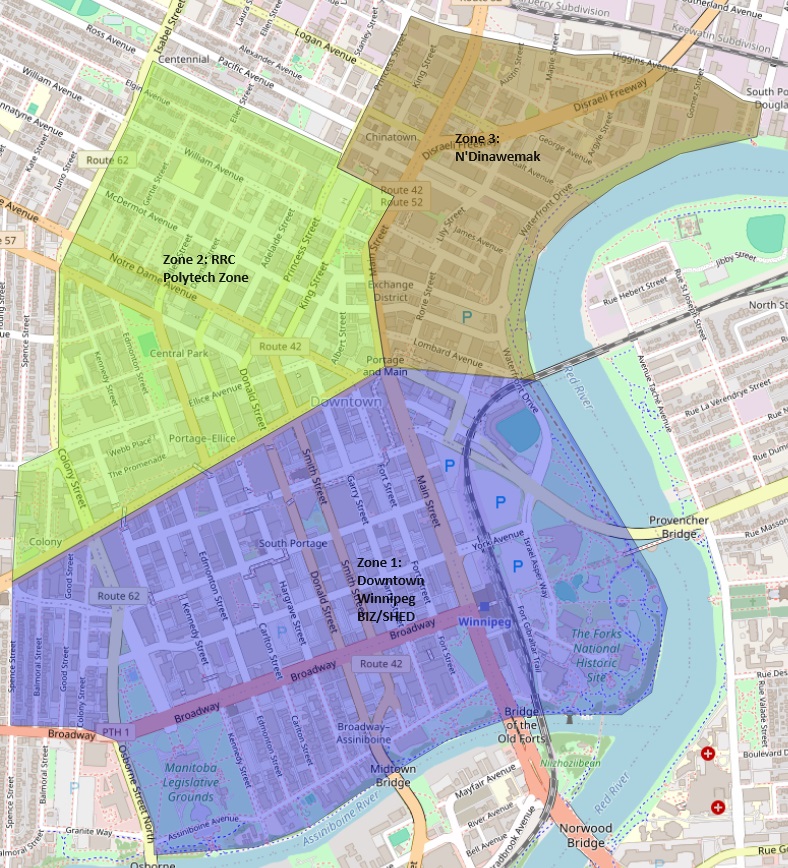
RRC Polytech is a central hub within DCSP’s patrol Zone 2 and therefore a space within the Roblin Centre has been designated for DCSP, community partners and RRC Polytech security personnel to do daily briefings, ensuring emerging safety concerns or issues are addressed in a timely manner. All partners communicate through a shared radio channel, leading to an improved incident response time. 

Map outlining DCSP's three patrol zones in downtown Winnipeg
Pictured: DCSP patrol zones as designated through this summer’s Downtown Safety Action Plan 

Having a dedicated space for DCSP and community patrol partners to be stationed on campus will help ensure members of the community can get the right supports they need, providing the RRC Polytech Security team with more capacity to support the College community – staff, faculty and students. Our Security team will primarily patrol within the three campus buildings – Manitou a bi Bii daziigae, Paterson GlobalFoods Institute and the Roblin Centre – and DCSP alongside community partners will patrol campus grounds and the entirety of Zone 2, supporting within campus buildings as needed. 

RRC Polytech security offices are open 7:00 a.m. to 11:00 p.m. daily, and with the support of DCSP and community partners, EDC campus grounds are patrolled 24-hours a day.  

On the Exchange District Campus and the surrounding area, if you see a DCSP Ambassador nearby, they are here to assist you and everyone who makes up the downtown Winnipeg community. DCSP also hosts regular walks on Wednesdays and are open to anyone and any organization wanting to attend. To sign up for a walk and learn about upcoming events, check their social media channels @WinnipegDCSP. 

While RRC Polytech’s expanded partnership with DCSP is made possible through funding for this summer’s Downtown Safety Action Plan, it will move forward into the beginning of fall. Beyond this time, we will continue to collaborate with DCSP and community organizations to support one another and prioritize the safety of staff, students, visitors on campus. 

As we begin the Fall Term, it’s a good time for a reminder about the safety and security services on campus, and how you can access them.  

Safe Walk and Safe Ride services provide escorts for students, staff and visitors between two points at the Notre Dame Campus or Exchange District Campus, or to a point near the College (including parking lots.)  

To contact the patrol, pick up a Safe Walk or Safe Ride phone located across campus, or call: 

  • Exchange District Campus – 204-949-8305 
    • DCSP can also be called directly at 204-947-3277 or 211 for Safe Walks 
  • Notre Dame Campus – 204-632-2323  

If you witness or are experiencing a safety concern, call or visit Security on campus. RRC Polytech security personnel will address and direct your concern as needed. For example, connecting with the DCSP front line team to provide support to vulnerable community members.  

Bikes to Help International Students Get Around in Steinbach

August 30, 2024

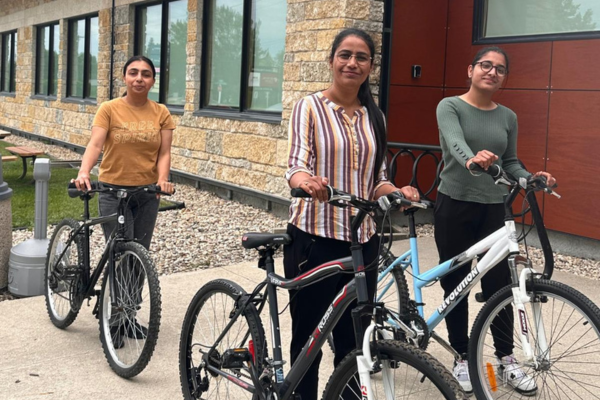
In June, six international students at the Steinbach regional campus were given bicycles to help them travel to and from their work placements over the summer.

Geoff Heath, Environmental Initiatives Coordinator at RRC Polytech, got involved with this project when on a site visit to the Steinbach campus. He heard some of the students could benefit from having access to bikes from Regional Campus Manager, Sheri Stoupe, and Student Success Coach, Syd Shukla-Bergen. Steinbach doesn’t have public transportation and some students’ only means of getting around was walking everywhere they went.

With Geoff’s background as Education Director of The WRENCH in Winnipeg, he knew exactly where to go to get the bikes they needed. The half-dozen used bikes chosen needed a little love, so Geoff, along with another staff member, fixed them up to be ready to ride.

He then brought the bikes out to Steinbach and connected Sheri, Syd, and the students with their local community bike shop, La Bikequerie, to set up a bike maintenance session so the students could learn how to best care for their new-to-them bikes.

The local Canadian Tire also donated helmets and locks to ensure the students could bike safely and keep their bikes secure wherever they go.

The students were excited to receive their bikes – some of them re-learning after not having ridden a bike for many years. One student, Urvashi Sharma, said using the bike has cut down their commute time from 45 minutes by walking to 10-15 minutes by bike to get to their job.

Kim Koop, staff member at RRC Polytech’s Steinbach campus, and a resident of Steinbach, often sees the students riding their bikes. She said, “It is wonderful to see the international students using their bikes to get around.”

As part of the sustainability team at RRC Polytech, Geoff hopes to encourage a “culture of repair” – one where we learn the value of repairing what we have rather than buying new. A new bike can be expensive to buy, but a used one with a few parts to make it work like new is a low monetary cost and a low environmental cost – and is more accessible to many folks who cannot spend hundreds of dollars on a new bike.

“Access to transportation is something that the Sustainability Office advocates for, and in some cases, options can be limited,” said Geoff. “Cycling can be a new option for some that is cost effective and sustainable. Our office is happy to support these choices and connect students and staff with community resources just as we did for these students in Steinbach.”

Sustainability is one of the six values the guides RRC Polytech forward. Learn more about the Sustainability Office and how they can support you in making sustainable choices.

Power has been restored at Notre Dame Campus

August 29, 2024

The Manitoba Hydro power outage impacting RRC Polytech’s Notre Dame Campus has been resolved and power is now restored.

We will move forward with the resumption of all classes as planned at 11:00am.

If you have any questions or concerns about your class, please contact your instructor.

Staff can continue to work with their manager to determine a plan for work for the rest of the day.

We appreciate your patience and understanding as we awaited the restoration of power.

Power Outage at the Notre Dame Campus:

August 29, 2024

Due to a Manitoba Hydro power outage, RRC Polytech’s Notre Dame Campus, morning classes will be cancelled. Manitoba Hydro anticipates power will be back on by 10:30am and we will provide an update at 9:30am to the College community.

We anticipate a resumption of in-person classes beginning again at 11:00am.

The campus remains open and if you are already on Campus, please do not use the elevator at this time. If you need assistance or support, please visit the Security Services team in the C Building.

Staff at NDC should work directly with their Manager to determine work arrangements during the power outage.

All other RRC Polytech Campuses are unaffected by this outage and will maintain regular operations and activities.

RRC Polytech celebrates students completing exclusive micro-credential training for support workers in homeless and family violence shelters across Manitoba

August 22, 2024

For immediate release: August 22, 2024

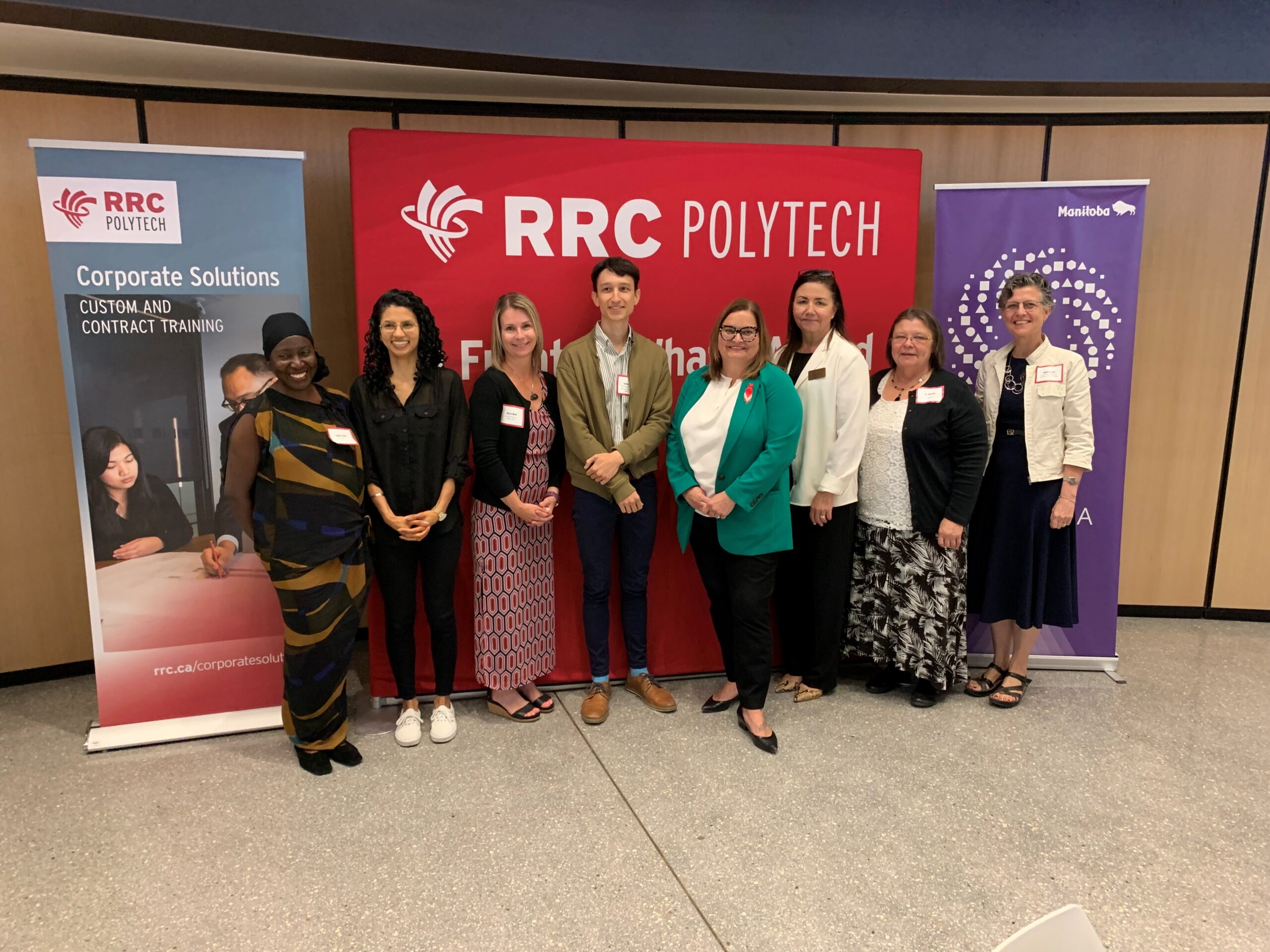
Winnipeg, Manitoba on Treaty No. 1 Territory and the National Homeland of the Red River Métis – On August 22, 2024, RRC Polytech is hosting a special celebration to recognize the latest cohort of students to earn a Shelter Support Worker micro-credential.

RRC Polytech’s Shelter Support Worker micro-credential program was designed with industry partners to address skill gaps, meet community needs, and improve staffing levels and delivery service in homeless and family violence shelters across the province.
 
The Shelter Support Worker micro-credential program is the first of its kind in Manitoba, and the result of a collaborative effort between the Manitoba Association of Women’s Shelters (MAWS) and RRC Polytech. It is supported by Women and Gender Equity Manitoba (WAGE).

The Honourable Nahanni Fontaine, Minister of Families and Minister responsible for Women and Gender Equity Manitoba will be among the speakers during the podium presentations and photo-op. Light refreshments will be served.
 
Date:
Thursday, August 22, 2024
 
Time:
1:00 pm – 3:00 pm
 
Location: 
Manitou a bi Bii daziigae
319 Elgin Avenue
Roundhouse Auditorium
RRC Polytech Exchange District Campus
 
Agenda:
Podium Presentation/Student Testimonials/Photo-op
 
Speakers:

  • The Honourable Nahanni Fontaine, Minister of Families and Minister responsible for Women and Gender Equity Manitoba
  • Jill Latschislaw, Director, Business Development, Corporate Solutions, Indigenous Strategy, Research and Business Development, RRC Polytech
  • Tsungai (Sue) Muvingi, Associate Provincial Coordinator, Manitoba Association of Women’s Shelters (MAWS) 
  • Nadine Smith, Acting Executive Director, Women and Gender Equity Manitoba
  • Nadine Powell, Instructor, RRC Polytech
  • Abhijot Kaur Chohan, Student
  • Adigun Ifeoluwa, Student
  • Lindsay Monkman, Student

Update on West Zone Parking at NDC

August 22, 2024

Over the summer, the Facility Management team made important repairs and updates to the West Zone parking lot at the Notre Dame Campus. While this project is nearly complete, we want to provide an update on what to expect when arriving on Campus for the first few weeks of the academic term while we complete this important work for the RRC Polytech parking community who uses the West zone.

Beginning on Monday, August 26, the West Zone Entrance 4 (Notre Dame Avenue/Lorimer Lane) will remain temporarily closed for repairs until September 3, 2024.

Entering West Lots:

During this period, a temporary gravel roadway and access ramp (East of Lorimer Lane) will be established, serving as an inbound one-way access point to the West parking lots. Barriers will be placed along sidewalks and pathways to alert pedestrians of the change in vehicle traffic location, and a flag person will be stationed at the entrance throughout the week.

Exiting West Lots:

Exits from the College will be routed through the northeast corner of Didcote Drive or Buhr Blvd.

Facility Management will install large signs at entrance and exit points to guide parkers accessing and exiting the West Lots.

Map indicating the flow of traffic for the West Lots at the Notre Dame Campus.

View PDF map of alternate access and exit routes.

We appreciate your patience and understanding as we complete these repairs to the West Zone.

Please take care when entering and exiting campus, adhere to all signage and barriers, and drive cautiously as everyone navigates these temporary changes. If you have any questions or concerns, please contact facilitymanagement@rrc.ca.

Lake Manitoba First Nation Expands Health Care Services

August 8, 2024

Newly trained staff who recently completed the in-community phlebotomy (blood-drawing) training program are now employed at the health centre lab which will be open permanently to provide essential health services within Lake Manitoba First Nation.

The in-community phlebotomy training was customized for students in Lake Manitoba First Nation and included online delivery and in-person skills labs and clinical placement. It was delivered in partnership with SCO, Lake Manitoba First Nation, RRC Polytech, Manitoba Shared Health, Manitoba Health, Seniors and Long-Term Care, and the Interlake Eastern Regional Health Authority.

“The hard work and dedication of these students not only results in enhanced healthcare services for Lake Manitoba First Nation, but their success also demonstrates to other communities across the province that RRC Polytech is eager to listen, collaborate and co-design customized training solutions that remove barriers for Indigenous learners,” said Jamie Wilson, Vice President, Indigenous Strategy, Research and Business Development. “We look forward to building our relationship with Southern Chiefs’ Organization and exploring other opportunities that will help to empower all communities through education.”

For the full press release, visit The Southern Chiefs’ Organization’s website.

Governments of Canada and Manitoba announce $350,000 towards continued support for RRC Polytech’s Shelter Support Worker micro-credential

July 23, 2024

Yesterday, the federal and provincial government announced over $12 million in combined funding towards community initiatives and organizations working to end gender-based violence. RRC Polytech’s Shelter Support Worker micro-credential will receive $350,000 to continue to offer this important tuition-free program – one of 19 organizations in Manitoba to receive support.

The announcement was held at RRC Polytech’s Manitou a bi Bii daziigae where the Honourable Marci Ien, Women and Gender Equality and Youth Minister for the Government of Canada and the Honourable Nahanni Fontaine, minister responsible for women and gender equity announced a combined $6.2 million in federal funding with $6.35 million from Manitoba through Year Two of the National Action Plan to End Gender-Based Violence.

“We are honoured to be a part of this announcement and receive support for our tuition-free shelter support worker micro-credential,” said Christine Watson, vice-president academic, Red River College Polytechnic at the announcement. “This training prepares current and future shelter workers to support those in need of refuge from difficult and sometimes dangerous situations. RRC Polytech is proud to be a partner in creating a safer Manitoba for all.”

RRC Polytech’s Shelter Support Worker micro-credential program is the first of its kind in Manitoba and was designed with industry partners to address skill gaps, meet community needs and improve staffing levels and delivery service in homeless and family violence shelters across the province.

Last year, RRC Polytech celebrated its first cohort of 23 students successfully completing the program and next month will host a ceremony for an additional 19 who will complete the second cohort.

The Shelter Support Worker micro-credential was developed in partnership with RRC Polytech and Manitoba Association of Women’s Shelters (MAWS) and Manitoba’s family violence and homeless shelters. The program aims to provide essential skills and knowledge for individuals involved in or aspiring to work in homeless and family and gender-based violence shelters.

The program trains existing and potential workers, provides individuals with specific knowledge and education and improves staffing levels and service delivery. It also provides individuals a chance to apply their knowledge through a practicum.

The bilateral funding agreement is part of the second year of a comprehensive 10-year National Action Plan to End Gender-Based Violence which aims to create a Canada free of GBV and provide support to victims, survivors and their families across the country.

Supported initiatives – like the Shelter Support Worker micro-credential – align with five pillars: supports for survivors and their families; prevention; responsive justice system; implementing Indigenous-led approaches; and social infrastructure and enabling environment.

“To work towards a future free from gender-based violence, our government is supporting community-driven actions in Manitoba,” said the Honourable Marci Ien in a joint press release. “By investing over $6.2 million in 2024-25, we are empowering Manitoban organizations to lead the way forward in preventing and addressing gender-based violence. Together with the Manitoba government, we are implementing the National Action Plan to End Gender-based Violence to ensure safety, support and justice for all.”

“We need to put a stop to gender-based violence in our homes and communities, and make sure survivors have the supports they need,” said the Honourable Nahanni Fontaine in a joint press release. “We are taking action to ensure there are more supports for survivors of sexual assault and domestic violence, working with communities to break cycles of violence, and supporting Indigenous-led and community-informed approaches to address gender-based violence across Manitoba.”

To learn more about the Shelter Support Worker micro-credential, visit rrc.ca

RRC Polytech’s Mobile Training Lab helping to build skillsets, structures and relationships in Shoal Lake 40 First Nation

July 23, 2024

Partnership brings fully funded construction trades training into community to strengthen local workforce and remove barriers for Indigenous learners

Winnipeg, MB on Treaty No. 1 Territory and the National Homeland of the Red River Métis – RRC Polytech is utilizing a mobile facility in community to deliver fully funded construction trades training to Shoal Lake 40 citizens this summer in a growing partnership with Shoal Lake 40 First Nation and Niiwin Wendaanimok, a Kenora-based Indigenous training organization. This collaborative effort aims to strengthen the local workforce and help shrink labour gaps as Shoal Lake 40 navigates record growth featuring numerous new building projects including a water extension project.

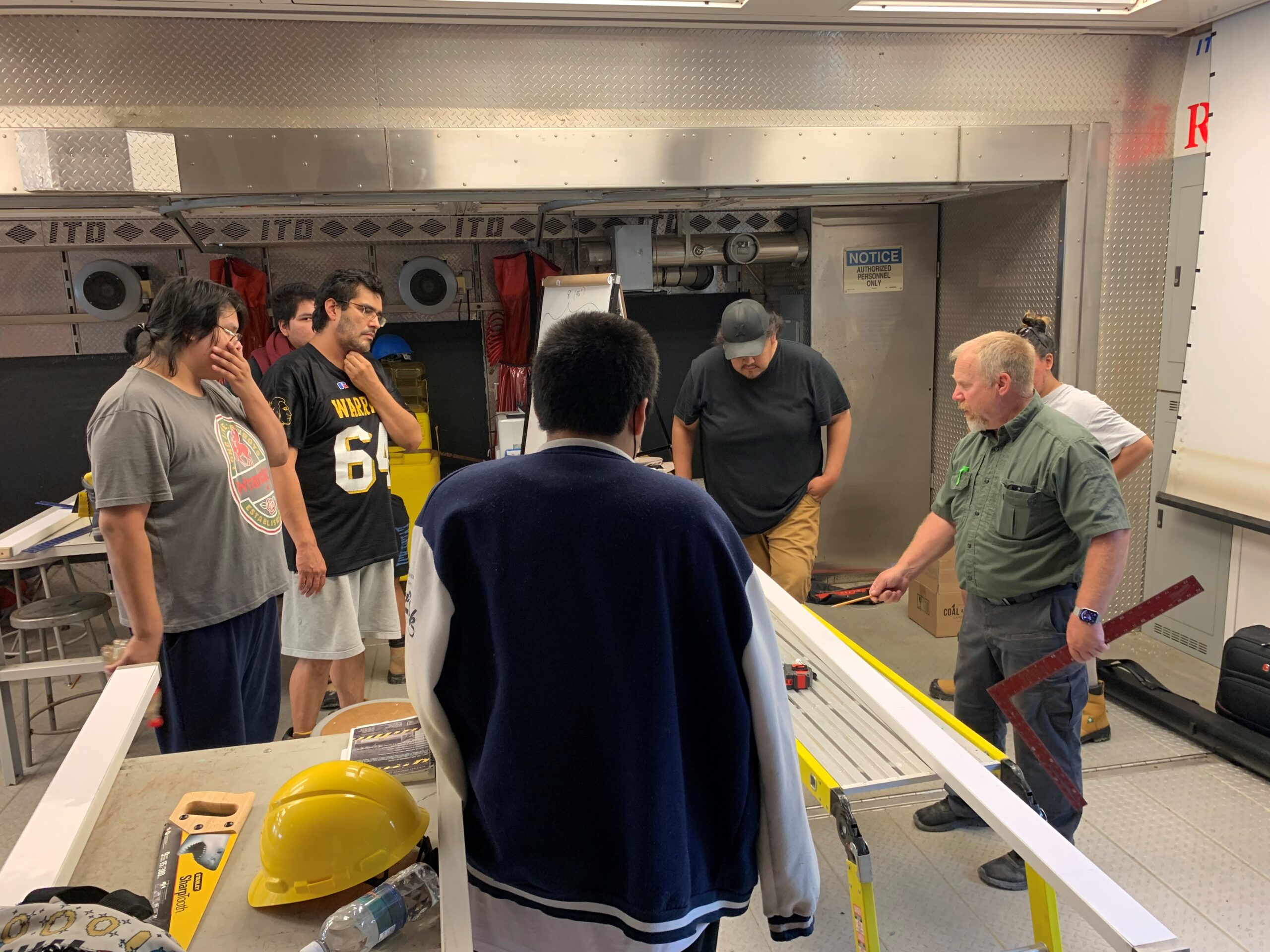
It’s the first time that RRC Polytech has deployed a mobile training lab (MTL) to Shoal Lake 40.  A dozen eager learners are taking advantage of the opportunity to learn about the tools and equipment, basic measurements and safety standards that will qualify them to seek immediate work as part of a construction crew, in community or beyond.

“One of the greatest barriers that many Indigenous learners face is access to education without being displaced from their support systems,” says Jamie Wilson, Vice President of Indigenous Strategy, Research and Business Development at RRC Polytech.

“RRC Polytech’s mobile training labs and our ability to customize course material with micro-credentials ensures that students can stay close to home and connected to family and tradition throughout their academic journey as they acquire new skills to make a positive impact in their communities.”

mobile training lab and education building in Shoal Lake 40

The project is being fully funded by Niiwin Wendaanimok via the Skills Development Fund offered through the Ministry of Labour, Immigration, Training and Skills Development (MLITSD). The Niiwin Wendaanimok (Four Winds) Partnership is an Indigenous owned and operated corporation dedicated to providing construction, contracting and environmental monitoring services in Treaty 3 territory with a mandate to employ Anishinaabe workers and assets in development projects and ensure Anishinaabe laws and voices are respected.

“At Niiwin Wendaanimok, our mission is to rebuild the economies of our four partner First Nations while following Manito Aki Inakonigaawin (MAI), the Great Earth Law of the Anishinaabeg. This journey begins with providing comprehensive training programs to our people,” says George Kakeway, Chairman of the Board, Niiwin Wendaanimok.

“The RRC Polytech training program in Shoal Lake 40 exemplifies our commitment, equipping members with the skills they need to meaningfully participate in projects in the community and beyond, including the vital highway twinning project. Through these partnerships, we hope to build a sustainable future for our people, where honouring tradition and progress walk side by side.”

Shoal Lake 40 has over a dozen new home builds underway as well as a number of larger commercial builds on the horizon so there is a local need for general labourers in construction.

“Training local community members in our community is vitally important to our collective strength and pride,” says Chief Kevin Redsky, Shoal Lake 40 First Nation. “Shoal Lake 40 First Nation is catching up from 100 years of isolation since the completion of Freedom Road in 2019 and we are very happy that our local community members are gaining the skills needed from the Red River College Polytechnic Mobile Training Lab to help rebuild our Nation.” 

Students began their initial 13-week learning journey earning micro-credentials in safety standards and awareness, tool and equipment use and care, and construction-related measurement and math. They are currently being introduced to the concepts and techniques of basic plumbing and piping and recently completed a two-week course on wood framing that led to the construction of ice fishing shacks that will be shared with the community.

two ice fishing shacks built by students

On Monday, they even got a chance to show off their work and share their experiences with a tour of special guests including His Worship, Scott Gillingham, Mayor of the City of Winnipeg and the Honourable Ian Bushie, Minister of Municipal and Northern Relations, who were in community for an annual meeting.

“The ice fishing shack is looking pretty good, so I’m proud of everyone’s work and how much they’ve learned,” said student, Rowen Sky, who is currently working as a framer for a company based in Richer, MB. He’s using the training as, “a good refresher that gives me more time with our young family.”

“We’ve always built things ourselves, but now we’ll know how to build them right so things around here will last longer and be safer for our kids,” added his partner and fellow student, Kendra Green.

The program gives students flexibility in their learning with entry and exit points that can lead directly to employment opportunities in their own community. Students also get a chance to become more comfortable in their new roles by touring current job sites and meeting with sub-contractors and potential employers.

“In addition to building new physical structures and stronger communities, these students are also learning to build relationships that can help them to achieve their goals and dreams while becoming positive role models within their community,” says Wilson. “We look forward to continuing to grow this partnership with Shoal Lake 40 and are committed to supporting all Indigenous communities across Manitoba.”     

RRC Polytech has previously supported youth entrepreneurs from Harvey Redsky Memorial School in launching a for-profit business that will generate revenue and bring attention to Shoal Lake 40 First Nation’s legacy from tragedy to opportunity in their generation.

RRC Polytech purchased decals designed by the student-entrepreneurs through a Future Business Leaders Project that will be placed near re-fillable bottle stations on campus. The decals provide information about Shoal Lake 40 providing clean drinking water to City of Winnipeg residents and promote our shared and sacred responsibility to protect the environment. (Learn more)

About Mobile Training Labs (MTLs):

The MTLs are 53-foot-long semi-trailers with slide-out sides that can quickly transform into 950 square feet of vocational training space bringing a classroom, any necessary equipment and professional instruction directly into rural communities.

About micro-credentials:

Micro-credentials are shareable endorsements of knowledge, skills or competencies gained through the completion of a course, a module or demonstration of understanding and are often represented by digital badges. They can also be stacked as learners build their knowledge base and this allows course content to be adapted to meet the specific needs of the students and the community.

saw in front of mobile training facility

RRC Polytech campuses are located on the lands of the Anishinaabeg, Ininiwak, Anishininwak, Dakota Oyate, and Denésuline, and the National Homeland of the Red River Métis.

We recognize and honour Treaty 3 Territory Shoal Lake 40 First Nation, the source of Winnipeg’s clean drinking water. In addition, we acknowledge Treaty Territories which provide us with access to electricity we use in both our personal and professional lives.