Research Partnerships and Innovation

Research Partnerships & Innovation

Success Stories

RPI’s 20 Stories for 20 Years – Lab to Market Funding

January 17, 2025


RPI 20th anniversary logo

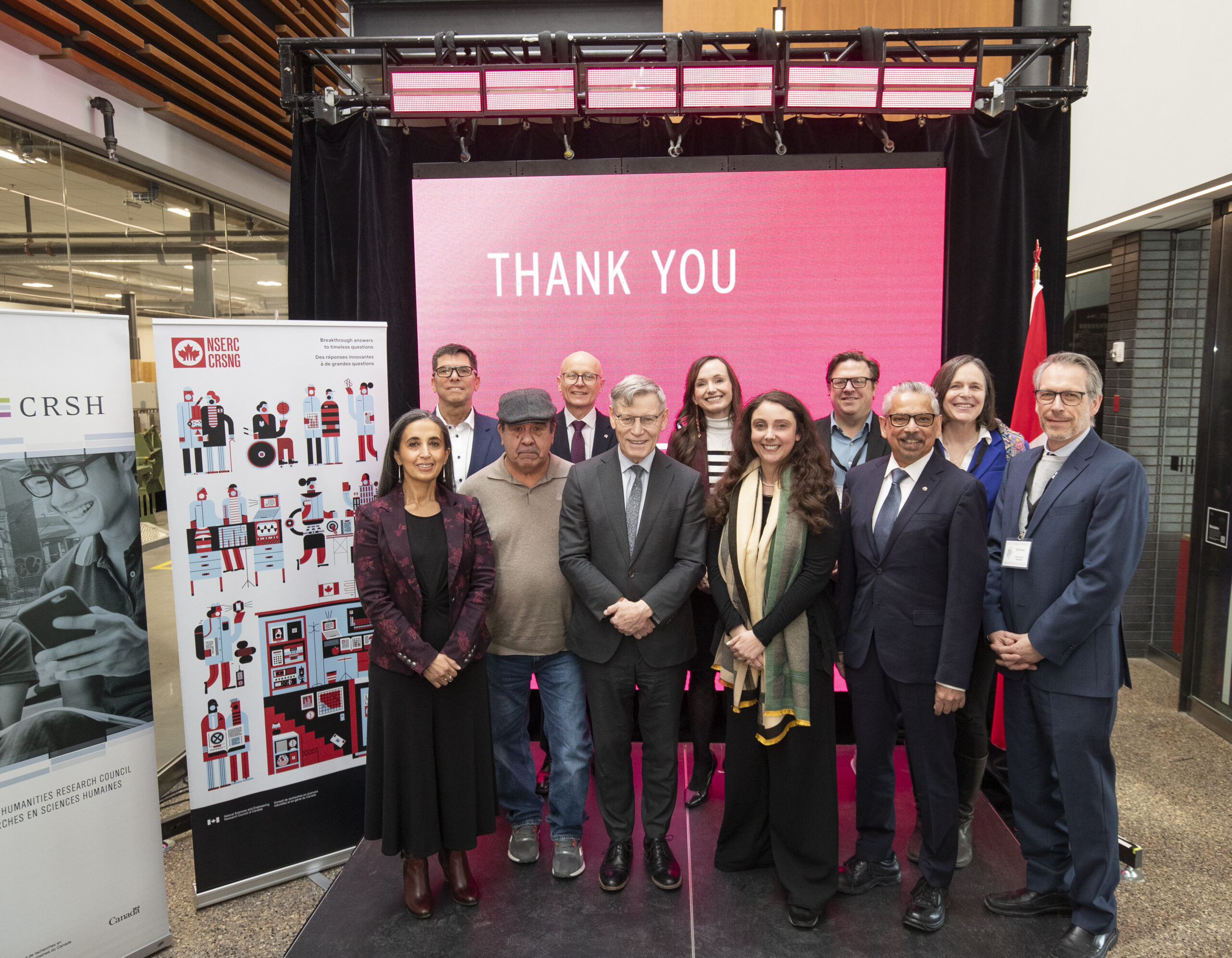
On January 15, 2025, the Government of Canada announced that RRC Polytech has been chosen to lead a national network of post-secondary institutions and collaborative partners to bring more academic research ideas to reality, support Indigenous business and drive economic growth.

As part of a national innovation strategy to increase entrepreneurship and research commercialization across Canada, the College has been awarded $24.1 million in federal funding over five years through a Lab to Market grant — becoming one of four network leaders to share in a total investment of $95.3 million.

Administered by the Natural Sciences and Engineering Research Council of Canada (NSERC), in collaboration with the Canadian Institutes of Health Research (CIHR) and the Social Sciences and Humanities Research Council (SSHRC), this is the largest tri-council grant ever awarded to or led by a college in Canada.

“For over 20 years, RRC Polytech has been solving industry problems and training tomorrow’s future leaders through applied research, and today we are honoured to continue to build on our strengths as a polytechnic and lead this collaborative, nation-wide network through the largest ever tri-council investment in a college,” said Fred Meier, RRC Polytech’s President and CEO.

“Our shared goal is to find solutions for the challenges that all Canadians are facing. This network combines the unique abilities of researchers at colleges and universities and connects them directly with industry and community to accelerate innovation.”

The College-University Lab to Market Network for Entrepreneurship and Research Commercialization spans eight regional hubs from B.C. to Nova Scotia and brings together 38 post-secondary institutions, along with other collaborators — including RRC Polytech’s Mittohnee Pogo’ohtah, one of three Indigenous hubs.

The support of Indigenous business growth is a foundational objective. Tailoring mentorship and resources to support Indigenous entrepreneurs while ensuring all research respects the principles of OCAP® (Ownership, Control, Access and Possession) is a shared goal that differentiates this network from other proposals that were considered.

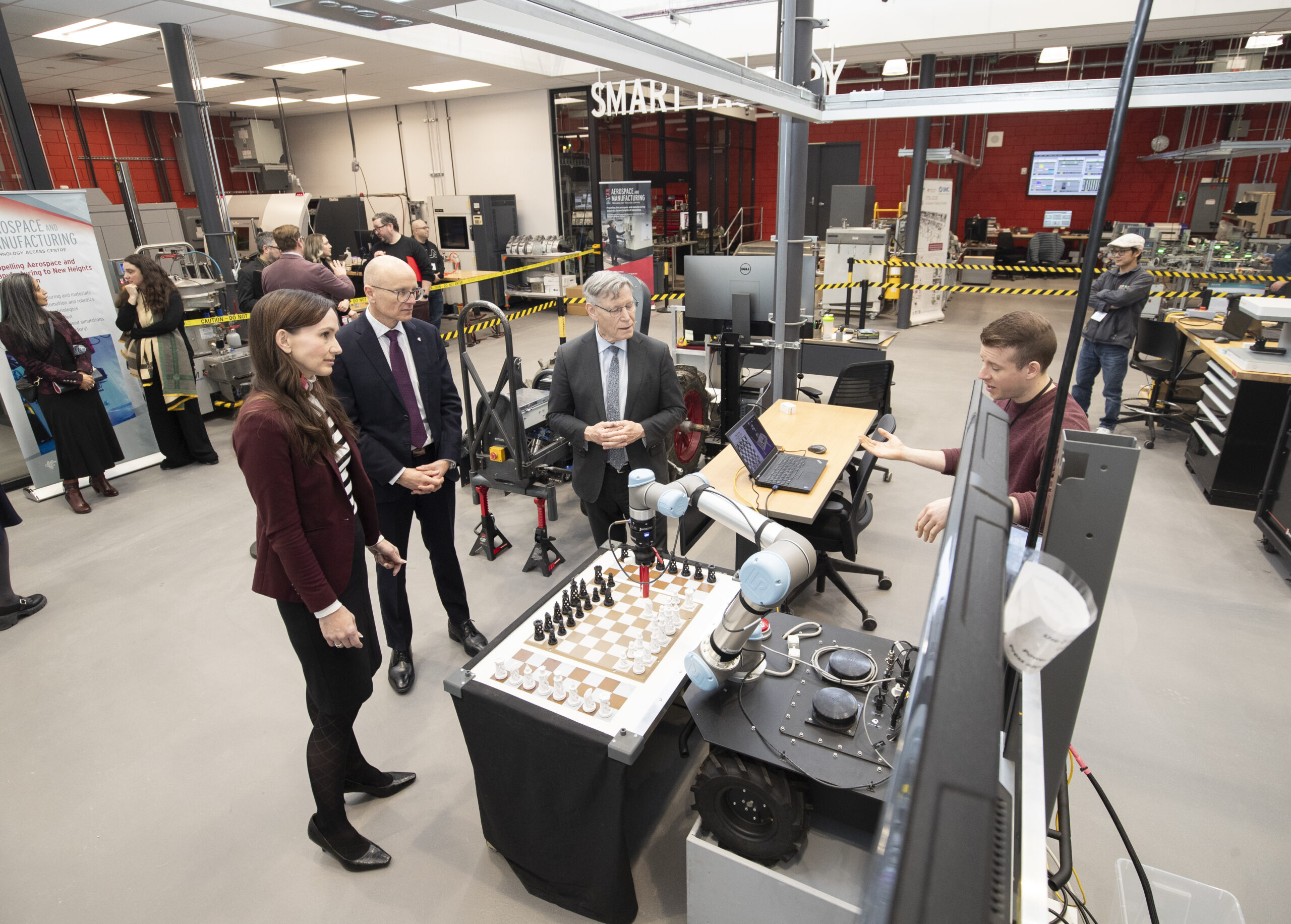
Group of men and women observing a robotics-controlled chess game.

Another unique element is including both colleges and universities, as they traditionally take a different approach to research. The network is designed to maximize the strengths of all contributors.

“Canada is home to world-class researchers, who generate ground-breaking technologies and innovations, and they need support to successfully commercialize their work,” said the Hon. François-Philippe Champagne, Minister of Innovation, Science and Industry. “Through these networks, researchers will receive the support they need to bring their innovations to market, benefiting communities from coast to coast to coast.”

Canadian researchers continually make discoveries with extraordinary potential across all sectors of the economy and society, but additional guidance and support is required for their ideas to become the next great products and processes.

The infrastructure and expertise in industry-facing applied research found at Canada’s colleges and polytechnic institutions is critical for translating university-led academic research into innovation for the market and community users.

“This investment is a significant step in supporting Canadian researchers by giving them the tools, resources and support they need to turn their ideas into real-world solutions,” said the Hon. Terry Duguid, Minister of Sports and Minister responsible for Prairies Economic Development Canada, who was at RRC Polytech’s Notre Dame Campus to make the announcement.

“By connecting academic research with industry, we are helping to create new opportunities for innovation and economic growth across Canada.”

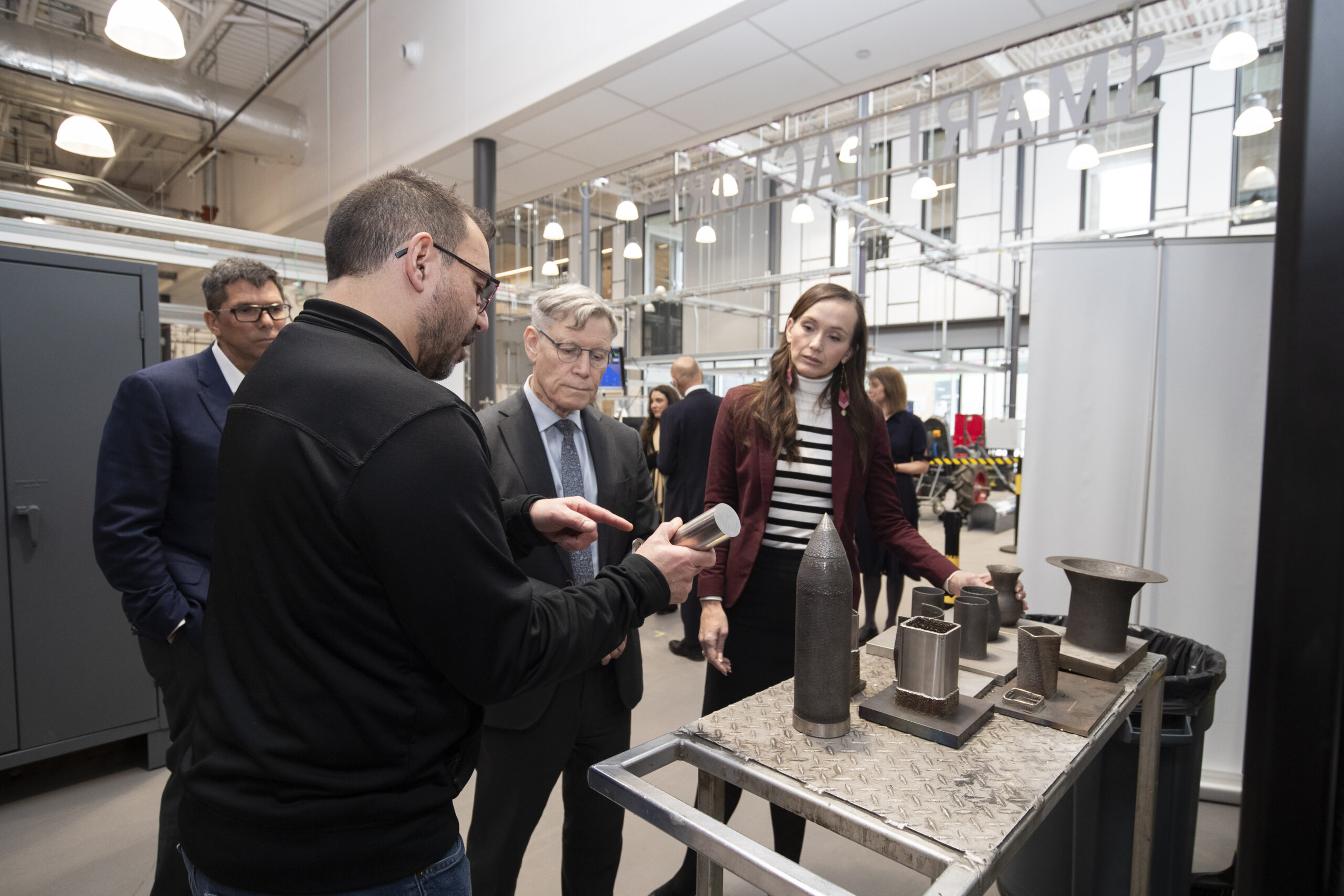
Visitors touring RRC Polytech's manufacturing lab.

The new network will provide researchers with what they need to transfer scientific, social and service innovation to market or to community users. This support includes the sharing of best practices, digital resources to enhance awareness and knowledge of commercialization processes, mentorship and business coaching, financial assistance and access to an established Canada-wide network of Technology Access Centres.

RRC Polytech’s strong reputation for collaboration, central location and commitment to deepening partnerships and Truth and Reconciliation made it a natural fit to lead the network — another first, considering its size and scope.

“The college, university, community and industry partners in this initiative are the links in a chain of innovation and entrepreneurialism,” said Dr. Jolen Galaugher, RRC Polytech’s Executive Director, Research Partnerships and Innovation.

“By working together to ramp up productivity through the commercialization of Canadian research and IP, we’ll enhance our global competitiveness and positively affect all aspects of life for Canadians — economic, social or environmental.”

The Lab to Market initiative provides stable, long-term funding for all disciplines within the natural sciences, engineering, the social sciences, the humanities and health. RRC Polytech will immediately begin building capacity to lead its network of participants dedicated to fostering an entrepreneurial ecosystem that accelerates the economic and societal impact of Canadian research.

“Lab to Market grants bridge the gap between research ideas and their translation into economic and social innovation,” said NSERC President Alejandro Adem. “I can’t wait to see the results that will emerge from this new initiative.”

Co-applicant institutions:

British Columbia Institute of Technology, Cégep de Sherbrooke, Cégep de Thetford, College of the North Atlantic, Humber Polytechnic, Lethbridge College, Loyalist College of Applied Arts and Technology, MacEwan University, Mohawk College of Applied Arts and Technology, Mount Saint Vincent University, New Brunswick Community College, NorQuest College, Northern Alberta Institute of Technology, Northwestern Polytechnic, Nova Scotia Community College, Olds College, Red Deer Polytechnic, Saint Mary’s University, Saskatchewan Indian Institute of Technologies, Saskatchewan Polytechnic, Selkirk College, Southern Alberta Institute of Technology, University College of the North, University of Alberta, University of Lethbridge, University of Manitoba, University of Regina, University of Saskatchewan, United College – University of Waterloo, Western University, Yukon University 

Collaborating partners:  

MTA, NorthForge, Mitacs, Polytechnics Canada, Tech Access Canada, C2R2, Applied Pharmaceuticals Innovation, Edmonton Regional Innovation Network, CARIN, Calgary Innovation Coalition, Innovation Saskatchewan, Cultivator powered by Conexus, Synchronex, Axelys, Springboard Atlantic, Atlantic Colleges Atlantique

RPI’s 20 Stories for 20 Years – Pandemic Response

January 16, 2025


RPI 20th anniversary logo

This week marks the fifth anniversary of the World Health Organization’s declaration of a global pandemic and the onset of Canada’s unprecedented precautionary policies to stop the spread of COVID-19. While the social and economic impacts of the pandemic still linger, life for most people has returned to normal because of the ongoing co-operative efforts made around the world to control the virus.

During the global fight against COVID-19, RRC Polytech proudly demonstrated its trademark agility and willingness to help by leaping into action to support its industry partners in the healthcare sector. With supply chains decimated by restrictions, the College’s Technology Access Centre for Aerospace & Manufacturing (TACAM) offered its assets and expertise to local partners like CancerCare Manitoba to aid in the production of much-needed medical equipment.

Under normal circumstances, CancerCare Manitoba is well-resourced to manufacture its own equipment, but increased needs combined with a short timeframe during the pandemic forced them to outsource immediate production of wheelbases for more IV poles.

TACAM’s digital manufacturing capabilities allowed for large-scale and rapid production of the unique items needed. TACAM supported the production of 100 new wheelbases for the poles. Specifically, the team manufactured 500 castor mounts for the wheelbases, which require 5 castor mounts per wheelbase.

“CancerCare Manitoba appreciates the ability of RRC Polytech to support us in the manufacturing of these components,” said Keith Sutherland, Business and Innovation Officer at CancerCare Manitoba at the time. “TACAM’s specialized machinery allows for quicker manufacturing, which allows us to get the required IV poles into the hands of hospital staff much quicker than if we had to manufacture them on our own.”

Throughout the pandemic, TACAM remained on call with Health Canada as a potential supplier of services should they need help in manufacturing other medical equipment and/or devices, as well as the National Research Council Canada (NRC), in case additional support for medical equipment and devices was required.

“Our professional research teams are experts in fostering collaboration to overcome challenges, so they are well-prepared to react quickly and leverage the College’s facilities and talent to support our partners, even in a crisis situation like a global pandemic,” said Dr. Jolen Galaugher, Executive Director, Research Partnerships & Innovation at RRC Polytech. “We are eager to continue building these important relationships and working closely with industry and community to address Manitoba’s needs by solving problems through applied research.”

RRC Polytech continues to build capacity for innovative processes such as additive manufacturing, 3D printing, and reverse engineering with the recent addition of the Centre for Automation and Manufacturing Technology Transfer (CAMTT) at the Price Institute of Advanced Manufacturing and Mechatronics.

RPI’s 20 Stories for 20 Years – Irrigation Wheel

January 10, 2025


RPI 20th anniversary logo

Not many companies can say they literally reinvented the wheel, but RAIN Irrigation (previously Cascade Manufacturing) worked with RRC Polytech’s Technology Access Centre for Aerospace and Manufacturing (TACAM) to be able to make that claim.

The typical agricultural irrigation system has steel rims and air-filled rubber tires that eventually lose pressure or go flat, leading to repair downtime and maintenance issues. RAIN’s all-steel bolted wheel for irrigation systems is low-maintenance by design.

“The improved irrigation wheel enhances equipment reliability and efficiency, directly benefiting Manitoba’s farming community,” says Ryan Cummine, Research Manager, TACAM.

Matt Waldner, CEO of RAIN, started working on the prototype for the bolted wheel in 2018 but eventually encountered issues with the steel cracking. RAIN partnered with TACAM to review the design and identify the causes of failure. 

“We support local industries by providing access to high-level technical capabilities that smaller companies might not have in-house,” says Cummine. “This project showcases how TACAM customizes its research and development services to address specific industry challenges, bridging the gap between theoretical solutions and practical applications.”

With 3D CAD files provided by RAIN, TACAM used 3D modelling and finite element analysis (FEA) to evaluate the stresses throughout the wheel. By testing solutions virtually, TACAM significantly reduced the development time and costs. 

“With TACAM’s expertise on how to minimize stress concentration points, we were able to produce a bolted wheel with thinner grade material than we thought possible,” said Waldner. “The FEA study they conducted determined that the stresses were within tolerance, which gave us the confidence to manufacture and test the product in field conditions.”

RAIN used TACAM’s recommendations to redesign the wheel. The original bolted wheel failed under 10,000 load cycles; after the redesign, it is expected to last over 200,000. In 2023, RAIN start manufacturing and selling the product to local and international customers.

RPI’s 20 Stories for 20 Years – Prairie Fava

December 30, 2024


RPI 20th anniversary logo

Prairie Fava and RRC Polytech’s Prairie Research Kitchen (PRK) are a dynamic applied research duo. So much so that in 2020, PRK won the Canadian Association of Research Administrators’ (CARA) Research Partnership Award for its ongoing work with Prairie Fava.

“PRK, and in particular, Mavis McRae, have assisted us since I brought in one of my first bags of beans for assessment and product development support in 2016,” says Hailey Jeffries, President of Prairie Fava, ​​Canada’s leading grower and ingredient supplier of fava beans. 

“PRK has played a role in so many stages of our growth and is an invaluable resource for Canada’s plant-based food industry.”

​​Hailey Jeffries founded Prairie Fava after searching for alternative protein sources for her mother, who was undergoing cancer treatment. She knew fava flour could enhance fibre and protein content in a wide range of recipes, but the market was limited in 2016, and so was Prairie Fava’s capacity for culinary research and recipe development. 

prairie fava logo with flour

At the time, PRK was still the Culinary Research & Innovation program (CRI). The program’s goal was to help food manufacturers better access the Manitoba food service industry, and Prairie Fava was the perfect candidate. 

So PRK started developing recipes for Prairie Fava that built on the fava bean’s greatest strengths while addressing the absence of gluten, which is typically essential for dough structure and teaching culinary students food science skills. Together, they’ve done extensive recipe development to prove that fava flour products can enhance the nutritional profile of existing food formulations and be used to develop new products, like plant-based fava bean spread. 

“Having input from an applied research team provided me with valuable insights and direction that could only come from a place where culinary and food sciences are combined,” says Jeffries. 

Both parties have grown immensely over the course of the partnership. In 2019, the CRI program received a game changing Technology Access Centre (TAC) grant, the Culinary Research Innovation Suite opened and all of the programs and the new facility were pulled together under one name: Prairie Research Kitchen. The same year, Prairie Fava won the Start-Up of the Year Award at the Manitoba Chambers of Commerce Business Awards.

Outside of recipe development and optimization, PRK does plenty of other research to support Prairie Fava. Most notably, in 2022, the PRK pioneered a unique processing method that led to the creation of the first commercialized allergen-free fava tofu.

“Prairie Fava has been a great partner of ours since the beginning. Working with them has showcased our ability to bring a chef’s experience and perspective to applied research,” says Mavis McRae, Director of the Prairie Research Kitchen. “We’re grateful for their support, and thankful to have grown alongside each other over the years.”

RPI’s 20 Stories for 20 Years – Cold Spray Technology

December 13, 2024


RPI 20th anniversary logo

Manitoba’s aerospace industry faced a maintenance, repair and overhaul (MRO) challenge: repairing aircraft components made from alloys highly susceptible to degradation and oxidization. These materials are lightweight but costly to maintain and repair—until now.

A collaboration between StandardAero and RRC Polytech’s Technology Access Centre for Aerospace and Manufacturing (TACAM) proved that cold spray technology can provide an innovative solution that meets the Original Equipment Manufacturing (OEM) standards.

“I was very appreciative of the work that RRC Polytech performed on this project and pleased with the collaboration between the two technical teams to produce an output we’ll hopefully be able to use for years to come,” says Brent Ostermann, Vice President of Product Assurance and Quality at Standard Aero. “[Cold spray] is going to help us advance our business, technology and capability in the future.” 

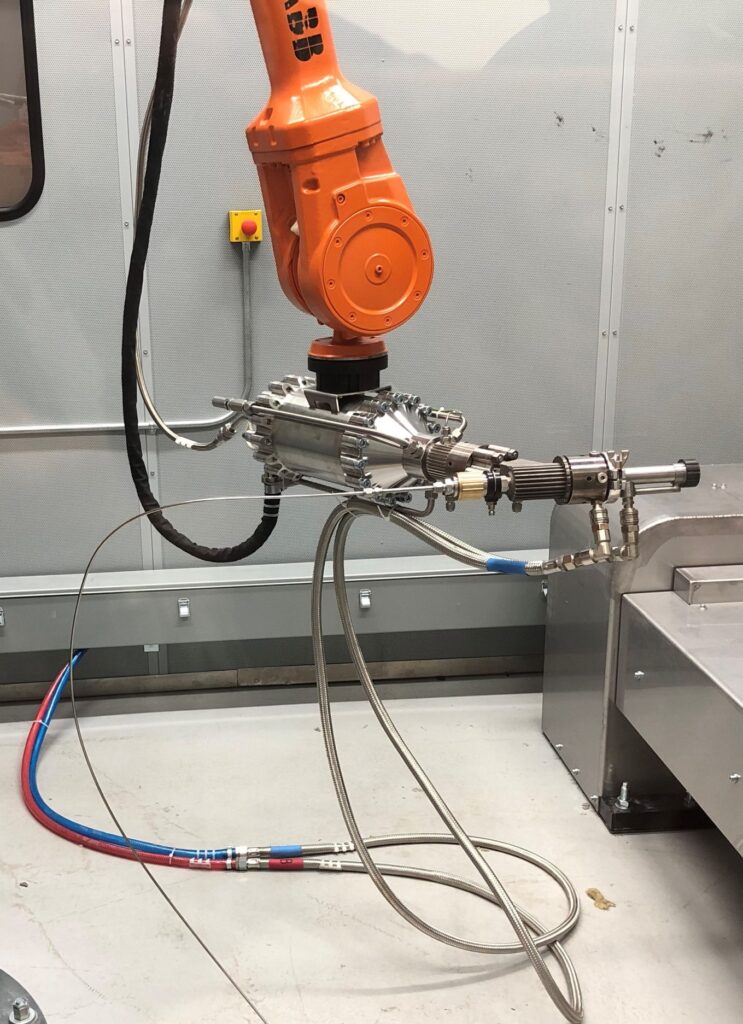
Cold spray is an additive manufacturing process where metal particles half the thickness of a strand of hair move at 23 times the speed of sound, impacting to a surface to form a bond. Light alloys are highly reactive so they can’t be repaired using traditional methods like welding, but they can be repaired using cold spray because the process occurs at a very low heat.

StandardAero worked with RRC Polytech researchers, faculty and students to identify which alloys had the best bonding properties and prove the technology’s capacity to repair those materials.

“Now that we have the proof of concept on specific materials, we’ll look at the data and identify some candidates from all the products we service…Sometime in 2025, we’ll start applying the technology to those products,” says Ostermann. “We believe this project has positioned us to be right there with the demands of the OEMs as they need new and advanced repair technologies to support their products.”

TACAM’s strong presence in the aerospace sector, experience with cold spray technology from ongoing projects and long-standing relationship with StandardAero made the Centre an ideal partner. 

“We were a bit challenged on having some of the internal expertise,” says Ostermann. “The collaboration gave us the bandwidth to get to the end result much quicker.

The year-long project took place at the Centre for Aerospace Technology & Training (CATT), co-located at StandardAero’s Plant 5 facility, engaging RRC Polytech researchers, faculty and students. It allowed the College and StandardAero to build in-house capabilities, provide training and foster technology transfer to support this MRO method. 

Along with producing highly skilled graduates, this project will have a broader impact across our province: The new experience and capabilities developed with cold spray technology can be transferred to support partners in other sectors across Manitoba.

“This project showed TACAM’s ability to push the boundaries of advanced manufacturing and repair techniques for critical aerospace components,” says Ryan Cummine, Research Manager, TACAM. 

“We are proud to have supported one of the province’s leading aerospace companies in developing innovative techniques for aircraft component repair by combining advanced manufacturing technologies and applied research.”

RPI’s 20 Stories for 20 Years – EV Tundra Buggy

December 6, 2024


RPI 20th anniversary logo

It was once unfathomable to build an electric battery that could power a Tundra Buggy in Churchill’s extreme weather conditions and allow visiting tourists to marvel at the wonders of nature in near silence. And yet, that’s exactly what RRC Polytech’s Vehicle Technology & Energy Centre (VTEC) and industry partner, Noble Northern, accomplished through applied research. 

“Our teams worked together on the design and integration of the electric components, focusing on optimizing performance, range and reliability,” said Tye Noble, CEO of Noble Northern.  

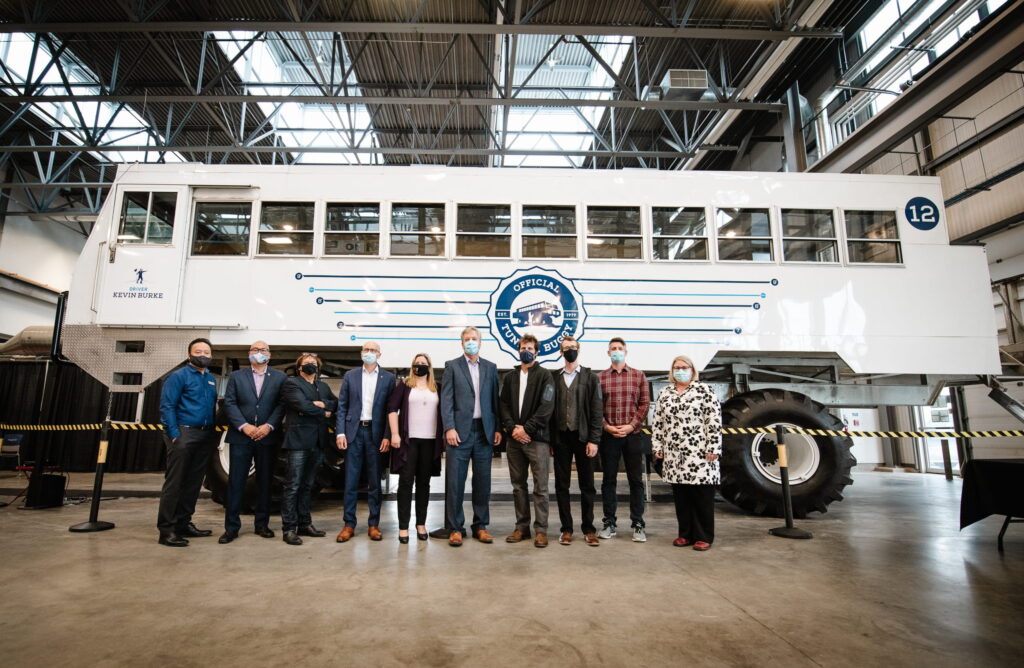
On Aug. 24, 2021, Frontiers North Adventures and RRC Polytech unveiled the first Electric Vehicle Tundra Buggy®. Ever since, the EV Tundra Buggy has reduced Frontier North’s GHG emissions and operated in all of Churchill’s subarctic seasons.

This zero-emission vehicle technology initiative leveraged Noble Northern’s in-depth knowledge of EV conversion and built on VTEC’s existing work electrifying transit buses. 

“This involved extensive engineering work, including adapting the vehicle’s existing systems to support the new electric powertrain and ensuring that all modifications met rigorous performance and safety standards,” said Noble.

Together, they repurposed an e-bus battery to create an innovative solution that reduces noise pollution and addresses the climate crisis at a local level. The EV Tundra Buggy garnered massive media interest, solidified RRC Polytech’s reputation as a leader in EV technology and promoted the geography and people of Northern Manitoba. Noble said the partnership with VTEC significantly elevated the company’s profile in the EV conversion industry. 

“Working on the EV Tundra Buggy project allowed us to showcase our technical capabilities and commitment to innovation,” said Noble. 

“It also provided us with valuable experience in adapting our technology to specialized applications, which in turn attracted further opportunities and projects. The success of this project reinforced our reputation for delivering high-quality, effective solutions, and enhanced our business relationships and market position.”

The EV Tundra Buggy was made possible through the province’s Conservation and Climate Fund and the Vehicle Technology Centre (VTCI) — a non-profit organization dedicated to supporting Manitoba’s heavy vehicle manufacturing sector. VTEC also provided in-kind support and technical services.

“The EV Tundra Buggy project is a quintessential made-in-Manitoba story. It has links to conservation, tourism and environmental stewardship, highlighting the ability of industry partnerships to create positive impact in Manitoba, for Manitobans, through reducing environmental impact and benefitting our local economy,” said Fred Meier, President and CEO, RRC Polytech.

It was just a few months after the unveiling, that Red River College evolved into RRC Polytech to better reflect its rapidly growing applied research capabilities and academic agility to support industry with the workforce of tomorrow. The EV Tundra Buggy project helped demonstrate to Manitobans that polytechnics help make things possible – things that would be impossible, were it not for our involvement. By the time, the project was featured in 2023’s comprehensive billboard, radio, print, digital and bus bench advertising campaign, the institution’s new identity had been embraced and it was chosen to showcase how we find solutions to local and global problems.

The project continues to resonate for all three partners today, as Frontiers North continues to shift its entire touring fleet of Tundra Buggies from diesel-powered to battery-electric. While in addition to lending their support, VTEC and Noble Northern are also using the valuable knowledge gained in their first successful endeavour, as they team up on an active school bus electrification project.

Students develop their own personal recipes for success at RRC Polytech’s Prairie Research Kitchen

November 4, 2024

Innovative ideas and fresh new products are always on the menu at RRC Polytech’s Prairie Research Kitchen (PRK), Western Canada’s only Technology Access Centre that blends culinary arts and food science. But in addition to contributing to applied research projects for industry partners and clients, this summer’s co-op students at PRK also whipped up a little something special for themselves.

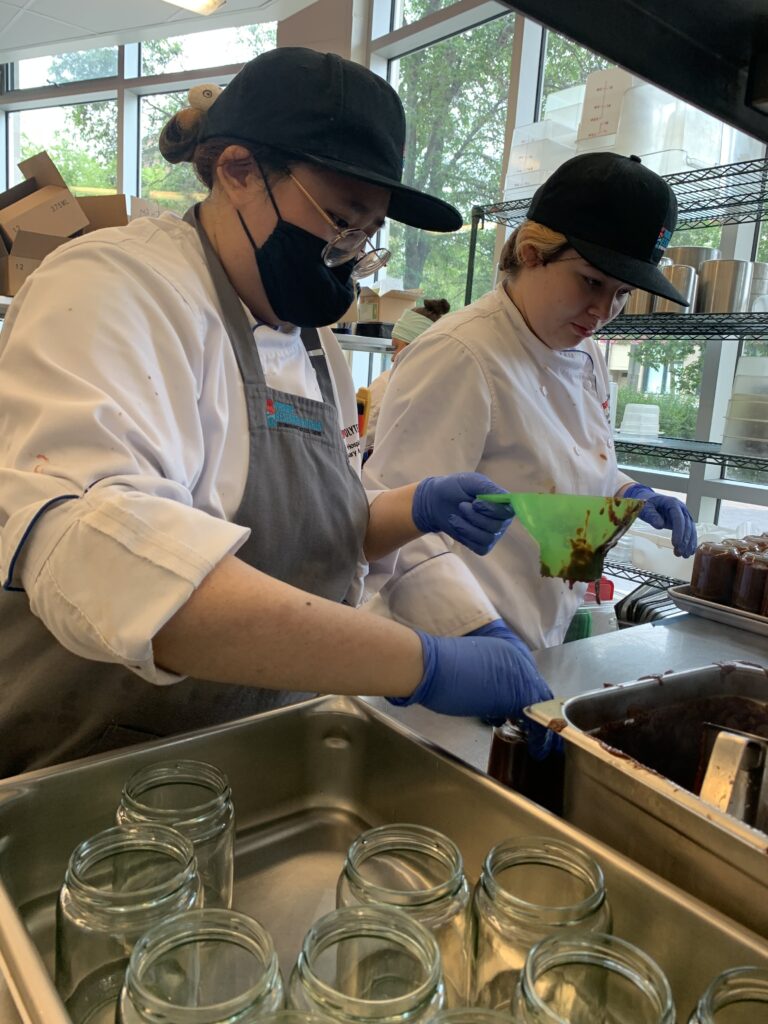
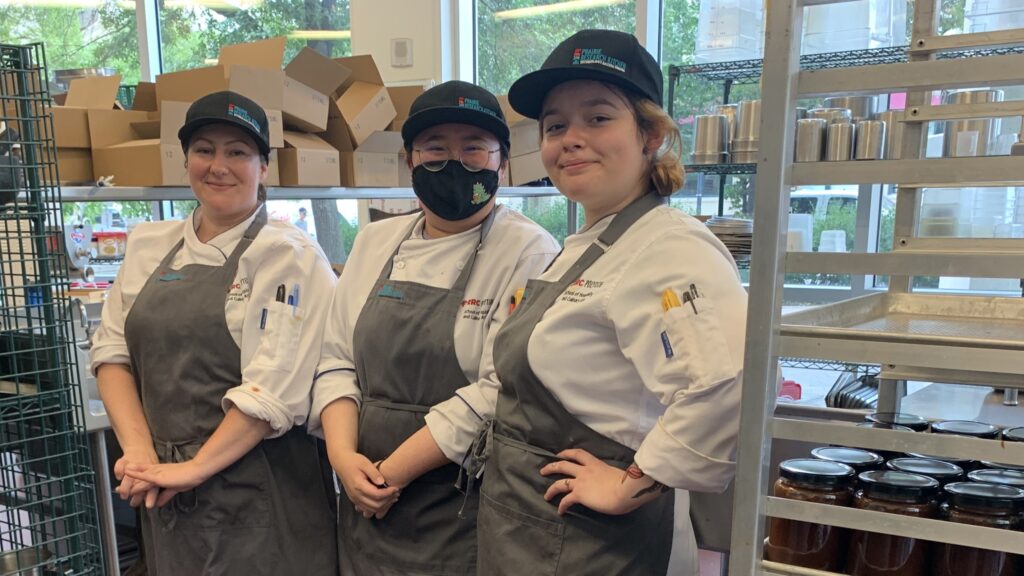
As part of their work-integrated learning experience, a trio of ambitious culinary students jumped at the challenge to create their own unique food product and take it from concept to market.

“It was a fun process that really tested everything we’ve learned and boosted my confidence,” said Culinary Arts student, Yesenia Portillo. “It’s a nice sendoff or grand finale to a chapter of my educational journey that I’ll never forget.”

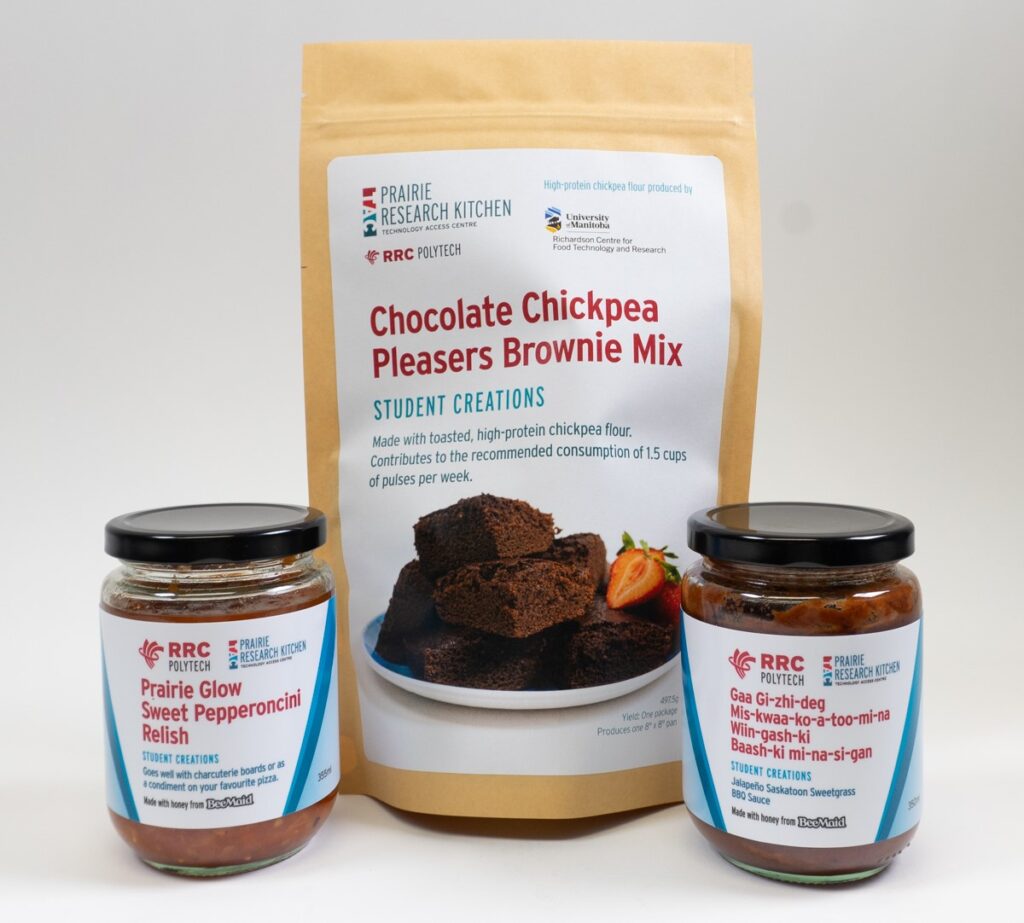
Portillo named their sweet pepperoncini relish ‘Prairie Glow’ as a tribute to their positive experience working at PRK. They actually stumbled upon the key ingredient by accident but say the combination of its acidic brightness and sweet subtle heat made their tastebuds dance. They recommend their relish to other pickle-lovers as a perfect complement to charcuterie boards or pizza.   

a person stirring a large pot of sauce

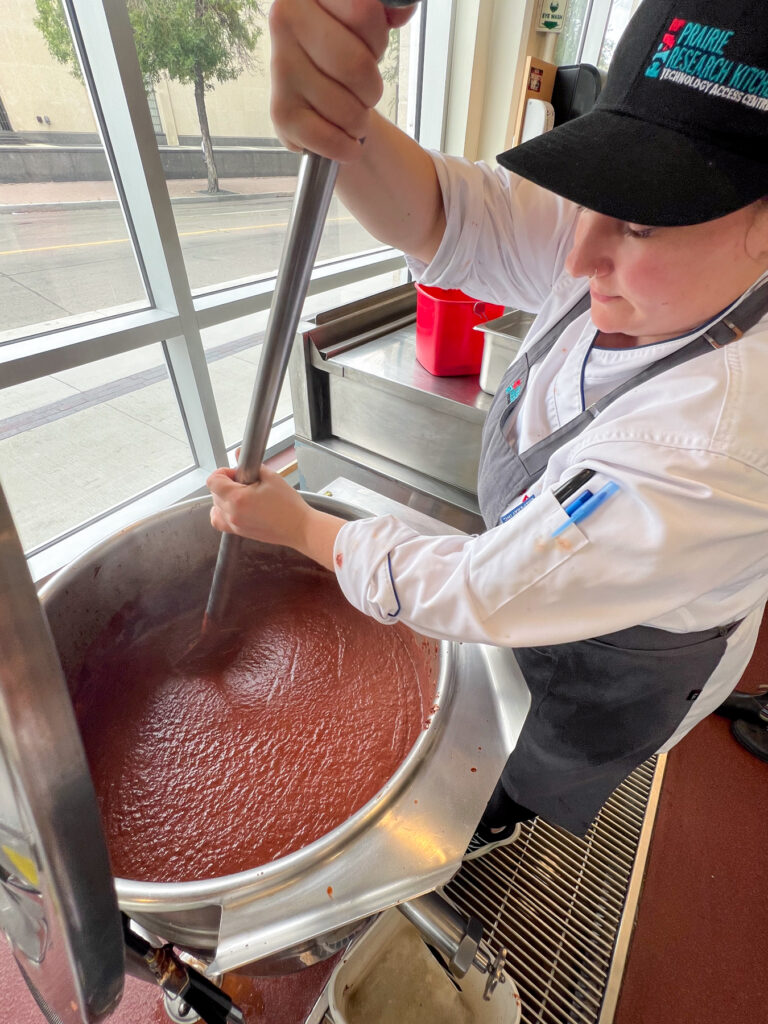
Originally from Winnipegosis and a member of Minegoziibe Anishinabe, Tia Fleming chose to highlight her Indigenous culture with a barbecue sauce that works well with the wild game commonly served in the area. She combined locally grown saskatoon berries with jalapeño and after consulting with community, Fleming harvested and torched her own sweetgrass then infused it into vinegar to add smoky flavour and a spiritual element.

Indigenous Language Instructor, Corey Whitford provided the Anishinaabemowin translation for the label of the sauce that lists the main ingredients. Gaa Gi-zhi-deg Mis-kwaa-ko-a-too-mi-na Wiin-gash-ki Baash-ki mi-na-si-gan will be gifted and not sold due to its medicinal properties.

“I wanted my product to demonstrate that food can be delicious, healing and tell a story all at the same time,” said Fleming, a student in RRC Polytech’s Indigenous Culinary Skills program. “I feel proud that I’m learning new skills that I can share with family and my community and eventually give back by teaching others. It would be awesome if this was the first in a line of sauces that someday I could bring to Pow Wows and ceremonies.”

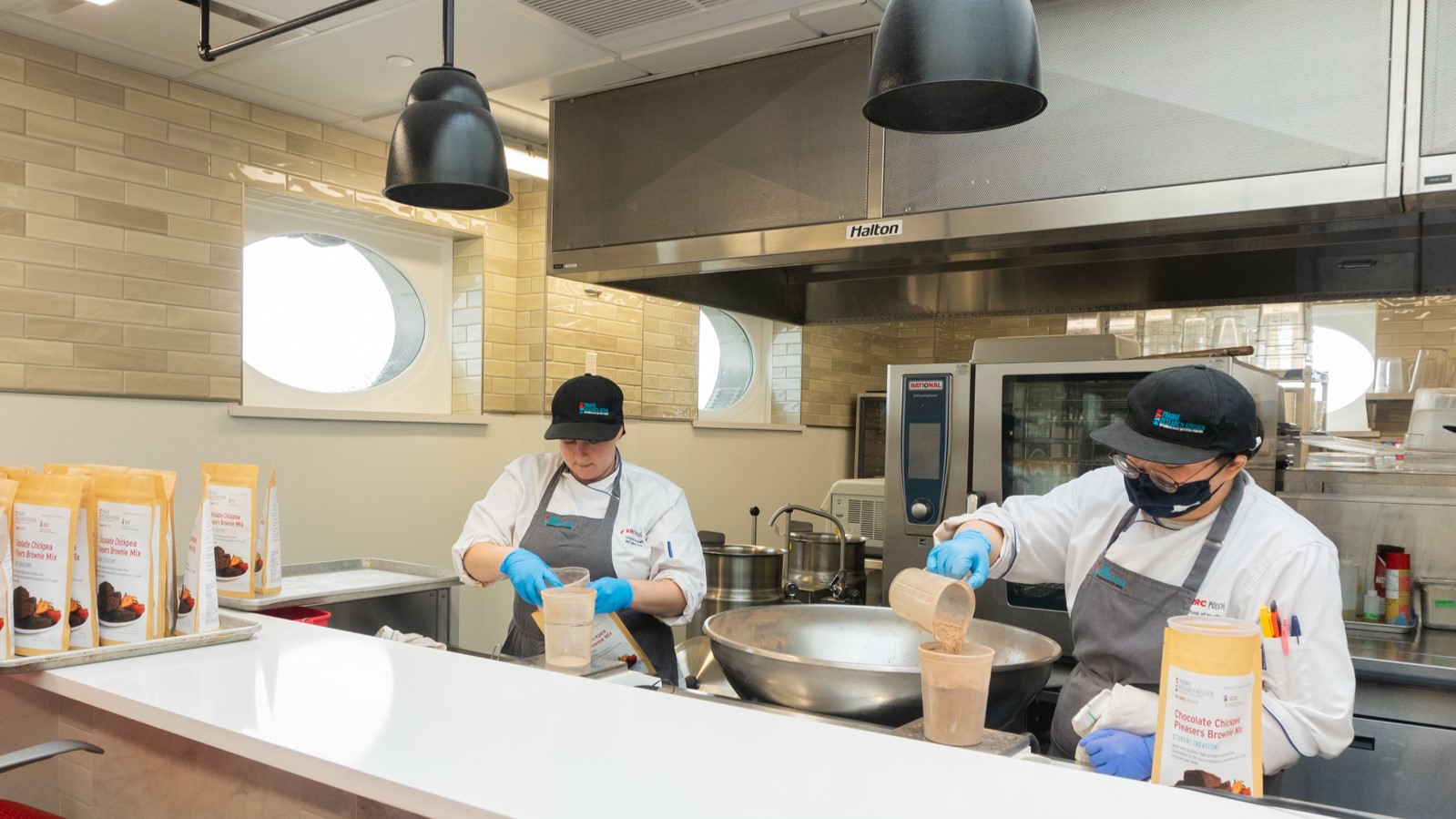
Intrigued by food chemistry with a focus on sustainability, Hui-Yun Sim, a Professional Baking student experimented with using a red lentil component before settling on a high protein chickpea pulse flour as the base for an instant brownie mix. Showcased at EDC’s Culinary Exchange, her Chocolate Chickpea Pleasers Brownie Mix lived up to its name as stock didn’t last long.    

“It’s so cool to see other students actually buying your product that’s made from weird or unfamiliar ingredients to them, and to know it tastes great,” said Sim. “PRK was an empowering place to work, I’m much stronger for it.”        

two people working in a kitchen

That’s because coming up with a clever or meaningful product idea was just the beginning. Determining the ingredients and recipe required more than just dozens of trials and taste tests – it took careful analysis of food costs and availability, allergens, nutritional values and scalability. They also needed working knowledge of procurement, health and safety measures, and marketing to navigate their ideas from potential to reality.

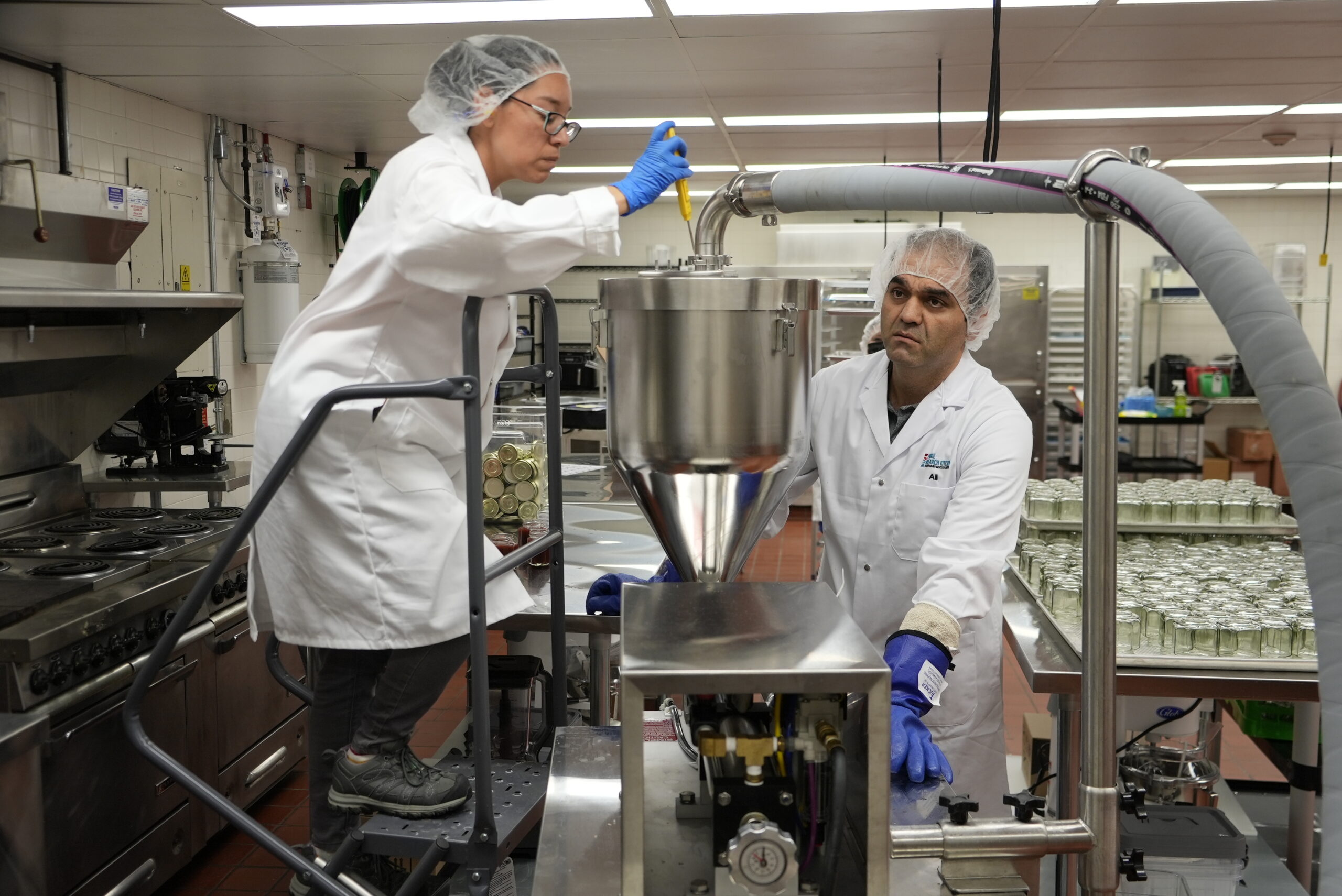
Despite the individual nature of the assignment, collaboration is a foundational objective at PRK, so the students worked together to perfect their creations and were supported by the professional research staff and even partners as Bee-Maid generously donated honey for the students to use.

“This is the first time we’ve attempted three separate student-led creations in one summer, but they each had their own vision and were very determined to showcase their culinary and critical thinking skills by seeing it through,” said Anna Borys, Research Technician at Prairie Research Kitchen.

“They ultimately came up with really tasty and thoughtful products while gaining a much better understanding of the amount of work it takes to put a single food item on a grocery store shelf.”

While their backgrounds, approaches, dreams and products are vastly different, all three of PRK’s most recent co-op students are moving forward in their careers with the same thought – it’s a healthy serving of thinking, learning, adapting, and planning that leads to culinary excellence and innovation.  

three people standing in a kitchen

“Our team at PRK approaches our work with an entrepreneurial mindset. We encourage each member, including our co-op students, to expand their creative boundaries to best support our clients, each other and their own personal development,” said Mavis McRae, Director, Prairie Research Kitchen.

“Incorporating concepts like cultural significance, practicality and sustainability into great tasting food demonstrates the ability of these students to blend their expertise with their passions – something I’m proud to say our team does every day and that will serve them well in all of their future endeavours.”

a jar of relish, a jar of barbecue sauce and a package of brownie mix

RRC Polytech’s partnership with Les Verts Living continues to produce success

January 11, 2024

Innovative hydroponic growing system now in use at the Paterson Globalfoods Institute (PGI) promotes sustainability and offers solutions to offset rising grocery costs

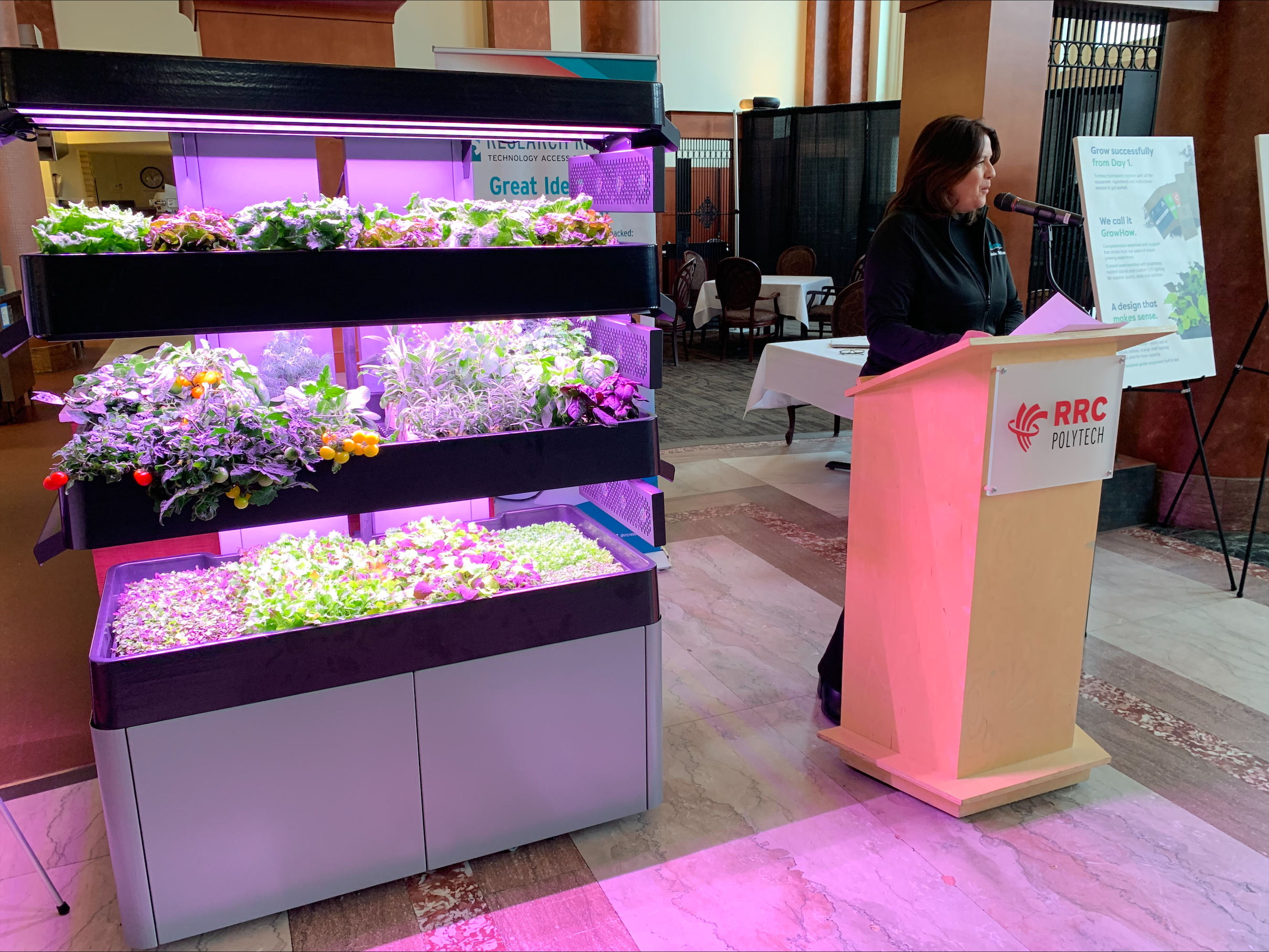
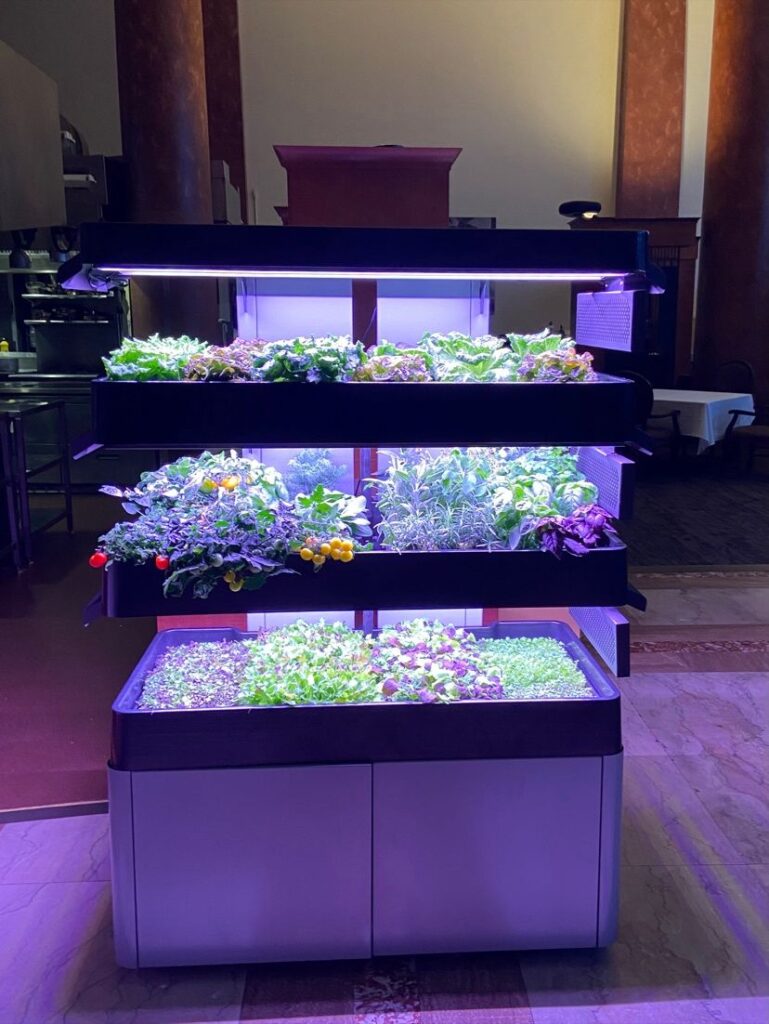
Les Verts Living originally partnered with RRC Polytech to help develop a prototype of its innovative soil-free and pesticide-free hydroponic growing system called the Terrace Pro – taking advantage of the resources and expertise available at the College’s Technology Access Centre for Aerospace and Manufacturing (TACAM), Prairie Research Kitchen (PRK), and Building Efficiency Technology Access Centre (BETAC).  

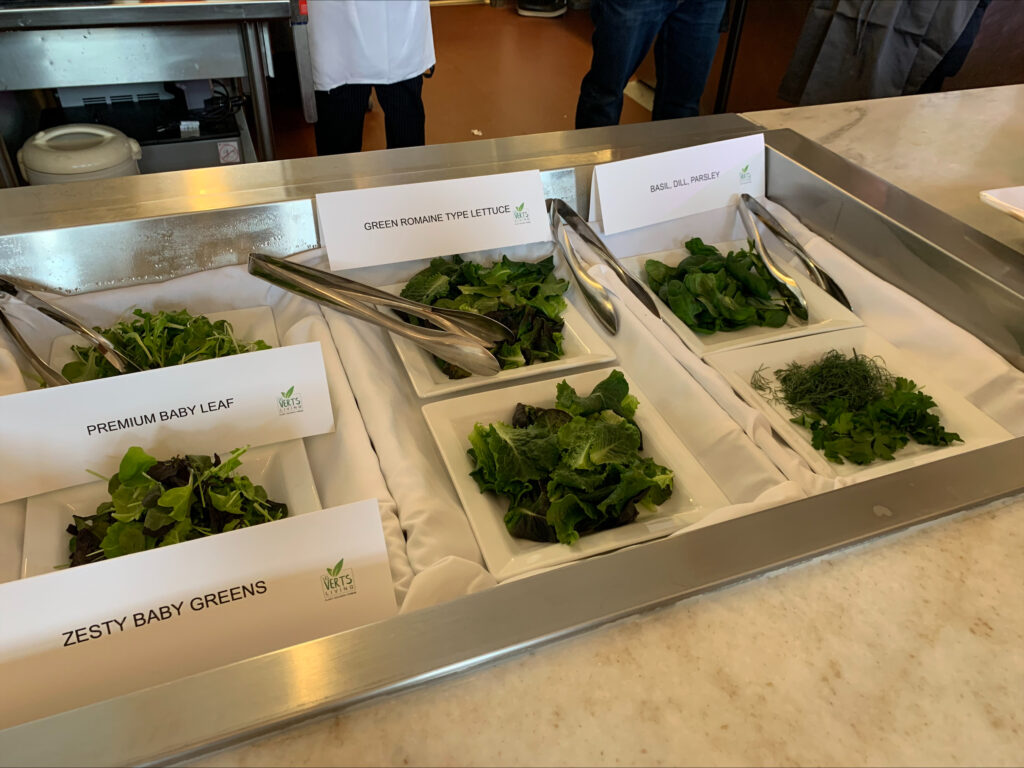
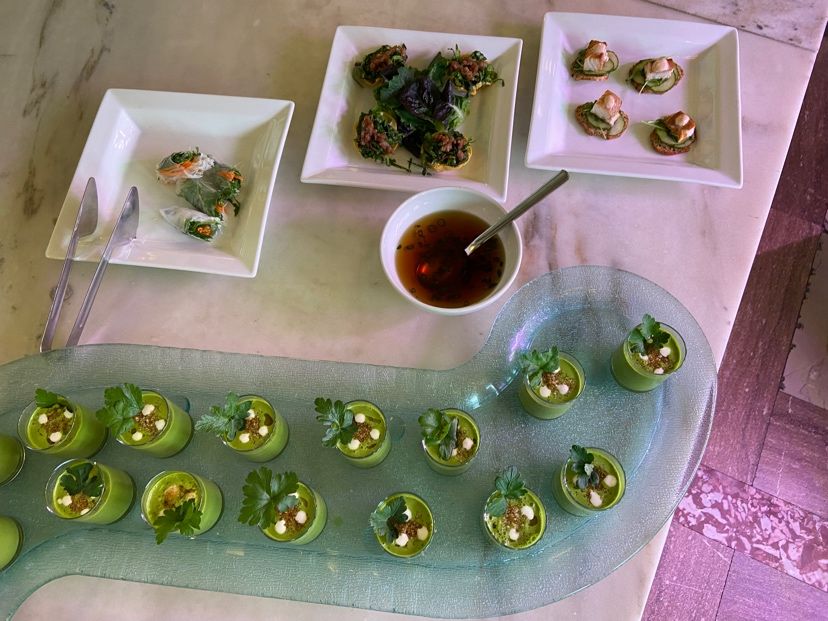
Now with its final product on the market, Les Verts Living is extending the partnership by sharing one of its Terrace Pro units with RRC Polytech to support Culinary Arts students with access to fresh, gourmet produce while they pursue their education. Housing the unit at the Paterson Globalfoods Institute (PGI) will also allow the PRK team to continue researching how to optimize its performance in a commercial setting while developing recipes that highlight the delicious living lettuce, fragrant herbs and hyper-nutritious microgreens and baby greens produced in the Terrace Pro.

“Through our technology, facilities and expertise, the College is uniquely positioned to bring these types of project ideas to life for our industry partners while training the workforce of tomorrow,” said Fred Meier, President and CEO of RRC Polytech. “This project demonstrates the power of partnership and the value of applied research in propelling our province’s economy forward.”

Learn more about the project

RRC Polytech named a top research College in Canada

December 7, 2023

Completed applied research projects at the College have increased by one third over the previous year 

Red River College Polytechnic (RRC Polytech) has earned the 14th place position in Re$earch Infosource’s annual ranking of the country’s top 50 research colleges.

“RRC Polytech makes innovation possible for our partners in industry and community – and every successful project builds trust in our technology, facilities and expertise,” said Jamie Wilson, Vice President, Indigenous Strategy, Research and Business Development at RRC Polytech.

“Today’s rankings reflect the College’s growing reputation for consistency and productivity that is driven by the work of our Research, Partnerships and Innovation enterprise and at our three Technology Access Centres. They also reinforce that our approach of strengthening relationships with partners and funders across all sectors, driving alignment between stakeholders, and valuing sustainability is accelerating applied research innovation here in Manitoba.”

RRC Polytech completed 170 applied research projects in the 2022 fiscal year – almost 60 more than the previous year – ranking it third in the Medium Tier category and fourth nationwide while posting a total of 117 research partnerships. By maintaining its average of 7.4 million dollars for a second consecutive year, Manitoba’s polytechnic also remains on par with the per-college provincial average of sponsored research income in Alberta and only slightly behind Ontario.

As an added feature to its annual publication, Canada’s Innovation Leaders 2023, Re$earch Infosource also shines a spotlight on college-industry research income as measured by grants, contracts or contributions received from industry sources over the past five years, where RRC Polytech again showed a remarkably consistent annual average of just over 7-million dollars from 2018-2022.

Applied research examples at RRC Polytech include a current partnership between the Technology Access Centre for Aerospace and Manufacturing (TACAM) and StandardAero, who are collaborating to test and validate that cold spray technology could be effectively implemented for repairing aircraft components.

The College’s Vehicle Technology & Energy Centre (VTEC) continues to facilitate the shift to electrification and zero-emission fuel sources with projects aimed at expanding workplace charging capabilities; partnering with Seven Oaks School DivisionNoble Northern and the Canadian Shield Foundation to develop a diesel-to-electric conversion kit for school buses; and even building on the success of completed projects by repurposing batteries from Winnipeg Transit electric bus trials in storage systems on fast chargers also created on campus.

The most comprehensive example is From Lab to Table, a Culinary Research Review in the form of a cookbook that shares the delicious outcomes of the applied research conducted at the Prairie Research Kitchen (PRK) since 2014, while documenting the history of Manitoba’s only Technology Access Centre that blends food science and culinary arts.  From discovering and developing novel uses for pulse and soybean products to upcycling food industry by-products and even embracing insects for protein, this unique cookbook is available at researchrecipes.ca.

“Celebrating the variety of products, techniques and technology that our researchers, staff and students have worked together with our partners to develop is as important as the volume of projects completed,” said Wilson. “Because regardless of the size or scope of the project, from entrepreneurs in search of support to launch and grow their business idea to established enterprises seeking advancements to propel them into the future, we want everyone to know that in addition to training the workforce of tomorrow, RRC Polytech is also here to provide innovative solutions that elevate all Manitobans.”

RRC Polytech’s Prairie Research Kitchen serves up success with ‘From Lab to Table’ research recipe book

November 9, 2023

This is not your average cookbook – in fact, RRC Polytech’s Prairie Research Kitchen’s (PRK) From Lab to Table is one of the first of its kind in Manitoba and features over 60 different applied research recipes developed in collaboration with various industry partners over the last eight years.

“This Culinary Research Review, in the form of a cookbook takes an engaging approach to sharing the outcomes of applied research conducted since PRK began collaborating with partners in 2014,” said Mavis McRae, Director of PRK.

“Recipe development is one of the best ways we can test out research results from food – eating and tasting it, and over the last eight years we have amassed a lot of recipes using innovative new foods. By compiling and sharing what we have accomplished, we celebrate the achievements of PRK and the partnerships with clients who have supported us to share these recipes. We hope this work inspire readers with ideas for new advances in food product development and culinary research.”

What makes this tasty and innovative work that takes place on the 11th floor of RRC Polytech’s Paterson GlobalFoods Institute unique is the interplay between PRK’s two mandates: to help industry produce new food products, and to train students to become tomorrow’s culinary industry and research professionals.

The research and recipe cookbook begins with a detailed retrospective history of Culinary Research and funding partnerships at RRC Polytech written by PRK Director, Mavis McRae. It showcases investments made by Natural Sciences and Engineering Research Council of Canada (NSERC), National Research Council of Canada Industrial Research Assistance Program (NRC IRAP), Canada Foundation for Innovation (CFI) and Research Manitoba in providing valuable infrastructure and research grants to companies that have helped PRK become what it is today. 

The next pages are broken down into four recipe sections: Capacity Building Projects, Client Projects, Indigenous Engagement and Staff Picks. Each page that follows explains the history of various industry partnerships and features a comprehensive overview of the projects, objectives and the mouthwatering results in the form of recipes readers can try themselves!

“Each section of this book focuses on the specific ways our culinary research team and students have helped industry partners, and highlights the results our collaborations have achieved, while underscoring the opportunities these collaborations have created for students to gain hands-on skills in culinary arts and research.” said McRae.

Capacity Building Projects focuses on projects and recipes that served as the building blocks of the culinary research program. The capacity building projects helped generate awareness with internal and external partners of the PRK capabilities as research and culinary chefs. Partnerships include Manitoba Pulse and Soybean Growers, Pea Tempeh – a student project to teach research methodology, Pulse Canada and Manitoba Agriculture and recipes range from a chicken pot pie with pinto bean crust, to tempeh nachos with a roasted corn salsa and lime crema, or for something sweet, a candy cane miso caramel popcorn or pistachio coconut crème pâtissière.

tempeh nachos with a roasted corn salsa and lime crema
pistachio coconut crème pâtissière

In the next section, Client Projects, explores the way PRK engages students and instructors on industry-initiated applied research projects that enhance their knowledge and expertise within an ever-changing industry landscape. It outlines the variety of ways PRK’s Culinary Research engaged with small- and medium-sized enterprises (SMEs) using technology and knowledge to meet a client’s vision – from developing new projects and commercialization, to seeking new applications for ingredients to enhance consumer experience and meet new market demands.

Partnerships include Prairie Fava, Juno Food Labs, Big Mountain Foods and Richardson International and in this section there are recipes for any meal of the day – cinnamon toast pancakes with cereal milk whipping cream for breakfast, summer rolls with tamarind sauce or lentil perogies for lunch, and finally a dan dan noodle bowl or fried chicken for the finale.

In the third recipe section, Prairie Research Kitchen focuses on incorporating Indigenous knowledge and engagement in food development opportunities and training – a key strategic priority for the College. This chapter brings together projects PRK has worked on featuring Indigenous foods, businesses and projects involving the chef instructors and student chefs from the School of Indigenous, Education’s Culinary Skills program. It includes recipes for a wild blueberry sauce, three sisters soup with smoked duck and wild rice buttermilk pancakes and wild rice Bannock.

The final section of the book features the people and recipes that make up culinary research and RRC Polytech’s Prairie Research Kitchen multidisciplinary team, complete with fun facts and quotes about the work and partnerships they care so deeply for that helped inspire the completion of this book.

“This innovative and tasty research recipe cookbook, From Lab to Table, is an important outcome of the Technology Access Centre Prairie Research Kitchen’s dissemination of knowledge gained through research to ensure economic prosperity for Canada and the future generations,” said McRae.

“The world of research is ever-changing – and for that reason, Prairie Research Kitchen will continue to adapt and grow in the years ahead. A lot of great ideas have started here, and we look forward to seeing the products of our creativity and collaboration hit grocery store shelves and reach dinner tables in the years ahead.”

The physical printed book isn’t for sale, however interested aspiring chefs can view the online version of From Lab to Table here. Copies of the book will also be used for special gifts, door prizes, and provided to partners who continue to support RRC Polytech.

RRC Polytech campuses are located on the lands of the Anishinaabeg, Ininiwak, Anishininwak, Dakota Oyate, and Denésuline, and the National Homeland of the Red River Métis.

We recognize and honour Treaty 3 Territory Shoal Lake 40 First Nation, the source of Winnipeg’s clean drinking water. In addition, we acknowledge Treaty Territories which provide us with access to electricity we use in both our personal and professional lives.