Communications and Marketing

News and Events

Notre Dame Campus activated as space for Red Cross volunteers

August 13, 2025

The following message was sent to all staff and students from Giselle Martel, VP Finance and Administration:

In response to the ongoing province-wide state of emergency due to wildfires impacting communities across Manitoba, RRC Polytech is working in partnership with the Canadian Red Cross to support emergency relief efforts across Manitoba.

Beginning tomorrow, August 14, 2025, several spaces at the Notre Dame Campus are being activated as a temporary site to host 100 Canadian Red Cross volunteers. These volunteers have come from across the country and are playing a vital role in providing aid and support to communities and evacuees affected by the wildfires.

Please note the following areas that will be closed to staff and students during this time to support the Canadian Red Cross volunteers (August 14, 2025 until August 31, 2025):

  • The South Gym (including the walking track, changing rooms, washrooms and locker areas).
  • The North Gym Women’s Student Locker Room area.
    • Please note the Women’s Staff Locker Room area will be available to staff and students during this time.
  • Three classroom spaces that are not currently in use by the Polytech community.

We are proud to continue to offer our spaces and support, and to contribute to this important humanitarian effort. We also thank areas from across the Polytech who have mobilized quickly to help make this happen.

We will provide updates as required on the status of the volunteer shelter site and share ways you may be able to welcome the volunteers or support them during their stay through Staff and Student News and LEARN updates.

We are committed to working closely with the Red Cross to ensure minimal disruption to campus operations and to maintain a safe environment for all. We thank everyone for their understanding and cooperation as we make space available for this critical need.

If you have any questions or require support, please contact safety@rrc.ca

Thank you for your continued compassion and community spirit.

Safety, Health and Security Update – August 2025

August 13, 2025

With the fall term approaching and more people on campus, RRC Polytech has important Safety, Health and Security updates to share. Whether you’re returning to campus or you’re a new RRC Polytech student or staff member, our goal is to help everyone feel informed, supported and ready for a safe and successful term.

Campus Hours

As of Monday, August 25, regular campus hours are in effect at the Exchange District Campus (EDC) and Notre Dame Campus (NDC) as follows:

  • Monday to Friday – 7:00 a.m. to 8:00 p.m.
  • Saturday and Sunday – swipe card access only at EDC and enter through Building C at NDC.
  • All RRC Polytech campuses are closed on Labour Day, Monday, September 1.

Accessing the Exchange District Campus (EDC)

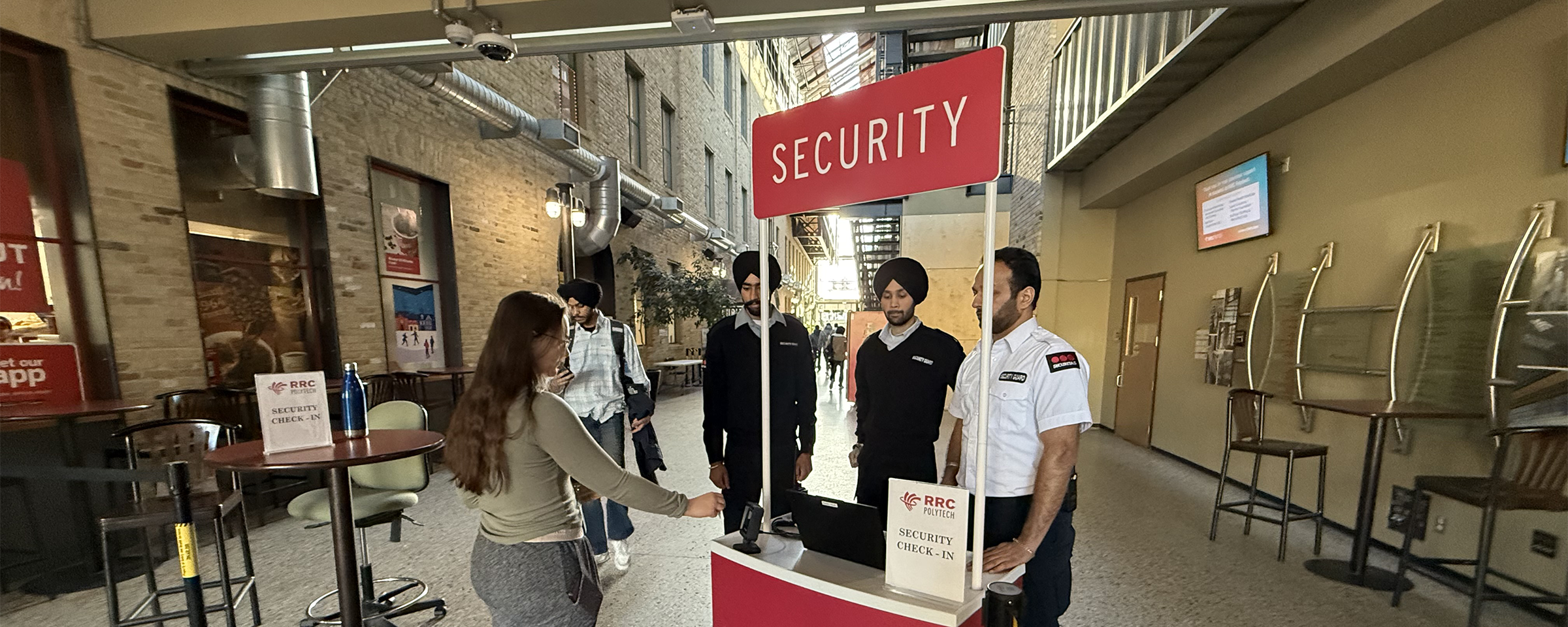
For accessing EDC during regular weekday hours, students and staff are required to present their RRC Polytech-issued ID card upon arrival. Swipe card access only for campus entry between 8:00 p.m. and 11:00 p.m. On weekends, campus is accessible by swipe card access only from 7:00 a.m. to 11:00 p.m.

If you forget your RRC Polytech-issued ID, please use the buzzer for the intercom system to connect with a member of the security team.

Accessing the Notre Dame Campus (NDC)

For accessing NDC during regular weekday hours, students and staff can enter through available building entrances. Contractors and visitors must check in with Security Services in Building C upon their arrival.

For campus entry between 8:00 p.m. and 11:00 p.m. on weekdays, staff, students and visitors must enter through Building C, using the doors on the east side. On weekends, campus is only accessible through the Building C doors.

RRC Polytech Card Access Update – EDC Only

As shared in the June Safety Update, changes to the entry process at EDC are coming this fall. Card scanners will be installed in late August, like those at the EDC fitness centre and what you would see at Costco.

Until the new system is in place, students and staff must continue to present their RRC Polytech-issued ID cards upon arrival. The transition to card scanners is expected to begin later in the fall, giving everyone time to adjust and familiarize themselves with the new process. More details will be shared as they become available.

Students and staff who do not have an RRC Polytech-issued ID card or need a replacement card, please visit rrc.ca/ID for more information. Everyone is encouraged to get their ID card in advance of the fall term to avoid delays.

EDC Health Centre Update

A new health centre space is coming to EDC later this fall, located in room W103 at the Roblin Centre. The health centre at EDC will be open Monday to Friday from 8 a.m. to 4 p.m. and available to all staff and students at no cost, with no appointment required.

Services will include mental health support, sexual health education, injury and illness assessment, student medical plan development, and connections to internal and external resources like Student Support Services, Klinic, and the Crisis Response Centre.

Stay tuned to future Safety, Health and Security Updates for more information on the health centre opening. In the meantime, for students and staff at EDC seeking health services, please call 204-632-2238 or email HealthServices@rrc.ca.

Security Help Phones

All former Safe Ride and Safe Walk phones at EDC and NDC have been transitioned to Security Help Phones. Students, staff and visitors can use these phones to connect directly to RRC Polytech’s Security Services team for emergencies, general security questions and concerns, or to access services such as Safe Walk and Safe Ride.

To find out where Security Help Phones are located on campus, visit the EDC Security Webpage or NDC Security Webpage.

Community Safety Partners at EDC

As part of RRC Polytech’s comprehensive safety strategy, we continue to collaborate with the Winnipeg Police Service, Downtown Community Safety Partnership (DCSP) and community partners to support students, staff and community members.

In the upcoming academic year, RRC Polytech will once again be partnering with DSCP and Bear Clan Patrol to offer smudging ceremonies in the Roundhouse Auditorium and community walks on Fridays at noon. All are welcome to participate – stay tuned to Staff and Student News for more information.

A reminder that if you witness a safety concern on campus, please contact the RRC Polytech Security team at 204-949-8305. The Security team will triage any concerns to the appropriate area, such as DCSP assisting community members in need.

Feedback and Questions

Thank for your continued support and feedback and we proactively work to enhance safety and security on campus. For any questions or feedback, please contact Safety, Health and Security Services at safety@rrc.ca.

A friendly reminder that all Safety Updates are posted on rrc.ca.

Art as Medicine at the Simulation Centre

August 7, 2025

When you step into RRC Polytech’s Interdisciplinary Health and Community Services Simulation Centre (the Simulation Centre), surrounded by sleek equipment and cutting-edge technology, you might be surprised by something soft, vibrant, and unexpected: drawings of traditional Indigenous Medicines that seem to bloom right out of the walls.

Sweetgrass curls in the corner, sage branches in pale greens and silvers, and Labrador tea in buds and bloom beckon from the end of the hall. Nine large-scale plant drawings are installed in different places around the Simulation Centre, reminding students, staff, and visitors that traditional Medicine is the foundation of today’s medical technology.

Christine Kirouac, the local artist behind the illustrations, says that the creative process for designing the drawings required a lot of patience and many conversations with different people, including with the Knowledge Keepers Council at RRC Polytech. The Knowledge Keepers provided direction on the spiritual and cultural significances of the selected Medicines and the names that described each plant in the different Indigenous languages to which they’re referred.

“I spoke with Elders, gardeners – whom I know have a wealth of knowledge about plants and Medicines – and builders to understand how the illustrations would appear within the architecture,” said Kirouac. “So, the question became: how do we move these together?”

The Simulation Centre project team envisioned a dynamic health environment that celebrates the latest advancements of modern medicine while honouring the roots of traditional Indigenous Medicines, which have shaped countless contemporary medical practices and remedies.

Aupilaktunnguat.
Pezhikhota.

They selected Kirouac, a Métis interdisciplinary artist, to craft striking illustrations that breathed life into this vision. Infusing the space with cultural and visual resonance, Kirouac’s drawings vividly depict a curated selection of sacred Medicines – wiingwashk, maskawáhtik, pezhikhota, aupilaktunnguat, ahsehsap, and nagothe – each chosen to weave a powerful reminder of healing and heritage.

The project began in the deep cold of January – too early in the season to find the plants growing in the prairie landscape, so she turned to photographs that showed the plants in various stages, some up close, some from afar.

She took care with every creative decision. Each illustration was created with its final placement in mind. Pezhikhota – sage in Dakota – and wiingashk – sweetgrass in Anishinaabemowin – nestle into the corners of the rooms, as if they’re creeping in from outside. Aupilaktunnguat – or saxifrage in Inuktitut – is the floral emblem of Nunavut, and the drawing bursts with colour in the Quiet Room.

This tension between the clinical and the natural is exactly the point. Kirouac says the drawings don’t feel like decoration. She intended for them to be in conversation with the function of the space – a bridge between traditional knowledge and Western medicine.

“There’s often this assumption that these worlds are at odds – like it’s either one or the other,” she says. “But it doesn’t have to be a trade-off. We can integrate. We can let them speak to each other.”

By highlighting focused, close-up views on broad canvases, the drawings invite deeper engagement with the complexity and nuance of natural forms in contrast with the manufactured equipment and medications with which students train in this environment.

This approach reveals the richness found in these Medicines. What might seem like a single shade of green at first glance turns out to be a complex mix of hues, each influenced by subtle differences in light, shadow, and timing.

“Take the cedar for example – some parts are really dark, and that’s because the reference image was taken at midday. The shadows are very sharp. Those shadows suggest an environment with a specific weather, climate, and time of day,” said Kirouac.

Other works, like her renderings of sage and sweetgrass, are filled with light. The angled shards of green framed with slashes of darkness capture the plants in an afternoon light on a sunny day.

Her compositions are intentional in both form and scale. The placements of the drawings, right up to the edges or corners, are designed into each original piece. This meticulous attention to detail, light, and structure evokes a distinct sense of place and moment in time, capturing the living essence of the plants Kirouac portrays. Through her work, viewers are invited to slow down, look closer, and appreciate the layered beauty of the natural world.

“Once they were installed, I realized it was like the plants had found their way into this sterile space, reminding everyone of something older, something still alive.”

Kirouac calls herself a shapeshifter – an interdisciplinary artist who listens to the subject matter, lets it guide her, and chooses her tools accordingly. In this case, painstakingly detailed graphite drawings became the medium to explore the place of Indigenous Medicines in a Western clinical environment.

Christine Kirouac and nagothe.

Visitors will have the opportunity to admire the original 32” x 40” drawings themselves once they are installed in the Library at Notre Dame Campus even when the Simulation Centre is in use.

When you see the illustrations, you might not know the whole story – but maybe you’ll recognize a leaf, a stem, a shadow, and maybe that’s enough to start your own connection.

Medicines in the Simulation Centre

English NamesTraditional NamesLanguage
Sweetgrass Wiingwashk
(Ween-gash-k)
Anishinaabemowin (Ojibwe)   
White Cedar     Maskawáhtik(wak) 
(Mask-ah-wah-dtig) (wug)
Note: (wak) is plural.
Ininimowin (Cree) 
Prairie Sage Pezhikhota
(Pezh-ee-GHOH-tah)
Dakota Oyate   
Saxifrage Aupilaktunnguat
(Ow-pe-LUK-toon-nuat)
Inuktitut 
Red Willow  Ahsehsap(an)
(Ah-seh-sup) (un)
Note: (an) is plural.
Anishininimowin    
Labrador Tea Nągothe  Denésuline 

Artist’s Statement

Kirouac is a Winnipeg, MB-born interdisciplinary artist, who draws. Draws on experience, draws on personal stories, draws on surroundings and circumstances, then draws on paper. Unlike her other projects requiring engagement with outside technical expertise, collaborators and materials, Kirouac’s long-term relationships with her drawn subjects require herself alone, her materials, and her investment of real time. This deep connection to form, light and texture (without context in some cases) and time spent is on clear display.

Kirouac is Métis and hermetic practices are natural to her biological people, but as an adoptee brought up around different formal structures of home and family, her struggle to secure her place has persisted since her first childhood recollection. Her rituals of walking in both urban and wild settings, recording then intensively drawing allows her to reconsider her pining to belong through the lens of organic elements and their inherent acceptance of constant rhythms of change and ultimate and ironic disappearance. Forms become figures and environments become sets into which she and the viewer can project themselves. Her quest has manifested differently throughout her career but her willingness to commit to drawing specifically became an act of preservation not only a memory of place, but of herself. Over time, she becomes encrypted with the moment she invests in and the drawn results house her.

New veterinary education agreement benefits aspiring animal healthcare providers in Manitoba

July 23, 2025

St. Matthew’s University School of Veterinary Medicine (SMUSVM) and RRC Polytech are excited to highlight this new pathway agreement, which supports aspiring veterinarians who have completed RRC Polytech’s Veterinary Technology Diploma Program (VTP) and wish to enter SMUSVM’s Doctor of Veterinary Medicine (DVM) program. Associated benefits for qualified students include a $10,000 USD partnership scholarship, eligibility for existing merit-based scholarships, a guaranteed admissions interview and ongoing application support.   

Established in 2005, SMUSVM proudly provides education and training for curious, collaborative and caring future veterinarians. Our DVM program allows students to graduate in just over three years, after seven semesters on safe and modern Grand Cayman (part of the Cayman Islands) in the Basic Science program and then three semesters of Clinical Medicine rotations at an affiliated veterinary school in the U.S., Canada or the U.K.. Thanks to our strong curriculum, dedicated faculty and individualized support, students achieve success on the NAVLE exam and go on to practice in the U.S., Canada and internationally.

“This dynamic new collaboration creates a clear route for graduates of RRC Polytech’s Veterinary Technology program to advance their education and embark on careers as veterinarians,” stated Dr. Tamara Chambers-Richards, Dean of the School of Health Sciences and Community Services at RRC Polytech. “With an increasing need for both veterinary technologists and veterinarians in Manitoba, this partnership with St. Matthew’s University presents a fantastic opportunity for our graduates to receive the training they need to address this demand. St. Matthew’s values the comprehensive nature and high standards of our Veterinary Technology curriculum and is dedicated to helping our students reach their professional aspirations.” 

“At St. Matthew’s University School of Veterinary Medicine, we are excited to partner with RRC Polytech’s Veterinary Technology Diploma program,” shared Samantha Shields, DVM, Dean of SMUSVM and Canadian expert in Clinical Nutrition, Conservation Medicine, and Ethics and Communication. “This collaboration offers an ideal path for Canadians to build on a strong academic foundation as they transition into our DVM program. With our small class sizes and supportive community, I have the privilege of getting to know each student personally and guiding them from day one of their veterinary journey. We look forward to welcoming Red River graduates into our SMU family on Grand Cayman.”

In order to enter the St. Matthew’s University DVM program via this partnership pathway, RRC Polytech graduates must meet all eligibility and admissions requirements. These include maintaining an overall GPA of 2.70 or higher, a GPA of 2.70 or higher in all prerequisite courses and successfully completing the VTP with no outstanding courses. As part of the application process, they must also submit all required support documents (transcripts, letters of recommendations, personal statement, etc.) and complete the admissions interview.

Supporting wildfire evacuees: donations needed for children’s items

July 15, 2025

Last week, the Province declared a state of emergency in response to the ongoing wildfires across Manitoba.

Understandably, this has raised questions about what this means for our College community, and how we can continue to offer our support. 

We remain in regular contact with the province’s Emergency Management Office (EMO) and the Canadian Red Cross to determine how we can help.  

Currently, the shelter site at NDC remains on standby status. At this time, we do not anticipate our facility will be needed as a shelter site, as the Leila Soccer Complex is already activated and preparations for the RBC Convention Centre are underway as another emergency shelter. 

Today, we received an urgent request from the community of Garden Hill First Nation who are in need of gently used and clean children’s clothing and shoes of all sizes. 

We will be collecting items on behalf of the RRC Polytech community and delivering them to a drop-off location later this week.

Any staff members who have items they would like to donate can do so today until the end of day Thursday, July 17 at the Security Office at the Notre Dame Campus or the Roblin Centre. 

Items we will be accepting and donating: 

  • Gently used, clean baby and children’s clothing (all sizes) 
  • Gently used, clean children’s shoes (all sizes) 
  • New socks and underwear for children 
  • Diapers and wipes 
  • Formula  
  • Gently used strollers 

We will continue to provide updates on further donations and the status of our shelter site as needed through rrc.ca/marcom and Staff and Student News to keep you informed. 

Thank you for your continued commitment to our community and for supporting one another during this difficult time. 

RRC Polytech Partners with Regional Health Authorities to Launch Health Care Aide Program in Treherne 

July 15, 2025

Portage la Prairie, Manitoba on Treaty No. 1 Territory and the National Homeland of the Red River Métis –

Aspiring healthcare workers in the Central Plains region will soon have the opportunity to train as Health Care Aides through a program delivered by RRC Polytech in Treherne, Manitoba.  

There are 25 seats available in the six-month program, which begins January 26, 2026, and is being run as a dual credit – providing grade 12 students from local high schools the opportunity to get a head start on their careers in health care.  

This initiative is made possible through a strong partnership with Prairie Mountain Health, Southern Health-Santé Sud, and Norfolk Treherne Community Development Corporation, all working together to address the growing need for skilled health care professionals in the region. This collaborative effort reflects a shared commitment to strengthening rural health care and creating accessible education pathways for Manitobans. 

“This program is a true example of what can be achieved through partnership,” said Guy Moffat, Regional Campus Manager at RRC Polytech, Portage Campus. “Together with Prairie Mountain Health, Southern Health-Santé Sud, and Norfolk Treherne Community Development Corporation, we’re creating opportunities that benefit both individuals and the broader community.” 

The Health Care Aide program combines classroom instruction with hands-on experience, preparing students to provide compassionate, high-quality care in a variety of healthcare settings. 

“Southern Health-Santé Sud is proud to collaborate with RRC Polytech and our community partners to bring this vital training opportunity to the region,” said Kathryn Reimer, Manager, Recruitment & Retention at Southern Health-Santé Sud. “By investing in local talent, we’re not only supporting our healthcare system but also empowering individuals to build meaningful careers close to home.” 

To help prospective students learn more about the program, RRC Polytech will host a series of information sessions this fall in: 

  • Treherne 
  • Glenboro 
  • Notre Dame de Lourdes 

Dates and locations for these sessions will be announced in the coming weeks. 

For more information about the program or to express interest in attending an information session, please visit rrc.ca/portage/programs

RRC Polytech’s Health Care Aide program is currently also offered in Winnipeg, Portage la Prairie, Steinbach, Winkler, and through the Peguis-Fisher River campus in Arborg.   

RRC Polytech Awarded NSERC Grant to Boost Building Retrofit Research

July 11, 2025

RRC Polytech is using federal funding announced this week to enhance the research capacity and innovation potential at its Building Efficiency Technology Access Centre (BETAC). The funding awarded by the Natural Sciences and Engineering Research Council of Canada (NSERC) enables BETAC to become the first in Canada to acquire advanced equipment that improves the accuracy and efficiency of retrofit planning.

“The new equipment will help to reduce risks, improve cost-efficiency in design, and accelerate innovation by providing detailed, reliable data on building conditions so that we can better support our industry and community partners,” said Dr. Alireza Kaboorani, Director at RRC Polytech’s Building Efficiency Technology Access Centre. “It will also enable BETAC to test and validate novel retrofit solutions in both laboratory and real-world environments.”

Leading-edge tools like the Sorama CAM for detecting building inefficiencies; the Nexys LiDAR system for precise building assessments; and the TRSYS20 system for accurate thermal resistance measurements will directly support BETAC’s ongoing projects such as the Gordon Bell High School retrofit and other heritage building upgrades across the province.

a person using a vapour device to test the efficiency of a window

The investment also aligns with sustainable housing goals by enhancing retrofit precision, supporting affordable housing initiatives, and fostering cross-disciplinary collaboration among architects, engineers, and researchers.

“By supporting research that fuels technological progress and economic growth, this investment ensures impactful collaboration between partners, benefiting industries, communities, and Canadians alike,” said Professor Alejandro Adem, FRSC, President, NSERC, in the government release.

The announcement included a total investment of $29.82 million through the College and Community Innovation (CCI) program, as part of a national strategy to strengthen the ability of colleges, CEGEPs and polytechnics to drive cutting-edge advancements, promote meaningful partnerships that create lasting impact, and ultimately bolster the Canadian economy.

BETAC was awarded a $200,000 Applied Research Tools and Instruments (ARTI) grant which provides funding for Canadian colleges to acquire essential research equipment, strengthen partnerships with industry, public, and health organizations while offering hands-on training opportunities for students.

“Manitoba’s rich history has endowed us with incredible infrastructure and stunning architecture, but it requires a significant commitment from all stakeholders to preserve and protect,” said Kaboorani. “Retrofits not only extend the life of heritage structures but can transform them into modern, energy-efficient and sustainable works of art. The new technology acquired with this funding combined with BETAC’s expertise will save time and money which are critical to the success of our partners across the sector.”

closeup of digital equipment testing building efficiency

Learning by Doing: International Students Cultivate Sustainability and Community 

July 8, 2025

Sustainability is one of the core values at RRC Polytech, influencing the way students and staff approach learning, living, and leadership.  

On June 25, 2025, close to 75 students from the Intensive English for International Students (IEIS) – Global Access program came together at the Notre Dame Campus for a unique mid-term event focused on land-based sustainability and service learning. 

This collaborative initiative between the Global Access program, Sustainability Office, School of Indigenous Education, Landscaping and Grounds team, and RRC Polytech Students’ Association, provided IEIS students the opportunity to take action on RRC Polytech’s sustainability goals while practicing their English language skills in a real-world setting.  

Beyond conversations and classroom learning, students used their skills to follow instructions, collaborate in teams, and reflect on their learning. This was the first time this event took place and has the potential to grow into an annual learning experience. 

The event supported key objectives from RRC Polytech’s Sustainability Strategy, including fostering cross-departmental collaboration, expanding land-based learning, and enhancing sustainability education beyond the classroom. 

Throughout the day, students participated in five engaging activities: 

  • Invasive Plant Identification and Removal: Students learned to identify and remove invasive species like Canada Thistle, helping protect native plant life on campus. 
  • Medicine Wheel Teaching: Guided by Elder Paul Guimond and Grandmother Janice Millar, students explored Indigenous knowledge systems and cultural teachings while caring for the land. 
  • Campus Clean-Up: Equipped with gloves and garbage pickers, students worked in teams to clean up the campus and surrounding community, reinforcing environmental responsibility. 
  • BioBlitz: Using the iNaturalist app, students documented local biodiversity, contributing to citizen science and deepening their connection to nature. 
  • Food Bank Clean-Up: Students organized and cleaned the campus Food Bank trailer, preparing it for the upcoming term and supporting food security efforts. 

Visit the Sustainability blog to stay up to date on upcoming news and events. 

Portage Campus Welcomes Student-Made Teepee

June 27, 2025

A Symbol of Collaboration and Commitment to Truth and Reconciliation

June is National Indigenous History Month, honouring and celebrating the rich cultures, histories and contributions of Indigenous Peoples across Canada. This month, RRC Polytech’s Portage Campus proudly welcomes a significant new installation on its grounds – a student-made metal teepee. This permanent installation symbolizes RRC Polytech’s commitment to Truth and Reconciliation while showcasing the creativity and craftsmanship of students.

“Our commitment to Truth and Reconciliation is woven into the very fabric of our campus community. We strive to create spaces where students, staff, and community members not only feel a deep sense of belonging, but also see their identities and stories reflected in our campus environment,” said Guy Moffat, Manager of the Portage Campus.

The teepee, standing prominently on campus grounds, incorporates the Ojibway teaching of the Medicine Wheel and its colours, yellow, red, black and white. Beyond its striking visual design, the structure embodies applied learning, as every component was crafted and welded by students at the Notre Dame Campus in Winnipeg.

A cohort of international students in the Introduction to Fabrication course collaborated to construct the teepee, gaining practical experience while learning about Indigenous culture in Manitoba.

“Students demonstrated not only technical skill but also a genuine respect for the cultural significance of this project,” said Shylyte Bloodworth, Chair of Manufacturing at RRC Polytech. “Through this collaborative work, students acquired hands-on experience and made a meaningful contribution to our campus community and its commitment to reconciliation.”

International Welding students wearing PPE, posing for a photo
Cohort of international welding students who created the metal teepee.

This project exemplifies how education intersects with culture, enabling students to refine their skills while deepening their cultural understanding and appreciation.

RRC Polytech is grateful for the consultation and collaboration of the Portage Urban Indigenous Peoples Coalition – which is also known as Suta Kachicha – and the Portage Community Revitalization Corporation, in developing the idea to construct a metal teepee. We also acknowledge the Portage Friendship Centre and Suta Kachicha for their guidance on the colours used and the number of poles.

We invite the Polytech community to visit the Portage Campus and experience this meaningful installation for themselves. The teepee stands as a symbol of our commitment to Truth and Reconciliation and serves as a reminder of the importance of cultural understanding and collaboration. Come and witness the creativity and skill of RRC Polytech students, and join us in celebrating this significant addition to the campus.

RRC Polytech Apprentices Shine with Gold at Skills Canada Nationals 

June 24, 2025

One small decision can impact your life forever – for five apprentices representing RRC Polytech and Manitoba at the 2025 Skills Canada National Competition, choosing which seat to take on the six-hour drive to Regina was the start of a lifelong bond.  

Josh Klassen (Bricklaying), Chris Hagyard (Sprinkler Fitter), Malaya Gertley (Steamfitter/Pipefitter), Izaak Verheist and Jordan Owen (Landscape Gardening) didn’t just represent Manitoba with skill and pride – they built a strong connection by going through the intense competition process together. 

“It felt so natural,” Klassen said. “We all understand what each other do, and we’re all trying to be the best at what we do. It made for easy connections.” 

That solidarity provided confidence for the competitors, with Klassen, Hagyard and Gertley bringing home gold medals and Verheist and Owen earning silver. 

For Klassen, winning gold in masonry was more than a personal achievement—it was a family legacy fulfilled.  

“What drew me to masonry was my dad,” he shared. “He has his own business where I work now. I kind of always grew up with it. I tell people, when they ask how long I’ve been doing this, I say as long as I’ve been able to carry a pail of water.” 

While masonry has always been a part of his life, Klassen’s time at RRC Polytech helped him refine his skills and creativity. He began taking on small creative projects, including building a new company sign that sits outside his dad’s shop 

Competing at Skills, with some encouragement from instructor Brian Gebhardt, showed him how far he has come in his career already. 

“I just wanted to do my best throughout school, and my best was very good,” Klassen said.  

Hagyard echoed that sentiment and credits his journeyman, Dylan Lamb, and the RRC Polytech apprenticeship program for his rapid growth.  

“Since I was younger, I’ve always loved working with my hands,” he said. “When I was looking for a career change in my early 20s, I jumped at the opportunity to get into sprinkler fitting,” he said. “Having a good journeyman showing me the ropes definitely helped.” 

Competing in Skills is something Hagyard said was a great opportunity and he encourages anybody who has the chance to participate to take the invitation. 

“One thing that I knew but was more reaffirmed in this would be how much I enjoy my trade,” he said. “I believe when you really enjoy something and put all your effort in you will thrive and this is a great example of what the outcome can be if you give it your all.” 

The competition was a revelation for Gertley.  

“I thought I didn’t have a shot at placing, let alone receiving gold,” she admitted. “But I went in thinking, ‘I probably won’t make it, but I’m going to try my best anyway.’” 

Not only did she win gold, but she was also the first woman to ever win gold in the steamfitter/pipefitter category at the national level. 

Gertley, who followed in her father’s footsteps into the trades, said the competition showed her how far she’s come as a tradesperson. 

“Competing and winning gold was very eye opening to me in terms of how far along my craftsmanship has come since I’ve started, and my ability to be able to problem solve on the fly,” she said. “A huge shoutout to my instructor Karl Schifke — he believed in me when I didn’t. And to all the members of Local 254 — I wouldn’t be here without the incredibly skilled journeymen and apprentices I’ve worked with.” 

The group was part of more than 60 individuals from post-secondary and secondary institutions representing Team Manitoba at the Skills Canada National Competition – 24 of which were RRC Polytech students and apprentices.  

“Each year it’s incredible to see the students take what they’ve learned from their training  at RRC Polytech and grow through competition. Even if they don’t land on the podium they’re bringing home a new experience that will help them achieve success in their careers,” says Scott Savoy, Chair, Construction Trades at RRC Polytech.  

In total, RRC Polytech students and apprentices earned Team Manitoba 8 medals: 

Gold 

  • Bricklaying – Josh Klassen 
  • Sprinkler Fitter – Chris Hagyard 
  • Steamitter/Pipefitter – Malaya Gertley 

Silver 

  • Electronics – Lucas Plett 
  • Landscape Gardening – Izaak Verheist and Jordan Owen 
  • Sheet Metal Work PS – Silver – Matthew Dercho 

Bronze 

  • Outodoor Power and Recreation Equipement – Yang Yu 
  • Autobody Repair – Renz Medida 

Two students from Team Manitoba also qualified to to represent Canada at the 2026 WorldSkills Competition in Shanghai, China: 

  • Brooke Heaman, 3D Digital Game Art from Assiniboine Community College  
  • Taylor Brewster, Aesthetics from Arts and Technology Center 

RRC Polytech campuses are located on the lands of the Anishinaabeg, Ininiwak, Anishininwak, Dakota Oyate, and Denésuline, and the National Homeland of the Red River Métis.

We recognize and honour Treaty 3 Territory Shoal Lake 40 First Nation, the source of Winnipeg’s clean drinking water. In addition, we acknowledge Treaty Territories which provide us with access to electricity we use in both our personal and professional lives.