Corporate Legal

Policies and Corporate Legal

Accessibility in Action

Recognizing Accessibility Through Awareness and Action

November 10, 2026

RRC Polytech continues to recognize and celebrate accessibility-focused days, weeks and months of observance through its Equity, Diversity, Inclusion and Accessibility (EDIA) communications and awareness initiatives. These efforts create opportunities for students and employees to learn about accessibility, celebrate disability communities, and reflect on ways to remove barriers and promote inclusion. Recent observances have included Disability Pride Month, International Week of Deaf People, Deafblind Awareness Month, International Day of Persons with Disabilities (IDPD), Disability Employment Awareness Month (DEAM), National AccessAbility Week (NAAW) and Manitoba Access Awareness Week (MAAW).

Throughout the year, these observances are supported through educational campaigns, learning resources, awareness activities, community storytelling, digital communications, campus lighting initiatives and opportunities to engage with lived experiences. Notable examples include participation in the national Light It Up! For NDEAM™ campaign, accessibility learning resources and events that promote disability inclusion and accessibility awareness.

By recognizing accessibility-focused observances and sharing stories from disability communities, RRC Polytech helps foster awareness, understanding and dialogue while reinforcing its ongoing commitment to accessibility, inclusion and belonging for students, employees and members of the broader community.
Celebrating the International Week of Deaf People 2026

November 10, 2026

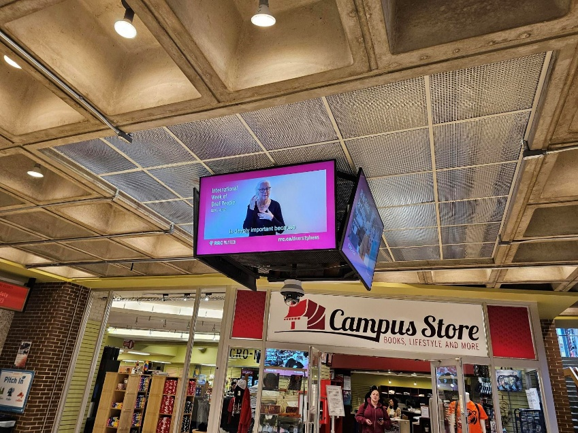
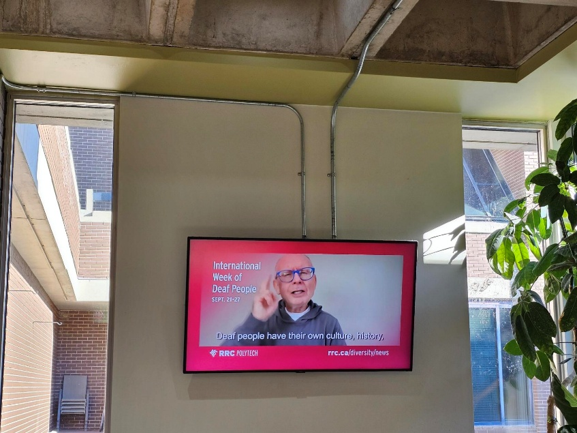
As part of the International Week of Deaf People 2026, RRC Polytech celebrated Deaf culture, sign languages and Deaf people’s human rights through a series of awareness and engagement activities across the institution. The celebration included raising the Deaf Flag at the Notre Dame Campus, illuminating the Exchange District Campus in blue for the International Day of Sign Languages, sharing a daily ASL learning series, and promoting accessibility resources and supports available across the Polytech.

A highlight of this year’s celebration was a collaborative video featuring members of RRC Polytech’s Deaf community, including Cindy Gent, Denise Watson-Jarigen, April Riel, Rick Zimmer and Deborah Owczar. Through their stories and reflections, participants shared the importance of ASL, Deaf culture and community. For the first time, the video was featured on campus digital screens and through internal communication channels, helping increase visibility, awareness and understanding of Deaf experiences across the College.

By creating opportunities for learning, dialogue and representation, the celebration helped raise awareness of Deaf culture and communication access while reinforcing RRC Polytech’s commitment to accessibility, inclusion and belonging for Deaf and Hard of Hearing students and employees.

Building Accessibility Knowledge Through the Accessibility Quick Tips Hub

November 10, 2026

To support ongoing accessibility awareness and learning, RRC Polytech launched the Accessibility Quick Tips Hub, a centralized resource that brings together accessibility guidance, tools and practical tips for employees. Building on the Accessibility Quick Tips campaign launched in 2024, the hub now provides access to more than 40 accessibility tips covering topics such as accessible documents, meetings, communications, digital content, Universal Design for Learning, neurodiversity and inclusive practices.

The hub makes accessibility information easier to find, access and revisit, helping employees build accessibility knowledge and apply inclusive practices in their everyday work.

Using Data to Improve Accessible Learning

November 10, 2026

The Centre for Learning and Program Excellence (CLPE), in partnership with Institutional Analysis and Planning (IAP), developed an Accessibility Dashboard to help academic leaders monitor and improve the accessibility of course content in LEARN. Led by Matt Miles, Katherine Coley, Christopher Bryan and Miguel Rivera, the dashboard uses data from the YuJa Panorama accessibility checker to provide visibility into course accessibility scores at the course, program, and school levels. By helping leaders identify accessibility issues, track trends over time, and prioritize improvements, the dashboard supports a culture of continuous improvement in accessible course design. This initiative strengthens RRC Polytech’s ability to monitor accessibility compliance, support instructors and improve equitable access to learning for students.

Accessibility Service Disruptions Webpage

November 10, 2026

RRC Polytech launched a dedicated Accessibility Service Disruptions webpage to provide timely information about significant or extended disruptions to accessibility features, such as elevators, automatic door openers, accessible washrooms and lifts. Developed through collaboration between Facilities Management, Marketing and Web Presence, and People Services, the webpage helps students, employees and visitors access information about affected accessibility features, anticipated timelines for resolution, and alternative ways to access services.

By providing advance notice and a centralized source of information, this initiative helps reduce barriers, support informed planning and enhance accessibility across RRC Polytech campuses.

Advancing Accessible and Inclusive Library Services

November 10, 2026

The Resource Management Team in RRC Polytech’s Library and Academic Services has made a significant impact on accessibility, inclusion, and reconciliation by reimagining how learners discover and access information. By embedding accessibility into library resource procurement and collection development, expanding alternate format options, implementing accessible service requests, and ensuring captioning for all library-hosted video content, the team has reduced barriers and created a more equitable learning experience for students and employees. The team also initiated an innovative Indigenous Subject Headings project, replacing outdated colonial language in the Library Catalogue with culturally accurate, community-informed terminology developed in partnership with Indigenous collaborators. Together, these initiatives have improved access, discoverability, and representation, while advancing RRC Polytech’s commitments to EDIA, Truth and Reconciliation, and student success. This work has enhanced the user experience by improving accessible, inclusive, and reconciliation-focused library practices.

Exploring Accessibility Through Accessible Document

November 10, 2026

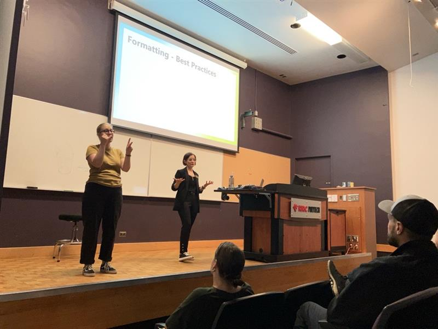
A presenter delivers an accessibility workshop in a lecture hall while an American Sign Language (ASL) interpreter provides interpretation beside the stage. A presentation slide on formatting best practices is displayed as participants learn about creating accessible documents and presentations.

As part of a professional development session delivered to the Work-Integrated Learning and Career Services (WIL&CS) Department on September 3, 2026, Lina Calderon facilitated “Exploring Accessibility”, a learning session focused on creating accessible documents and presentations. The session highlighted RRC Polytech’s commitment to accessibility and provided practical strategies for making content more accessible to a wider range of users, including individuals who rely on assistive technologies.

Through demonstrations and interactive activities using Microsoft Word, PowerPoint and Excel, participants learned six key accessibility habits: using proper document structure, describing visuals with alternative text, creating meaningful hyperlinks, making tables accessible, improving readability through clear formatting and plain language, and effectively using accessibility checking tools. The session emphasized that accessibility should be considered during content creation rather than added as an afterthought.

By equipping employees with practical skills and resources, “Exploring Accessibility” helped strengthen awareness of accessible communication practices and support the creation of more inclusive documents, presentations, and learning materials across RRC Polytech.

Improving Accessibility in Career Services Resources

November 9, 2026

Career Services redesigned its LEARN shell to create a more accessible, user-friendly and engaging experience for students accessing career development resources. Content was reorganized into clear modules, lengthy PowerPoint presentations and recorded workshops were replaced with accessible HTML lesson pages, plain language, proper heading structures, alternative text and knowledge checks were incorporated to improve navigation, comprehension, and accessibility. These changes support accessibility at RRC Polytech by making information easier to find, understand and use, while improving compatibility with assistive technologies. The updated LEARN shell helps students access career resources more independently, engage more effectively with learning content and connect with Career Advisors when one-on-one support is needed.

Building Inclusive Healthcare Simulation Experiences 

November 9, 2026

Nursing instructors Brikena Dibra and Diane Ammeter developed a simulation scenario that helps nursing students explore the impacts of distrust, bias and racism within the healthcare system. Through a simulation built on real-life experiences, students practice recognizing barriers, responding with empathy and professionalism, and building trust with racialized patients in a safe learning environment. The scenario was developed with input from Terri-Lynn Anderson and Wade Parke to support meaningful learning while maintaining students’ psychological safety. 

This initiative is a strong example of how experiential learning can foster empathy, awareness, and more inclusive interactions in service environments. By helping future healthcare professionals recognize and address their own biases and assumptions, the simulation supports accessibility, inclusion and culturally safe service delivery. 

Building on this work, the Simulation Centre is exploring accessibility-focused simulation opportunities informed by discussions with programs in the School of Health Sciences and Community Services, including Disability and Community Support and ASL–English Interpretation. Ongoing consultations with faculty, community organizations and RRC Polytech employee working groups are helping shape future simulation experiences. The Sim Centre team also plans to establish a community of practice and a network of individuals with lived experience who can contribute to scenario development. Together, these efforts support RRC Polytech’s commitment to accessible, inclusive, and person-centered services. 

Accessible Childcare – A Necessity, Not a Privilege 

November 9, 2026

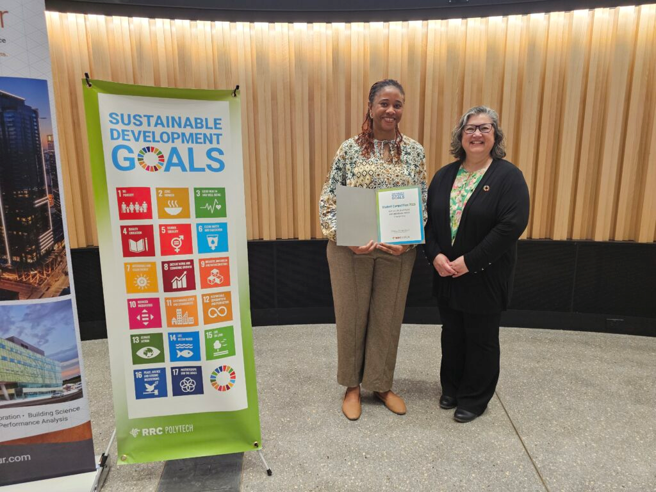
Two individuals stand beside a Sustainable Development Goals banner, with one holding an award certificate recognizing a project that raised awareness of childcare as an accessibility and inclusion issue for students and families.

From left: Edwige Ozo, winner of the Top Equity, Diversity and Inclusion Entry, and Kathleen Tiede from event sponsor Crosier Kilgour

As part of an RRC Polytech course project that was later submitted to the Sustainable Development Goals (SDG) Student Competition organized by the RRC Polytech Sustainability Office, Edwige Ozo explored how access to affordable and available childcare can affect a person’s ability to participate in education, employment and community life. Through research and personal experience as a newcomer and parent, the project highlighted childcare as an accessibility issue, recognizing that caregiving responsibilities can create significant barriers for students and families. “Accessible Childcare: A Necessity, Not a Privilege” encouraged a broader understanding of accessibility by emphasizing that equitable access to education extends beyond physical accommodations and includes supports that enable full participation. The project was recognized with the Top Equity, Diversity and Inclusion Entry Award and helped raise awareness of the role childcare plays in creating more inclusive opportunities for learners and caregivers. 

RRC Polytech campuses are located on the lands of the Anishinaabeg, Ininiwak, Anishininwak, Dakota Oyate, and Denésuline, and the National Homeland of the Red River Métis.

We recognize and honour Treaty 3 Territory Shoal Lake 40 First Nation, the source of Winnipeg’s clean drinking water. In addition, we acknowledge Treaty Territories which provide us with access to electricity we use in both our personal and professional lives.