Health Minds Healthy College

Campus Well-Being

Mental Health

An Impactful Mental Illness Awareness Week at RRC

October 8, 2017

Last week, RRC observed Mental Illness Awareness Week by learning about the realities individuals face when they experience mental illness. Since we know that many staff, students, and faculty members will experience mental health problems and illness, understanding the illness and recovery process is an important part of working toward a more supportive and inclusive campus community.
Learning About Recovery Through Art and Community

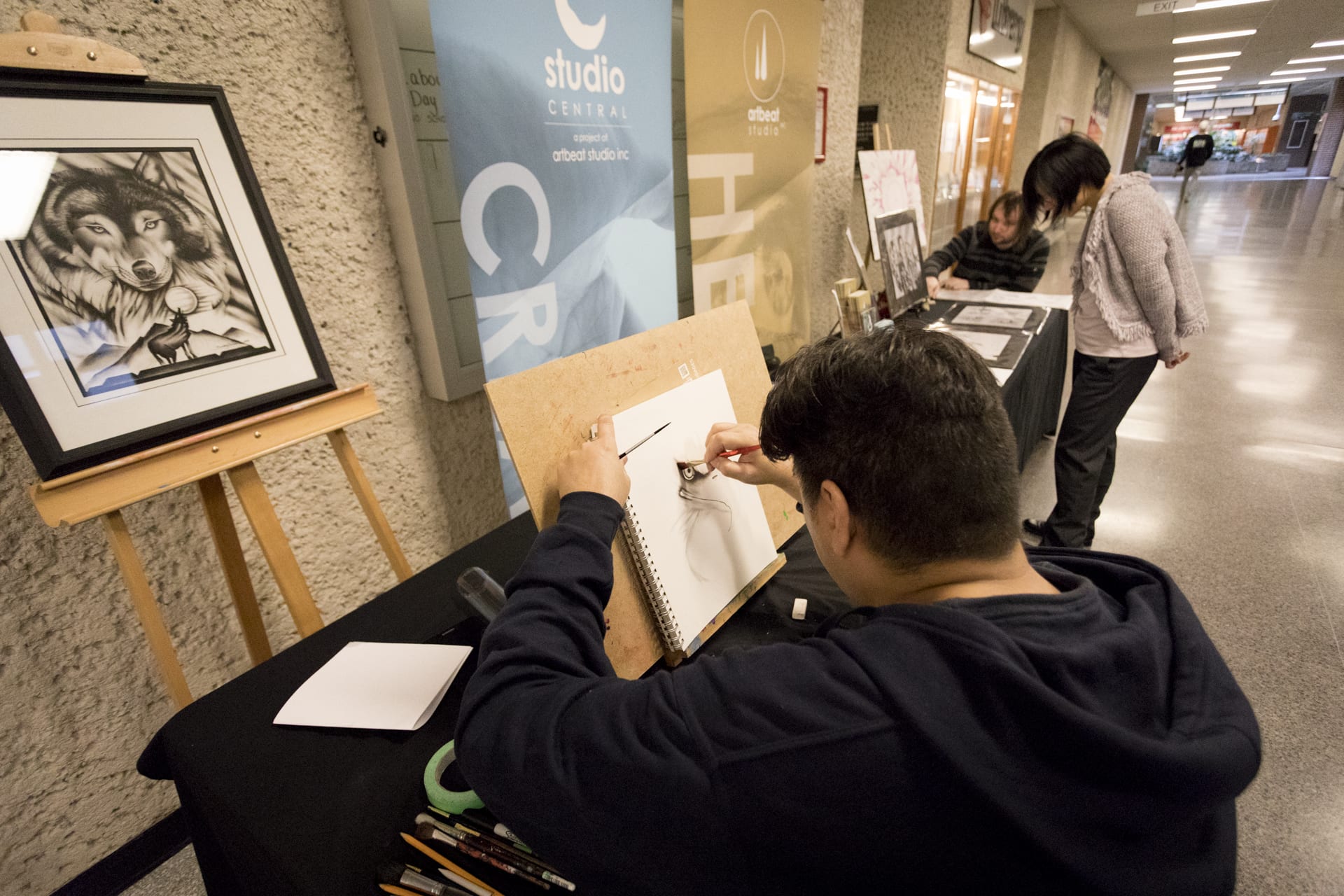
Local non-profit, Artbeat Studio, visited both NDC and EDC to spread the word about their community based, peer directed program that supports artists with lived mental illness experiences to heal through art and community. You can catch the City News coverage here: City News and Artbeat at RRC
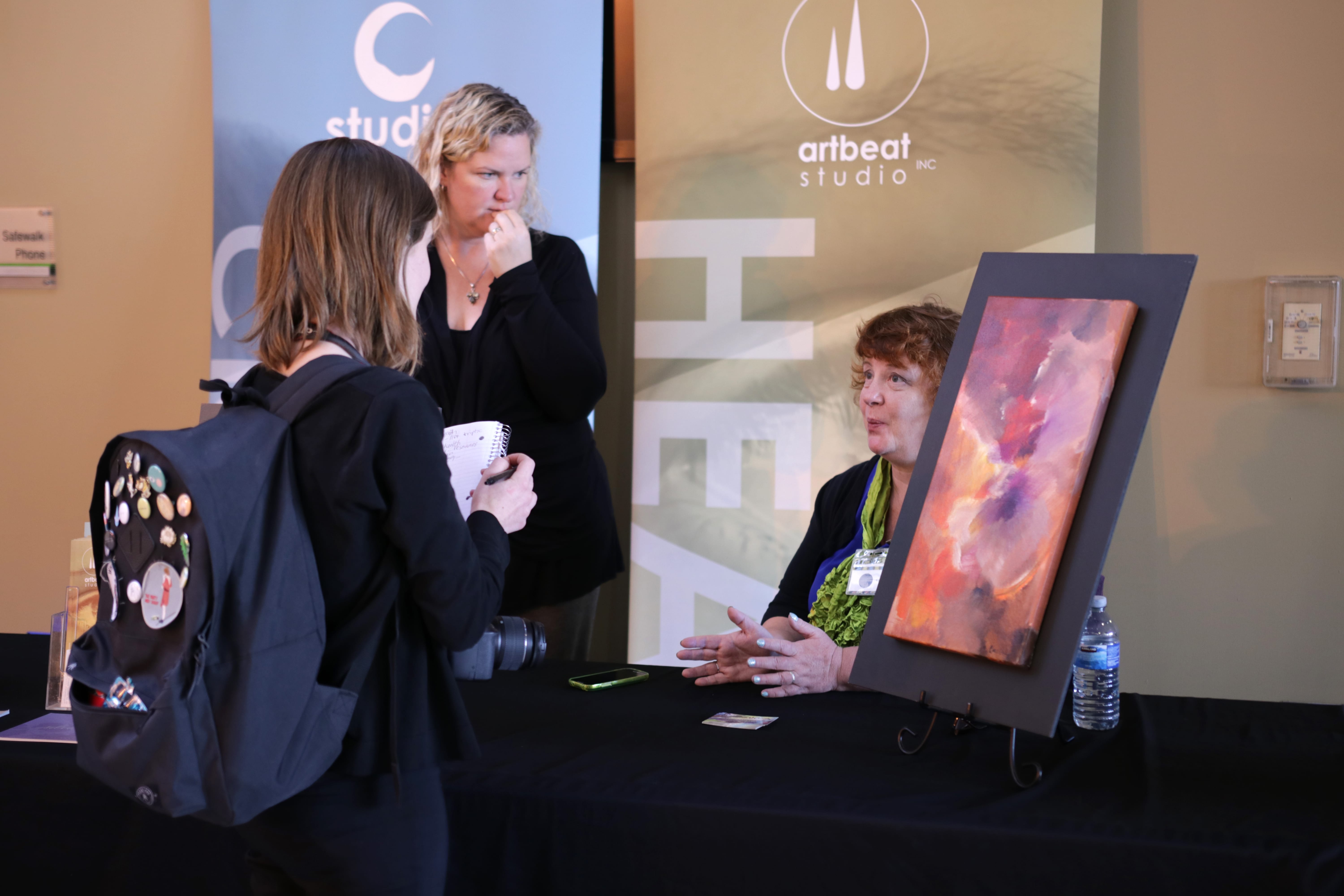
The artists who visited our campuses are: Bradley Guiboche; Nicholas Ahrens-Townshend; and Kathleen Crosby.

Learning About Anxiety Disorders

Further, we were pleased to host talks by Sarah Petty and Kendall McLean from the Anxiety Disorders Association of Manitoba (ADAM); a non-profit, peer-led self help organization  where all staff have personally experienced and overcome the disabling effects of anxiety, and are now sharing that knowledge and hope with others.

If you missed the talks, we’re thankful that eTV Studio recorded Sarah’s presentation and has posted the link to view it here.

Learning about Schizophrenia

Courtesy of the Manitoba Schizophrenia Society

On Thursday, October 5th we hosted the Manitoba Schizophrenia Society; a non-profit, charitable, community-based mental health organization whose mission is to improve the quality of life for those affected with schizophrenia and psychosis. Speaker Jane Burpee helped us better understand this disorder, which effects one per cent of the population. You can find the video recording of her talk here.

Learn More

The Canadian Alliance on Mental Illness and Mental Health is the driving force behind Mental Illness Awareness Week annually. One of MIAW’s major initiatives is the Faces of Mental Illness campaign, a national outreach campaign featuring the stories of Canadians living in recovery from mental illness. Five Canadians have shared their stories so that you and I can better understand illnesses like Depression, Bipolar Disorder, Schizophrenia, Obsessive Compulsive Disorder, ADHD, and Generalized Anxiety Disorder. You can read bios and watch video clips put together by this national campaign.

If, as you learn more about these disorders, you feel you might be experiencing one yourself, please reach out for help. Your family doctor is often a good place to start. RRC staff can also access our Employee and Family Assistance Plan. RRC students can complete an intake form in order to access confidential Counselling services. People who experience mental illness can get help, get better, and live a good life.

Breanna Sawatzky, Mental Health Coordinator

Mental Illness Awareness Week

September 20, 2017

Mental Illness Awareness Week

Mental Illness Awareness Week (MIAW) is an annual national public education campaign designed to help open the eyes of Canadians to the reality of mental illness. Many people who work and learn at RRC have experienced or will experience mental illness in their lifetime.Show your support for an inclusive campus community by attending one or more of or MIAW events.

Art Show by Artbeat Studio

Artbeat Studio is a mental health consumer initiated, peer-directed, recovery oriented program providing studio space, mentorship and more to artists living with mental illness. Come view artwork and chat with an artist about the power of art and community to promote healing.

NDC: Tuesday, Oct 3rd noon-2:00 pm, Library Hallway

EDC: Thursday, Oct 5th noon- 2:00 pm, Atrium

Coping with Anxiety as a Student: A Lived Experience

The Anxiety Disorders Association of Manitoba is a peer-led organization whose staff have personally experienced and overcome the disabling effects of anxiety. Attend this talk where the presenter will share knowledge about Anxiety Disorders as well as strategies to cope in an academic and workplace setting.

NDC: Wednesday, Oct 4th, noon-1:00 pm, Orange lecture theatre, livestreaming available

EDC: Wednesday, Oct 4th, noon-1:00 pm, P107

All About Schizophrenia

One percent of the population live with Schizophrenia so chances are you’ll work with, learn with, or teach someone who has this diagnosis. Attend this talk, by the Manitoba Schizophrenia Society, to increase your knowledge about Schizophrenia and Psychosis, while having your questions answered by the experts.

NDC: Thursday, October 5th, 11:00-noon, White lecture theatre, livestreaming available

Faces of Mental Illness Campaign

The Faces of Mental Illness is a national outreach campaign featuring the stories of Canadians living in recovery from mental illness. Posters featuring the Faces will be all over campus in an effort to raise awareness and end the stigma associated with mental illness.

If you’d like a poster to put up in your area, please contact blsawatzky@rrc.ca.

Multitasking, Memory, and Meeting Deadlines

September 19, 2017

Do you often have your phone on your desk while you work or study? Do you have multiple browser tabs open at once, checking social media while working on an assignment?  Do you quickly check your email during a lecture or presentation? If you answered yes, you’re not alone; these are common habits for most people, including students.

If you’re trying to make the most of your time and meet deadlines efficiently, however, this kind of multitasking may be sabotaging your efforts. “Switching cost” is the term Psychologists use to describe the price of changing from one task to another.  Researchers have found that switching attention like this leads us to take longer to complete a task, remember less, and make more errors. For busy students who are trying to balance demanding programs, home responsibilities, and self-care there’s certainly no time to waste!

In fact, the switching cost, or time and quality loss, is higher when the tasks were doing are more complicated. For example, searching for your keys and walking to your car are not very demanding tasks, so you may not experience much of a cost for multitasking. But, completing difficult math problems and engaging in a text conversation are complicated tasks where you’d likely take longer and make more errors if you were to multitask.

So, what can we do? Try devoting a set amount of time to one task and rewarding yourself with a break to take a walk, stretch, check email, or respond to a text. When you’re not on a break, turn off all notification sounds or vibrations and close other browser tabs. It will likely feel mentally difficult to resist the urge to switch tasks, but remember that feeling of difficulty is actually your brain getting better at focusing.

A helpful free App to check out is Focus Keeper: Work & Study Timer (available for iPhone). It uses a timer to help you manage your focused times and break times. Read a review here. If you know of an App that helps you avoid multitasking and increase your productivity, place your recommendation in the comments.

Breanna Sawatzky, Mental Health Coordinator

The Rebel in You – A 12 Week Wellness Program

September 5, 2017

Sometimes starting an exercise program can be more challenging than the working out itself. Having to figure out how to get started, learning new terminology to what’s the difference between a rep and a set as well as knowing what to exactly do while in the gym. That is why we designed a custom program specific for The Rebel in You.

This program is a complete guide to getting moving and started on a journey of healthy living. Inside you’ll learn different terms and a glossary of definitions. The program booklet has advice as to why being active is the right thing for you to do and it gives tips to help keep you on track, even when we find ourselves with a setback, we can still learn from it and use the tips to get back on. You will be shown how to find your target heart rate to make sure that when you are training aerobically you are being efficient and reaching the level needed to reach your goals. It also helps you with how to make and set goals!

Included in the program booklet is a couple of full workout programs, which you can do at your own pace and you can keep track of it with the weekly calendar data chart to measure progress. Each program can be done for the entirety of the 12 weeks, or you can switch to another one if you feel you’d like to be challenged a bit more from the previous program. One of the programs is designed without any equipment which means it can help you become more familiar with movement and your body but also it means you can also do it at home. At the end of a workout or on a day you feel you need a stretch you can use the stretching guidelines to help balance out the work you’ve been putting in from the exercising.

Regardless of your level of fitness or experience, this program is designed to help you get a little bit more from your wellness plans and to help guide you in a total wellness program. The Rebel in You wellness booklet can be found on our website and it is free to download. Feel free to ask coworkers to join in, or family members to help provide support and a bit of social gathering time while you do something good for you. To be well is less about how you “should” go to the gym, or about the time you denied yourself dessert but more of an understanding that you matter and are important. That the higher value you place on yourself to take one more step or do one more rep pays out not only in your future self but also in your present self. We all are living a life where life happens, so we do not need to wait for life to happen in the “right way” for us to be well but we can practice being well in ourselves with each moment so that we create a life of wellness and well-being.


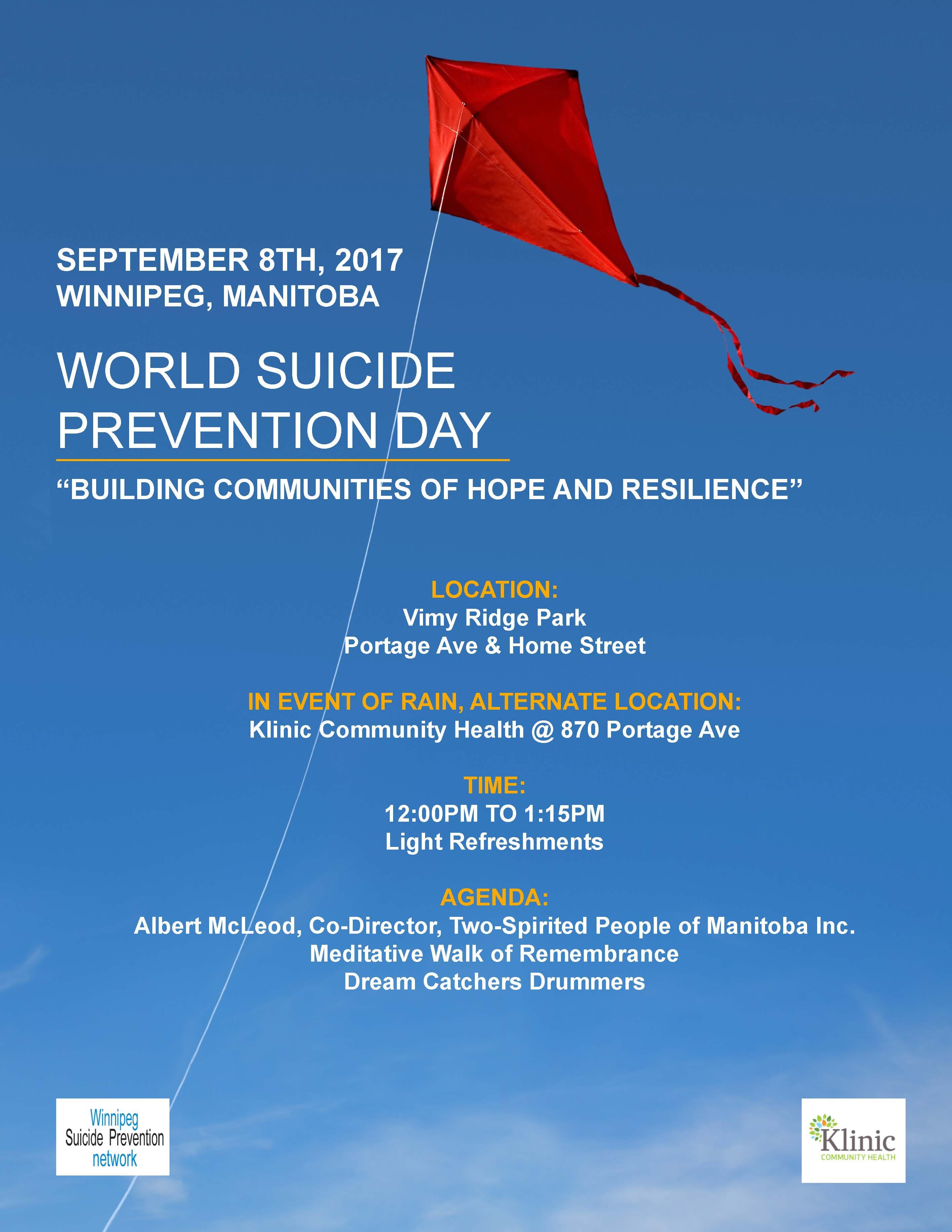
Observe World Suicide Prevention Day with RRC

August 28, 2017

Each year, roughly 4000 Canadians die by suicide. Not only are these losses tragic, but each individual who dies by suicide was no doubt connected to a community of people who will experience complex grief. There are family members, colleagues, and friends who are left to sort through intense feelings, sometimes of helplessness, guilt, or pain.

The Winnipeg Suicide Prevention Network (WSPN) recognizes that communities like RRC have an important role to play in both preventing suicide and supporting individual and collective healing; we agree. Laureen Janzen, Manager of Counselling and Accessibility Services, is a WSPN member and has been helping to plan World Suicide Prevention Day 2017. There will be a free public event over the noon hour on September 8th.

As part of the Healthy Minds Healthy College initiative at RRC, we would like to invite staff, students, and faculty to join us in observing this important day. This year’s theme is “Building Communities of Hope and Resilience.” Please contact Breanna Sawatzky at blsawatzky@rrc.ca if you are interested in attending with the RRC group. As you will see below, the event is about an hour in length and is open to all in the community.

Support for Alcoholism Recovery Coming to Campus

August 22, 2017

This Autumn, there will be an additional support on campus to help individuals attain recovery and wellness: an Alcoholics Anonymous (AA) group.

According to AA, Alcoholics Anonymous is a fellowship of men and women who share their experience, strength and hope with each other that they may solve their common problem and help others to recover from alcoholism.

For more information about AA, and answers to frequently asked questions, visit http://www.aamanitoba.org/

At this point, we are asking any individuals who would like to either help start the group, or attend the group contact Steve (with AA) or Breanna (RRC’s Mental Health Coordinator) so that we can decide on a day and time to hold the meeting.

Contacts

Steve: area80picpc@gmail.com

Breanna: blsawatzky@rrc.ca


Struggle and Strength

May 17, 2017

My 4-year old’s “Spidey Sense” always seems to kick when I am in the grip of stress, even when I try to hide it from him. I know he can tell if I’m frustrated, or anxious, or worried, or panicked, even if I do my best to seem cool and “together”. Sometimes he takes advantage of the moment and fuels the fire by acting out, and other times he offers an awesome leg hug. Either way, he notices.

Knowing that my kids see me not just at my best but also my worst is normal, but it can be hard. I think that for many of us, it’s an emotional battle to allow young people to see us truly struggling, whether in anger, sadness, disappointment, or stress – without feeling shame.

Have you ever read the work of Brene Brown? If you haven’t come across her yet, you are in for a bit of a life-changer.

Brene is a “researcher-storyteller” who has opened up the conversation about vulnerability, shame and human connection. Among many other things, Brene has written a beautiful Manifesto on Wholehearted Parenting that can be printed as a poster (for free!)


What I really, really love is her call to parents – and indeed to anyone who cares for young people –to model struggle and strength so that kids and youth can witness how we navigate those challenging, and sometimes ugly, emotions.

The Manifesto also talks about making a commitment to model self-compassion and embrace imperfections in front of children.

When my daughter sees me forgive myself (sometimes by me actually saying, “Darn it. I forgot to call my dentist back. That’s okay – I forgive myself!) – it registers in her mind that this is something she can try too.

As we work through giving ourselves grace to be wholehearted with our kids, I know many parents also struggle with age-appropriate language, especially when confronting more serious struggles such as depression or anxiety. I recently came across a news article that provides some advice about this and I encourage you to give it a read and let me know what you think.

http://globalnews.ca/news/3425035/parents-this-is-how-to-tell-your-children-youre-dealing-with-depression-anxiety/

I’ll leave you with the invitation to check out the Wholehearted Parenting Manifesto.

And, to check out more of Brene Brown’s amazing work, go here: http://brenebrown.com/

Leave a comment and let me know what you think about this topic!

RRC piloting online mindfulness training for faculty and staff: Enter draw for a spot!

May 9, 2017

Red River College is piloting the evidence based 30 Day Mindfulness Challenge with 30 faculty and staff who will be selected by lottery. The training starts on Monday, May 29 and everyone who registers gets to take the Challenge for free with a buddy of their choice.

We’re pleased to pilot mindfulness training at the College as it dovetails nicely with our Healthy Minds Healthy College initiative’s goal of providing mental health supports in innovative ways. Faculty and staff who would like to be included in the lottery should email blsawatzky@rrc.ca by May 19.

The 30 Day Mindfulness Challenge has been implemented at the Mental Health Commission of Canada, UBC, WestJet, Memorial University, Harvard Law School and more. Research at Sauder School of Business found evidence that the Challenge lowers stress, increases resilience, improves teamwork, and strengthens leadership skills. The Challenge also teaches ‘mindfulness-in-action’ so people don’t need to stop what they are doing to become calmer, present and focused.

If the pilot is successful at RRC and we offer the Challenge again in the future, there may be a modest cost attached. Getting involved in the pilot is your chance to receive this training for free!

Guest Blog: Student Mental Health Story

May 3, 2017

The following is a guest blog from Laura McNaughton, Child and Youth Care student at the Notre Dame Campus.


Laura McNaughton, RRC Student

For a long time, I have felt like I’ve been living two lives. The life everyone else sees, and the life I see. These two lives are drastically different.

When I was in high school, I was known as the happiest kid in school. “She is always smiling”, “She’s so upbeat and happy”. I was sarcastic and witty and joyful, but as soon as I got home, I would sleep until the next day of school. Then I would put on my happy face again and be the other side of me. No one knew the side of me when I was alone. Even now, after I have told my story to others, they are shocked- they still always say to me “But you were so happy in high school”.

Laura’s original artwork.

Depression is like a paradox. You want the illness acknowledged, but at the same time, you also want to deny it. I guess I was in my denying stage at that time. Then I started to realize I was sinking way too far down into a hole. I was in a full blown depression, I was self harming, and to me that was my normal. I had people in my life who were there for me and helped me get through it, but it was still always there- like a friend that just won’t leave you alone. But they’re not really a friend, they’re this toxic being that helps to deteriorate you. I felt all alone, even though there were people all around me. And it took years for me to be able to look at myself and see someone who was worth being around, worth living, just worth it.

Mental health is a process….

Laura (left) helping bring therapy dogs to RRC as part of her student-led practicum in Child and Youth Care.

I am now 22 years old, and actually about to graduate the Child and Youth Care Program here at Red River College. For my last practicum in my course, I actually did this new, unique student led practicum. I was a mental health advocate, connecting with people and organizations all over the city, and helping to facilitate events. Some things I accomplished were; I helped bring therapy dogs to the college for students in exams, I joined an online peer support network, I joined the advisory committee here at the college, I went to mental health talks, created my own business cards and am currently working on my own mental health event. Basically, I did so much in this last 7 weeks that I am shocked. This is not where I thought my life would be.

Laura displaying her prescribed psychiatric medication.

I used to be anxious as all hell, and too depressed to get out of bed to come to school. I used to think I had no future, and I was not going to amount to anything. This last practicum has really helped me to flourish and become who I was meant to be. Mental health is something I am so passionate about, and because of that passion, I have seen my dream become a reality.

Don’t get me wrong- I still have my bad days, I’m still depressed and have those days where I can’t function, I am still anxious, I am on medication to help, but I have something in my life to look forward to. I have found something that gets me out of bed everyday- my passion for helping others.

Mental health is so important to understand, and I want all of us to be on the positive spectrum, but it is an everyday process. It is not something that is going to come easy for some, and that is ok. It is ok not to be ok! I want to be that support for people who feel so in the dark, they cannot see the light. I want to be that light for them.

I have and am currently struggling with a mental illness, but I am here to say, that it will not stop you from accomplishing what you want out of life. It might give you some hiccups here and there, but it is not your whole life. It is not you, it is a part of you- and you are strong and beautiful and amazing and you can do anything you set your mind to. Don’t listen to the lies your illness tells you, You can do it. I believe in you.

I used to be scared to talk about my issues openly, but if it can help someone else not feel alone then I am going to do it everyday for the rest of my life.

“I know its hard to understand, if its never happened to you, but just realize its important to talk about for someone to be able to get through


so lets start talking about mental illness – realize it is not a choice. these people are sick, and need more of a voice


We need to end the stigma around mental health, Stand up, make a change, and realize happiness is our greatest wealth”


-excerpt from poem by Laura McNaughton

If you would like to write a guest blog about your mental health journey, please contact Breanna, Mental Health Coordinator, at blsawatzky@rrc.ca.

“13 Reasons Why” and Responsible Discussions Around Suicide

April 27, 2017

There is currently a popular television series on Netflix that is centered around youth suicide and as such is opening discussions about this important topic. There is however, much criticism of how the show “13 Reasons Why” presents suicide and many are concerned that the popularity of the series will increase suicide ideation and attempts amongst viewers.

If you or someone you are working with is at risk of suicide, please call the confidential, 24/7, Toll-Free Manitoba Suicide Prevention & Support Line at 1-877-435-7170.

If you have watched the series or are likely to be interacting with folks who have watched the series, I suggest you read the following pieces which encourage responsible discussions around suicide.

Responding to 13 Reasons Why by Michael Redhead Champagne

Excerpt: I recently binge watched the new Netflix series 13 Reasons Why — All 13 episodes in 24 hours. To summarize, it is a series about a young woman who dies by suicide and leaves 13 cassette tapes behind t o share insights with 13 people who were the “reasons why”.

I was captivated. And horrified. And confused. And sad. And relieved.

Statement re: Netflix’s 13 Reasons Why series by The Centre for Suicide Prevention

Excerpt: This is a statement regarding the recent Netflix release, 13 Reasons Why, which follows the story of a young girl who dies by suicide.

The Centre for Suicide Prevention (CSP) is concerned that the Netflix adaptation of Jay Asher’s 13 Reasons Why novel does not follow the Canadian Association of Suicide Prevention and the American Association of Suicidology’s media guidelines.

CHMA National Statement Responding to Netflix Series: 13 Reasons Why

Excerpt:

The following are ways in which portrayals of suicide may be harmful:

  • They may simplify suicide, such as, by suggesting that bullying alone is the cause;
  • They may make suicide seem romantic, such as, by putting it in the context of a Hollywood plot line;
  • They may portray suicide as a logical or viable option;
  • They may display graphic representations of suicide which may be harmful to viewers, especially young ones; and/or
  • They may advance the false notion that suicides are a way to teach others a lesson.

Suicide is an important public health issue and must be treated as such. Responsible, informed conversations around suicide are important to reducing stigma and ensuring those at risk get the help they need.

Breanna Sawatzky, Mental Health Coordinator (blsawatzky@rrc.ca)

RRC Polytech campuses are located on the lands of the Anishinaabeg, Ininiwak, Anishininwak, Dakota Oyate, and Denésuline, and the National Homeland of the Red River Métis.

We recognize and honour Treaty 3 Territory Shoal Lake 40 First Nation, the source of Winnipeg’s clean drinking water. In addition, we acknowledge Treaty Territories which provide us with access to electricity we use in both our personal and professional lives.