Celebrating Sustainability Leadership: Excellence in Sustainability Award Winner — Ginger Arnold
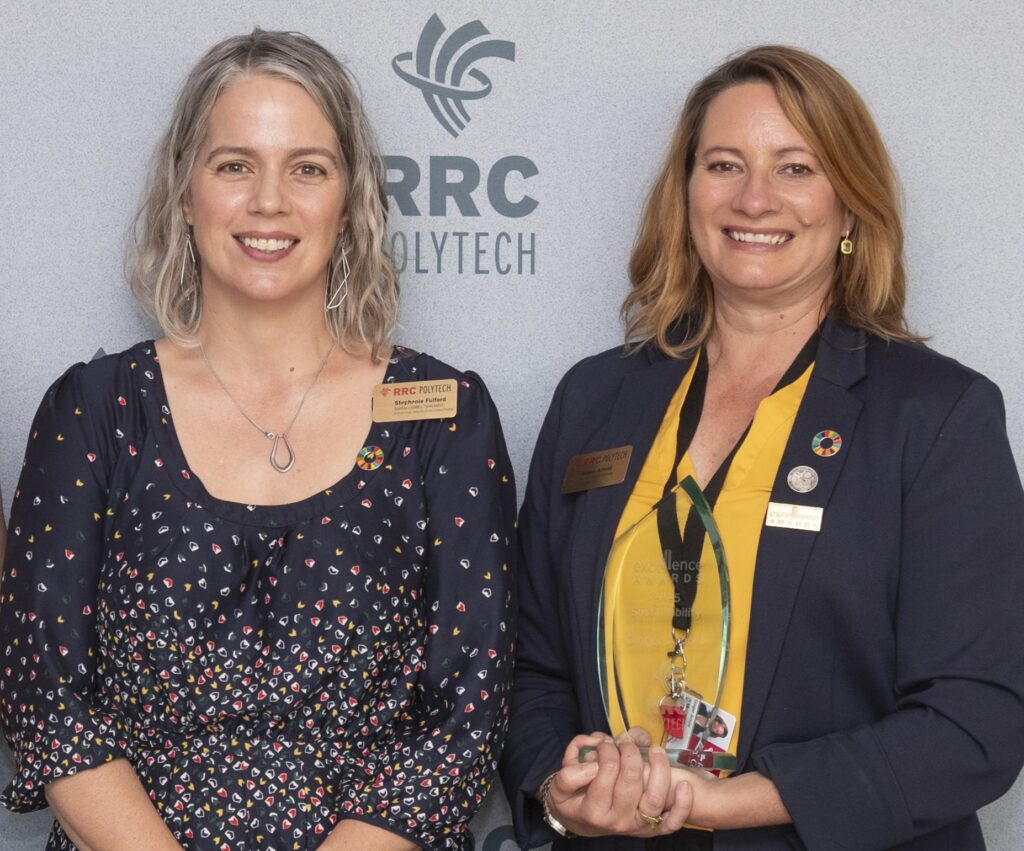
Excellence in Sustainability Award Winner, Ginger Arnold (right), with Stephanie Fulford, RRC Polytech’s Sustainability Specialist.
RRC Polytech is proud to recognize Ginger Arnold as one of this past year’s recipients of the Excellence in Sustainability Award. Her story is a meaningful reminder that sustainability is not only a professional commitment, but a way of seeing, living, and learning that grows through connection to land, community and people.
Rooted in the Land
Ginger’s journey in sustainability began long before she entered the field. She grew up between her grandparents’ farm in rural Manitoba and a remote log cabin on an island in Lake of the Woods, two landscapes that shaped her deeply. As Ginger reflects, “My childhood was grounded in nature. I was always outside, in every season, and that shaped how I see the world and what I care about.”
A high school marine biology course strengthened this connection. Through field trips, hands-on research and a study experience in Belize, she discovered how powerful it felt “to understand the world more deeply and to care for it more intentionally,” a realization that set her on a lifelong path of environmental learning and community-centered work.
A Career Shaped by Community and Environmental Care
Ginger’s career carried her across the North, where she worked in Yellowknife as a Fish Habitat Biologist with Fisheries and Oceans Canada and later with Natural Resources Canada, supporting environmental monitoring and field studies in partnership with Indigenous communities. Her work took her to remote regions along the Mackenzie River, where she lived in a wall tent for weeks at a time while conducting baseline monitoring with community members. She also spent time working in Churchill and held a role with Bird Studies Canada, contributing to research and community-engaged science before returning to Winnipeg.
For the next ten years, Ginger served with the Province of Manitoba in the Department of Conservation, later called Sustainable Development, as a Senior Policy Analyst in Indigenous Relations. In that role, she supported policy development, interdepartmental collaboration and initiatives advancing sustainability, community engagement and the Truth and Reconciliation Commission Calls to Action.
These experiences gave Ginger a deep understanding of how environmental work and Indigenous knowledge inform one another. She carried this perspective with her when she joined RRC Polytech as an instructor in the Social Innovation and Community Development program, supporting learners who want to make a difference in their communities through social and environmental change.
Today, alongside her work as an instructor, Ginger is leading the development of the new Moojigitoodaa Aki – Environmental Studies and Land Relations program. She also serves as the Employee Representative on the Board of Governors at RRC Polytech, ensuring that staff voices contribute to the institution’s governance and long-term planning.
Designing a Program Centered on Land, Community and Sustainability
Ginger is currently working on the development of the Moojigitoodaa Aki – Environmental Studies and Land Relations program, a two-year diploma shaped by community voices and grounded in land-based learning. As she explained, “Two-eyed seeing allows us to bring Indigenous and Western knowledge together,” a principle that guides every stage of the program’s design.
The program began with a request from an Indigenous community seeking graduates who understood both environmental science and land-based knowledge. After many conversations with communities and industry, the program now reflects what people shared. It responds to a growing demand across Manitoba and beyond for professionals who can navigate environmental challenges while working respectfully with communities and the land.
Teaching Sustainability as Shared Learning
Ginger’s dedication to embedding sustainability into curriculum has shaped the learning experience of every student she has taught. Courses such as Impact of Climate Change on Communities and Reconciling Our Economic Futures have encouraged learners to think critically about environmental issues and their responsibilities within their own communities.
For Ginger, teaching sustainability begins with creating space for multiple worldviews. She believes that students learn best when they are invited to explore how land, community, and the environment connect in their own lives. To help students navigate these perspectives, she grounds her teaching in frameworks such as the UN Sustainable Development Goals, the Truth and Reconciliation Commission Calls to Action, and the United Nations Declaration on the Rights of Indigenous Peoples. These tools, she noted, offer a shared language for understanding global challenges while also valuing Indigenous knowledge and community experience.
Ginger describes her classroom as a place of reciprocal learning. “I learn just as much from students and community partners as they learn from me,” she said. “That exchange is one of the most meaningful parts of this work.”
Supporting Sustainability Across the College
Ginger’s contributions extend well beyond her teaching role. She has consistently demonstrated a deep commitment to advancing sustainability at RRC Polytech, volunteering her time to support College-wide initiatives, strengthen the curriculum, and encourage community engagement. Her influence reaches students, colleagues, and partners across the country.
She has led workshops that explore how the Sustainable Development Goals connect with the Truth and Reconciliation Commission Calls to Action, helping staff reflect on how global sustainability frameworks relate to local responsibilities. This included a presentation during Truth and Reconciliation and Community Engagement Week, as well as a national webinar for Colleges and Institutes Canada (CICan), where she shared practical approaches for integrating sustainability and reconciliation in post-secondary education.
Ginger also played a key role in developing the College’s SDG Student Competition, providing guidance and serving on the adjudication committee. She finds this work especially meaningful because it allows her to see how students interpret sustainability through their own identities, studies and lived experiences. Their creativity continually inspires her and reinforces the importance of integrating sustainability across all programs.
Looking Forward
When Ginger imagines the future of sustainability education at RRC Polytech, she sees a campus where learning extends far beyond the classroom, with naturalized spaces and places where students and community members can gather, learn, and feel connected to the land. She is especially excited about expanding project-based learning, creating more opportunities for fieldwork and strengthening partnerships with First Nations and Métis communities.
Ginger Arnold’s story is a powerful example of leadership rooted in community, reciprocity, and respect for the land. Her commitment has strengthened sustainability learning at RRC Polytech and inspired change both locally and nationally. RRC Polytech is proud to celebrate her contributions and the lasting impact she brings to sustainability and education.