RRC Polytech Advanced Care Paramedic Grad One of First New Clinical Service Leaders in Manitoba
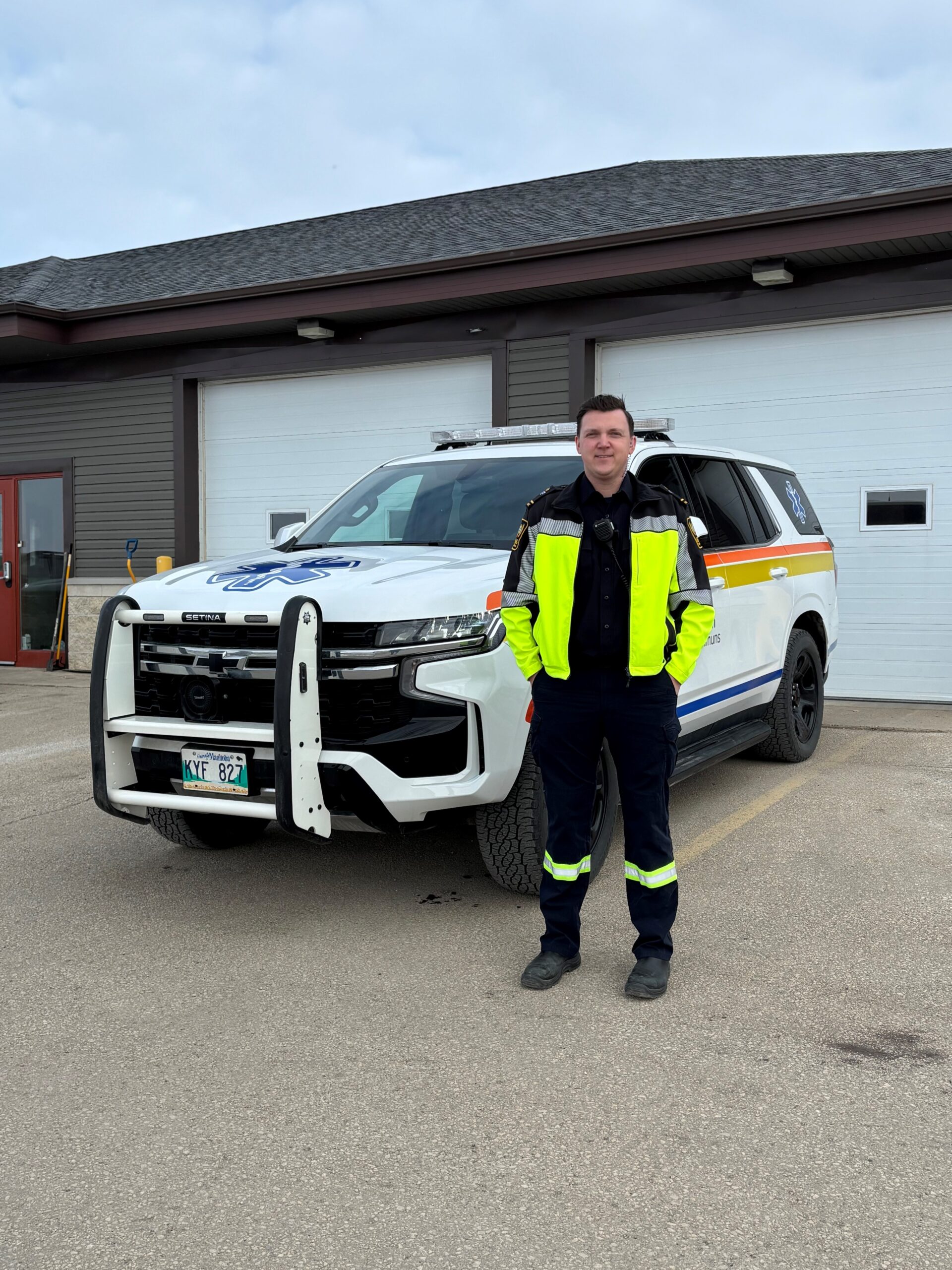
Six weeks after Nick Bourgeois first heard RRC Polytech’s Advanced Care Paramedicine (ACP) program would be offered again, he was enrolled and on a path that would make him one of the first new Clinical Service Leaders (CSL) in rural Manitoba.
“I’d been working as a Primary Care Paramedic for about five years,” says Bourgeois. “I was looking to advance my knowledge, and ACP felt like the perfect fit. I heard about the program through station chatter and applied right away.”
Working full-time while studying in an intensive program wasn’t easy. Bourgeois and his two classmates, Jamie Borock and Breanna Koch, juggled demanding shifts with learning new knowledge and skills. Throughout the challenges of the program, Bourgeois and his classmates credit their instructors’ passion for teaching, interest in the career and constant support for their success.

“The support we received from our instructors was incredible,” he says. “I didn’t really know what to expect going in, but the amount of content was a surprise—there was a lot of it, and it was all relevant. No corners were cut.”
That rigor paid off. When it came time to write the national ACP exam through the Canadian Organization of Paramedic Regulators, Bourgeois and his classmates all scored in the “green” – the highest performance tier, which he says is a testament to how well the program and instructors prepared them.
The Advanced Care Paramedicine program was revised and relaunched in Spring 2023, with Bourgeois, Borock and Koch as the first cohort. The 28-month program trains students in to be leaders in stressful situations and to take a clinical approach in the field. Courses include Advanced Respiratory Studies, Advanced Trauma Studies, Advanced Pharmacology and other courses that increase what decisions an ACP can make and what medicines they can use when responding to people in need.
“We’re proud to see the first cohort of the revised Advanced Care Paramedicine program graduate and enter the next stage of their careers,” says Tammy Harper, Associate Dean, Health and Community Services at RRC Polytech. “RRC Polytech works closely with Shared Health to determine what training and skills are needed and we’re confident that these students and future cohorts are re-entering the field as confident leaders.”
Now as a recent graduate, Bourgeois is stepping into a new role as one of the first CSLs in rural Manitoba. Fourteen CSLs have been strategically located in seven rural and northern areas of the province – Portage la Prairie, Flin Flon, Dauphin, Ashern, Neepawa, Swan River and Lac du Bonnet – and play a crucial role in improving emergency response and accessible patient care.
“We support crews on scene and also take care of operational duties. It’s a different way of delivering care, and it’s exciting to be part of something new,” he says.
The opportunity is one he couldn’t have imagined when he first started in the field.
“When I started as a paramedic, and even when I applied to the ACP program, there weren’t any ACP positions in rural areas. It felt like a bit of a risk,” he says. “But the timing worked out perfectly. I’m excited to see the ACP profession progress in rural Manitoba, and I look forward to providing a higher level of care that rural Manitobans deserve.”
The Paramedicine – Advanced Care program continues to evolve based on industry and community needs, and will begin to incorporate more simulated scenarios with other programs through RRC Polytech’s Interdisciplinary Health and Community Services Simulation Centre.
Visit RRC Polytech’s Program Explorer for more information.