Reflections on Racism: Story, Spirit, and Immersion at RRC Polytech
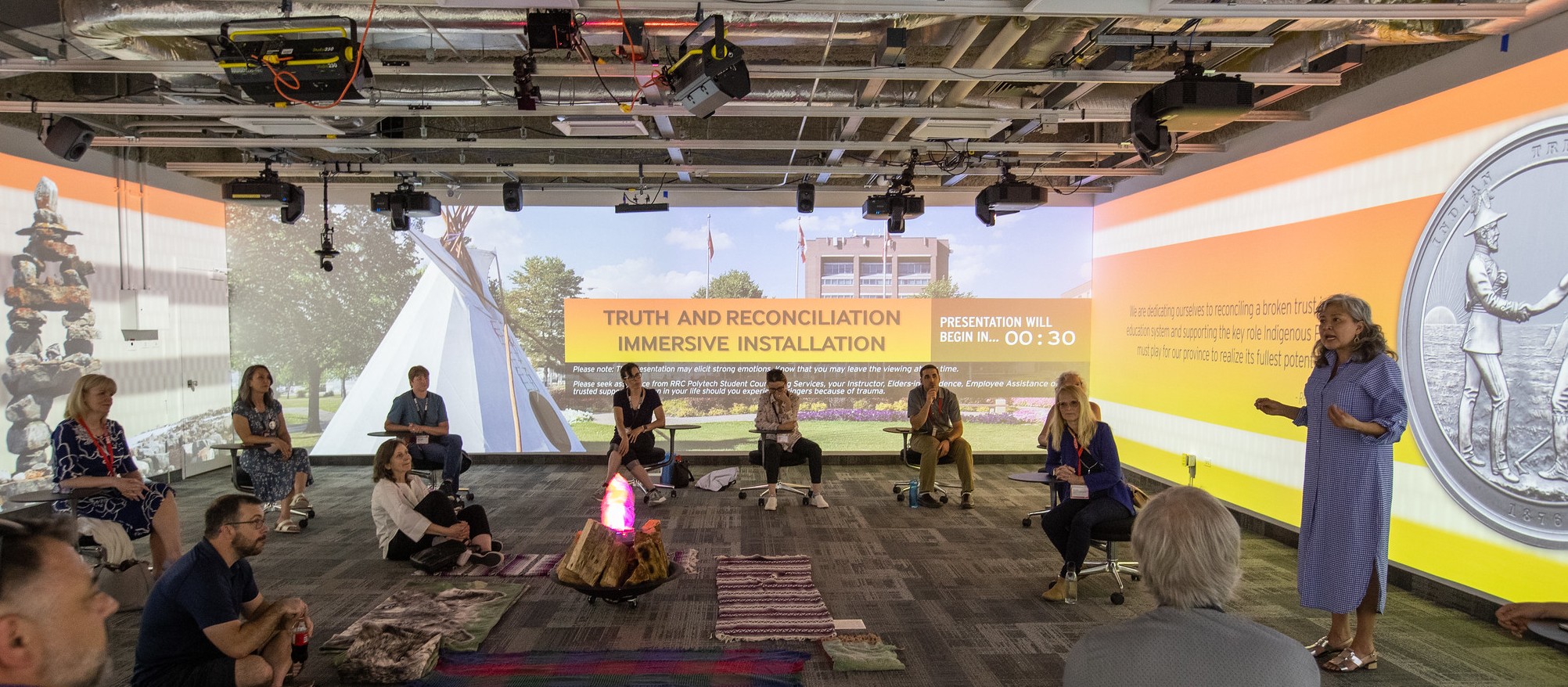
When you step inside the Emerging Media and Production (EMP) Immersion Room at RRC Polytech, you aren’t just entering a space – you’re entering a story.
Ininew artist Heather Endall has partnered with EMP and Truth and Reconciliation and Community Development (TRCE) to create an immersive media installation centered on anti-racism called Reflections on Racism (working title). It transforms Indigenous storytelling into a sensory experience that invites viewers to feel, question, and reflect on their own understanding of racism, empathy, and inclusion.
As Artist-in-Residence, Endall is responsible for designing all the visual elements in the 360º wraparound projection – every inch is created through the strokes of a brush on canvas and superimposed through the projections with photography. The production team at EMP uses Endall’s work as the foundation for the immersive experience and progresses the story through animation, narration, and music.
At the centre of the installation is How the Dog Learned to Dance, a story by Swampy Cree author Michael Hutchinson that explores diversity, acceptance and allyship through a lens of spirit and humility. The story unfolds through motion, light, and sound that surrounds viewers in a world that challenges perceptions and inspires introspection.
The project reflects Universal Design for Learning, ensuring accessibility through virtual reality and online formats so all members of the Polytech community can engage. It’s a living example of how technology and Traditional Knowledge can coexist, creating space for empathy and understanding in ways that are both deeply personal and widely shared.
Endall says that Reflections on Racism is the first multimodal project she’s worked on.
“When [the Polytech] approached me, they already had the storyline to guide the painting – I was tasked with creating something that moved and flowed between moments in time, between the physical and the spiritual,” said Endall. “I’ve experienced racism throughout my life, so I knew immediately that this project is going to show us how we shouldn’t see each other as being different.”
Endall says she was introverted as a child growing up in Brandon, Manitoba with her grandparents and communicated best through drawings and crafts. Her creativity sparked a small business in elementary school where she sewed, beaded, and painted small gifts for her peers. Since then, she’s become a nationally-recognized entrepreneur with a bachelor’s degree in fine arts from the University of Manitoba and an ARTC diploma in classical piano. Her artistic designs can be found on moccasins, mukluks, and ceremonial drums through her work with Manitobah Mukluks, where she continues to weave contemporary expression with ancestral inspiration – and now, her work will be seen in motion in RRC Polytech’s Immersion Room.
In the Immersion Room, visitors will have the opportunity to engage not only as observers, but as participants – sharing their own reflections, stories, and experiences through interactive elements woven into the installation.
For RRC Polytech, the installation embodies the Polytech’s mission to “embrace disruption, diversity, new technology, and Traditional Knowledge” while cultivating a community where everyone feels recognized and valued. Through Endall’s artistry and the collaborative work of EMP and TRCE, Reflections on Racism transforms those values into something you can see, hear, and feel – a reminder that empathy begins with understanding, and that every reflection can lead to change.
“Embedding anti-racism into everything we do means that we’re using all the tools and resources we have available to strengthen our message: we have zero tolerance for racism in our institution,” said Carla Kematch, Director, Truth and Reconciliation and Community Engagement. “Creating a multimedia experience to engage with anti-racism is another way for us to open up the discussion and help people learn to recognize and address implicit biases in themselves and in their community.”
Reflections on Racism is expected to be unveiled in September 2026 for the eighth annual Truth and Reconciliation and Community Engagement Week. Members of the Polytech community can book time in the Immersion Room to view the Truth and Reconciliation Immersive Experience any time along with several other installations by contacting Emerging Media and Production.