International Day of Persons with Disabilities 2026
Every year on December 3, people around the world observe International Day of Persons with Disabilities (IDPD). It is a time to recognize the contributions, experiences, and rights of persons with disabilities. It is also an opportunity to reflect on how we can build a more accessible and inclusive world.
This year’s theme is “The CRPD at 20: Building on Progress, Advancing the Future.” The theme marks the 20th anniversary of the United Nations Convention on the Rights of Persons with Disabilities (CRPD).
Adopted in 2006, the CRPD changed how disability is understood around the world. It moved the conversation beyond a medical view of disability and affirmed that persons with disabilities have the same rights, freedoms, and opportunities as everyone else. It also recognized that society has a responsibility to remove barriers that prevent full participation.
Twenty years later, the theme invites us to celebrate progress, recognize ongoing challenges, and renew our commitment to accessibility, inclusion, and equity.
Understanding Disability
Disability is often described in terms of limitations. However, disability is not defined by what a person can or cannot do.
Disability can include physical, sensory, intellectual, cognitive, learning, mental health, and neurodevelopmental conditions. Some disabilities are visible. Many are invisible. Disabilities may be permanent, temporary, episodic, acquired, or present from birth.
There is no single disability experience. People with the same diagnosis may have different strengths, challenges, and support needs. Others may experience barriers that affect how they learn, work, communicate, or move through the world but may not identify with the term “persons with disabilities.”
The CRPD recognizes that disability is shaped not only by an individual’s condition, but also by the barriers they encounter. These barriers may be physical, technological, informational, systemic, or attitudinal.
Accessibility helps remove those barriers. When environments, services, and systems are designed to be inclusive, more people can participate fully and contribute their strengths.
Beyond Assumptions
While understanding disability is important, creating inclusion requires us to challenge assumptions.
People’s experiences, needs, and preferences can vary widely. One of the simplest ways to create a more inclusive environment is to avoid assumptions about what someone can or cannot do, or what support they may need.
If someone appears to need assistance, ask first. Some people may welcome support. Others may prefer to do things independently. Asking respectfully allows people to decide what works best for them.
Every person brings different strengths, experiences, and support needs. Taking time to listen and respond thoughtfully helps create communities where more people feel welcomed, valued, and able to participate fully.
Creating a sense of belonging starts with curiosity, respect, and a willingness to learn from one another.
Accessibility at RRC Polytech: Progress and the Path Forward
Understanding disability and challenging assumptions are important first steps. Lasting change happens when awareness leads to action.
At RRC Polytech, accessibility is an ongoing journey. It requires collaboration, continuous learning, and a commitment to removing barriers so that everyone can learn, work, and participate fully.
Meaningful progress begins by listening to the experiences of our community.
In May 2025, RRC Polytech launched the Your Voice, Our Future: Building an Inclusive Campus survey. The anonymous survey invited employees to share their experiences and perspectives on equity, diversity, inclusion, and accessibility (EDIA) across the Polytech.
The survey findings, along with ongoing feedback mechanisms, employee engagement initiatives, and stakeholder consultations, informed recommendations and priorities reflected in the upcoming 2027-2028 Accessibility Plan. These insights continue to guide EDIA initiatives, programs, services, and accessibility efforts across the institution.
This year’s IDPD observance comes at an important time for RRC Polytech. We are reflecting on the progress made through our current Accessibility Plan and preparing for the next phase of our accessibility journey. In the coming weeks, the Polytech will share updates on progress achieved through the 2025-2026 Accessibility Plan. We will also continue engaging our community as we prepare for future planning and the next cycle of the Inclusive Campus Survey.
Accessibility is ongoing work. By listening, learning, and acting on feedback, we can continue to identify barriers, advance accessibility, and strengthen inclusion across the Polytech. As we look ahead, let us continue building on our progress and working together to create a community where everyone can participate, contribute, and belong.
Get Involved and Learn More
Whether you are looking for support, learning opportunities, or ways to get involved, the following are available to members of the RRC Polytech community:
Featured Event: These Four Walls Film Screening
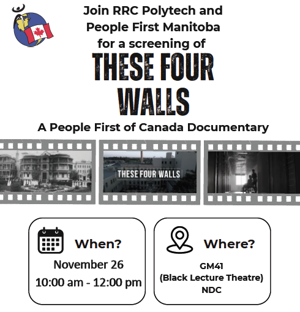
In recognition of International Day of Persons with Disabilities, RRC Polytech is pleased to host a screening of These Four Walls in partnership with People First of Manitoba and the Disability and Community Support Program.
Event Details
- Date: Thursday, November 26, 2026
- Time: 10:00 a.m. to 12:00 p.m.
- Format: Hybrid
- Location: GM41, Black Lecture Theatre, Notre Dame Campus, or online through MS Teams
These Four Walls follows survivors, families, and advocates connected to the Manitoba Development Centre. Through personal stories and historical perspectives, the documentary explores the impact of institutionalization, the pursuit of justice, and the strength and resilience of community.
The screening offers an opportunity to learn from lived experiences, reflect on disability rights, and engage in meaningful conversations about accessibility, inclusion, and belonging.
Register for the film screening
RRC Polytech Resources
- Accessibility at RRC Polytech
Learn about the Polytech’s accessibility commitment and ongoing efforts to reduce barriers.
- Accessibility Services for Employees
Visit the Accessibility page on Staff Forum for information about workplace accommodations, supports, and accessibility-related resources for employees. - Student Accessibility Services
Support and accommodations that help students access and participate fully in their education. - Deaf and Hard of Hearing Services
Services, accommodations, and resources available to Deaf and Hard of Hearing students.
- Neurodiversity Working Group
A community that promotes awareness, belonging, advocacy, and support for neurodivergent employees. - Accessibility Garden: Community of Practice
A collaborative space where employees can share accessibility practices, learn from one another, and build more inclusive environments.
External Resources
- Canadian Centre for Diversity and Inclusion (CCDI) (login required)
Resources and webinars on accessibility, disability inclusion, and neuroinclusive workplaces. - Manitoba Accessibility Office
Training, tools, and resources related to accessibility in Manitoba.