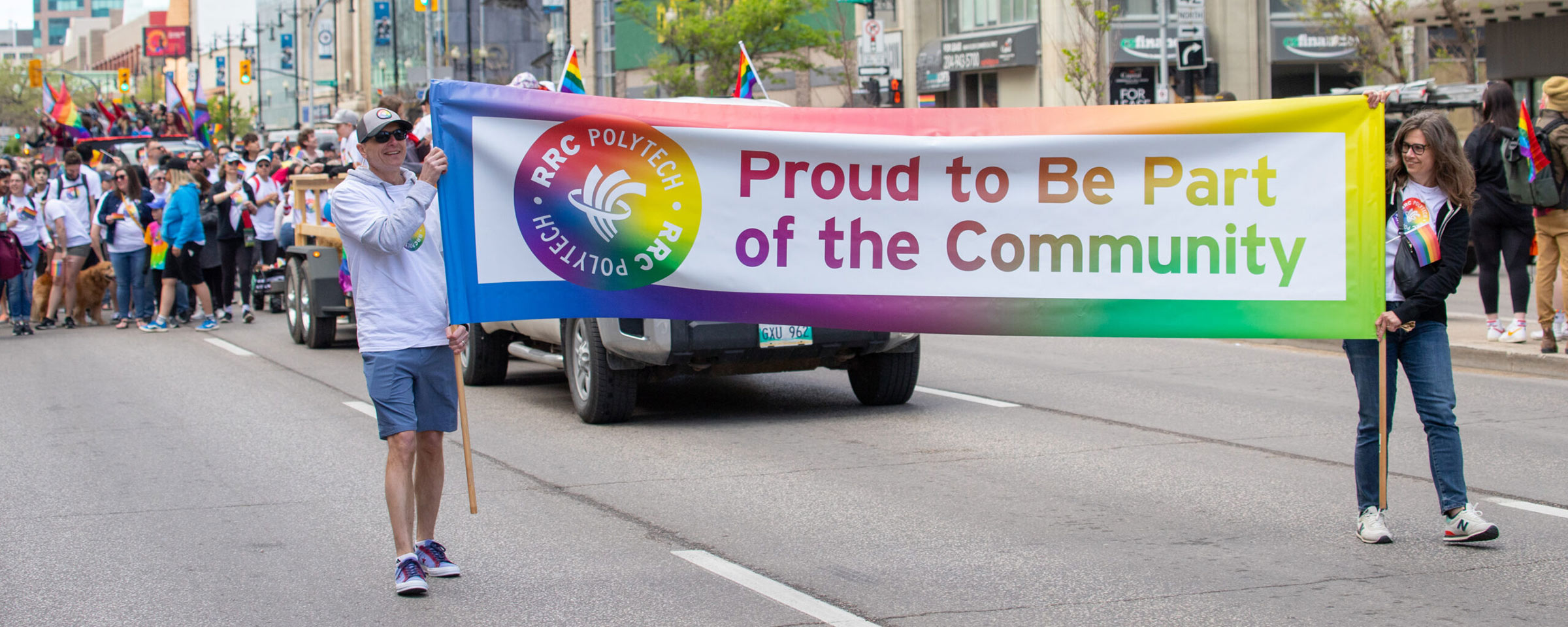
A World Within a Word: Celebrating Canadian Multiculturalism Day at RRC Polytech
June 27 is Canadian Multiculturalism Day, a time to recognize and celebrate the many cultural communities that help shape Canada’s diverse and vibrant society.
Canada became the first country to adopt multiculturalism as an official policy in 1971, later strengthening this commitment through the Canadian Multiculturalism Act in 1988. This recognizes the importance of preserving, sharing, and celebrating the many cultures, traditions, and identities that contribute to Canada’s story.
Multiculturalism is built on the belief that everyone should be able to take pride in who they are, celebrate their heritage, feel a sense of belonging, and participate fully in society. It is about respect, understanding, and recognizing the value that different experiences and perspectives bring.
At RRC Polytech, diversity is one of our greatest strengths. Our campuses bring together students and staff from many backgrounds, cultures and lived experiences. We are committed to creating learning and working environments where people feel welcomed, respected, and valued. By embracing the many cultures represented across our campuses, we create opportunities to learn from one another, strengthen connections, and build a more inclusive Polytech community.
Community Voices: A World Within a Word
One of the most powerful ways cultures are preserved and shared is through language.
Language is more than communication. It carries memories, identities, stories, traditions, values, humour, and ways of understanding the world. It connects generations, keeps cultures alive, and helps people remain connected to their roots.
To mark Canadian Multiculturalism Day, members of the RRC Polytech community shared a word or phrase from their language that holds special meaning. Each contribution provides a glimpse into the experiences, values, and perspectives that shape our community.
As you explore these words, you will discover that language can hold much more than a definition. A single word can carry stories, memories, relationships, and an entire world of meaning.
Together, these words offer lessons about community, resilience, belonging, kindness, and connection, and remind us of the many voices that make our Polytech community stronger.
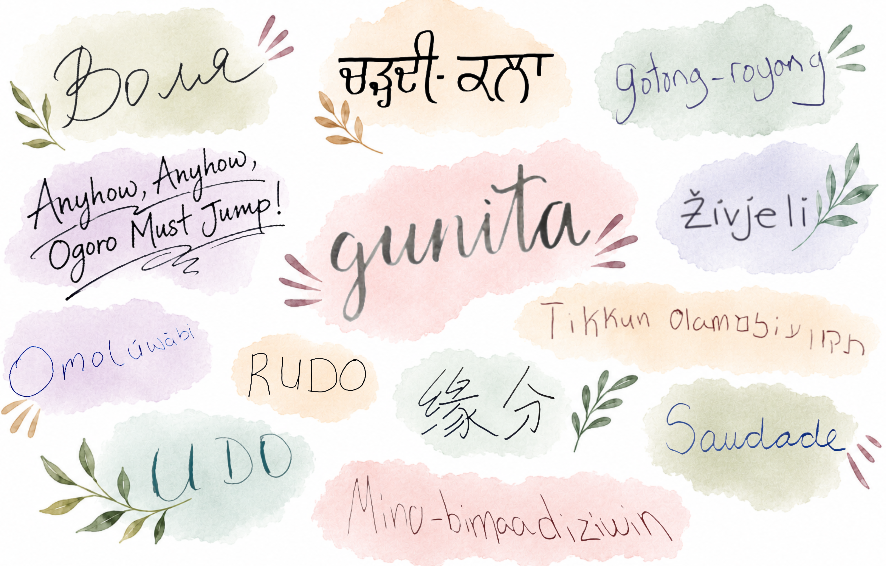
A mosaic of languages and cultures. Handwritten words and phrases shared by staff members to celebrate Canadian Multiculturalism Day.
“Tikkun Olam” – Adam Nepon, Corporate Solutions
Language: Hebrew (תיקון עולם) | Pronunciation: Tee-koon O-lum
“Tikkun Olam” translates literally to “repairing” or “healing the world”. It is a foundational Jewish concept that emphasizes humanity’s shared responsibility to act as partners with the Divine to fix injustice, heal the sick, and improve society.
For me personally, this concept means being aware of our daily actions and consciously seeking opportunities to address social injustices beyond the borders of our own communities (within our daily work, volunteering, advocating and activating). Living with awareness can also help increase gratitude for one’s own societal privileges, building both empathy and emotional intelligence.
“Gunita” – Paw Madrid-Auger, Work-Integrated Learning and Career Services
Language: Tagalog (Filipino) | Pronunciation: goo-nee-tah
“Gunita” is a poetic Tagalog word that means remembrance or memory, often carrying a deep sense of nostalgia and affection for moments, places, and people from the past.
Living in Winnipeg has made me appreciate the meaning of “gunita” even more. It lives in the quiet moments when memories of home return—the familiar roads of Dasmariñas, days at Academia Trinitas, weekend mornings at the market, family meals, afternoons painting with my siblings, and slow days with my dog, Miso—and reminds me that distance does not erase belonging.
“Rudo” – Lilian Mugweni, Nursing
Language: Shona (Zimbabwean) | Pronunciation: as it is spelled “ru..do”
“Rudo” means love.
“Rudo” (love) is a powerful word because it’s meaning is universal and is the opposite of hate. With love, we can all come together and appreciate one another and the diversity that we bring to this world.
“Gotong-royong” – Eddy Lau, Centre for International Education and Global Partnerships
Language: Malay (Bahasa Melayu), with cultural roots widely recognized across Malaysia, including Sarawak | Pronunciation: go-tong roy-ong
“Gotong-royong” refers to people coming together to help one another and work collectively for the good of the community.
As someone from Sibu, Malaysia, this expression reflects a value I grew up with—community is strongest when people show up for one another in practical, generous ways. To me, “gotong-royong” is more than cooperation; it is a spirit of shared responsibility, humility, and care that helps people feel they belong.
“Chardikala” – Dupinderdeep Kaur, ITS Client Services
Language: Punjabi | Pronunciation: char-dee-ka-laa
“Chardikala” is a state of high spirits, optimism, and resilience, even in difficult times.
“Chardikala” reflects a mindset of staying positive and resilient no matter the circumstances. For me, it’s a reminder to approach both life and work with optimism, strength, and a forward-looking attitude.
“Anyhow anyhow, Ogoro must jump” – Odiri Ajakpovi, People Services
Language: Warri Slang | Pronunciation: Anyhow anyhow, O’ go’ ro’ must jump
“Anyhow anyhow, Ogoro must jump” means no matter what happens, or how difficult it is, take the leap, face it and overcome the obstacle.
It was often said with a smile, but behind the humor lies a powerful message: “Giving up is not an option”. What I love about the phrase is that it acknowledges reality, it does not pretend life is easy or everything will go according to plan, instead it accepts that there will be obstacles, disappointments, setbacks and moments when the odds seem stacked against you. The expectation is not perfection, rather perseverance.
When I think about my own journey as someone who has lived in different countries, rebuilt life more than once, moments when I was trying to understand a different culture, build a career from the scratch and prove myself all over again. There were times I questioned whether all the sacrifices were worth it, missing home, family and wondered if I had taken on too much but continued to push forward even when the path ahead was uncertain. Not because I am extraordinary, but because I was raised with the understanding that life becomes difficult, you do not stop. You adjust, you learn and you keep going and showing up even on days when nobody sees the effort.
Most Nigerians are familiar with the phrase “warri no de carry last” not knowing the reason we are never last is because, “Anyhow anyhow, O’ go’ ro’ must jump.”
“Živjeli” – Petra Lucyk, People Services
Language: Croatian | Pronunciation: zhee-veh-lee (sounds exactly how it’s spelled phonetically)
For many Croatians, “Živjeli!” is meaningful because it expresses more than just “cheers.” It carries the idea of wishing life, health, happiness, and good fortune to the people you’re sharing a moment with.
Connection and hospitality: Croatian culture places a strong value on gathering with family, friends, and guests. Saying “Živjeli!” acknowledges the bond between the people at the table.
Celebrating life: Since the word is related to “living,” the toast reflects appreciation for life, health, and the opportunity to be together.
Tradition: Toasting is an important part of many Croatian celebrations—weddings, baptisms, holidays, village festivals, and family meals. “Živjeli!” is a familiar ritual that links generations.
Good wishes: Historically, wishing someone health and a long life carried special weight in communities that experienced hardship, war, disease, or economic uncertainty. A toast wasn’t just ceremonial—it was a genuine blessing.
The significance varies from person to person. For me it is a heartfelt expression of friendship, respect, and shared joy.
“Воля” – Khrystyna Chornobai, Library and Academic Services
Language: Ukrainian | Pronunciation: Vol-ya
“Воля” means both freedom and will, expressing the deep connection between personal strength and the right to live freely.
To me, “воля” is more than just freedom – it’s a deep, unbreakable spirit that lives inside people, even when everything around them tries to take it away. Volya is more than a will; it’s coded in Ukrainian DNA, and those four letters, ВОЛЯ, are reflected in the Ukrainian tryzub – the coat of arms of Ukraine – which I wear every day as a symbol of resilience, dignity, and the courage to choose one’s own path.
“Yuan Fen” – Iris He, Business Systems & Transformation
Language – Mandarin | Pronunciation – ywen-fen
“Yuan Fen” is a special connection or chance to bring people together, maybe through an unplanned event or activity. It refers to the idea that certain relationships, encounters, or opportunities happen because they are meant to be.
Yuan Fen is a very meaningful concept in Chinese culture that may not have a direct equivalent in English. For me, it represents the belief that every person we meet and every experience we encounter comes into our lives for a reason. These meaningful connections can happen at any moment, often unexpectedly. The idea of “Yuan Fen” encourages me to appreciate each encounter, value the relationships I build, and approach life with an open heart, gratitude, and a willingness to embrace new connections.
“Udo” – Ndidi Onyeukwu, Financial Services
Language: Igbo | Pronunciation: Oo-doh
“Udo” means Peace.
“Udo” represents inner calm and harmony with others. To me, it’s a reminder to approach life and people with kindness, patience, and a desire to make them feel understood and welcomed. It reflects the quiet strength of choosing peace in how I live and relate to others.
“Omolúwàbí” – Simisola Alegbeleye, People Services
Language: Nigerian Language, dialect is Yoruba | Pronunciation: Oh-mo-lu-WAH-bi
“Omolúwàbí” describes a person of good character, integrity, and moral uprightness, meaning your purpose is not just about what you achieve, but about how you treat people along the way.
Growing up, my parents always talked about this word, and it has stayed with me my whole life. In Yoruba culture, calling someone this is the highest compliment you can give them.
What makes it so special and powerful is that it is not just about what you achieve, it is about how you treat people along the way. It speaks to having a purpose while also lifting and including others around you.
“Kisâkihitinâwâw” – Kisa MacIsaac, Early Childhood Education
Language: Nêhiyawêwin | Pronunciation: gee-SAW-gee-tin-ahwow
“Kisâkihitinâwâw” means “You are all loved by me”.
The language itself is connection and reclaimation: to culture and to my family and my roots. I have learned that love is our greatest gift and how we learn and grow best is through love, community, and supporting unique ways of knowing, doing and being. I strive to put my love into action with courage and humility.
“Saudade” – Eduardo Rodrigues da Costa, Finance and Administration
Language: Portuguese/Brazilian Portuguese | Pronunciation: Saudadjee
“Saudade” is a profound Portuguese/Brazilian emotional state of melancholic longing for a person, place, or thing that is absent. It is the acute awareness of a void left by someone or something you cherish.
For me, “saudade” is the “the presence of absence”. While English speakers use phrases like “I miss you”, the phrase “I feel saudade” would mean something like “You are missing from me”. The whole idea is that you are part of me, and I am feeling “Saudade” because you are not here anymore.
“Mino-bimaadiziwin” – Adam Nepon, Corporate Solutions
Language: Ojibwe
“Mino-bimaadiziwin” (or Mino-pimatisiwin) means “the good life.”
For me this means striving to do better and be better each day, not just for the benefit of self, but also for the benefit of everyone we encounter. It involves embracing the Seven Sacred Teachings: Humility, Honesty, Respect, Love, Truth, Courage and Wisdom.
Why These Words Matter
These are just some of the many languages and cultures represented across our Polytech community. Canada is home to hundreds of languages, each offering unique ways of understanding family, community, resilience, care, and belonging.
When we learn even a single word from another language, we gain more than a new term. We open the door to experiences and perspectives beyond our own and deepen our appreciation for the diversity around us.
A big thank you to all our contributors for sharing your words and stories in this feature. Your participation creates opportunities for learning that build understanding, connection, and respect. These moments remind us that multiculturalism is strengthened through everyday opportunities to listen, learn, and share.
Resources and Ways to Engage
Participate
Communities across Canada host events for Canadian Multiculturalism Day. Explore opportunities to celebrate, learn, and connect in Manitoba and beyond.
Stay informed
- Explore resources about the history of multiculturalism in Canada, including information about multiculturalism, educational resources, teaching tools, and research.
- Learn more about cultural observances and upcoming events through the EDIA Blog and resources such as the Canadian Centre for Diversity and Inclusion’s (CCDI) 2026 Diversity Calendar (CCDI login required) and the Celebrate Everything page in Staff Forum.
Share your story
Take part in the Celebrate Everything initiative and contribute your own traditions and experiences to help shape future blog features.
Support inclusion efforts (staff)
If you feel comfortable, consider completing or updating Employment Equity Self-Identification in HRIS. This helps ensure our community is accurately represented and supports efforts to build a more inclusive workplace.