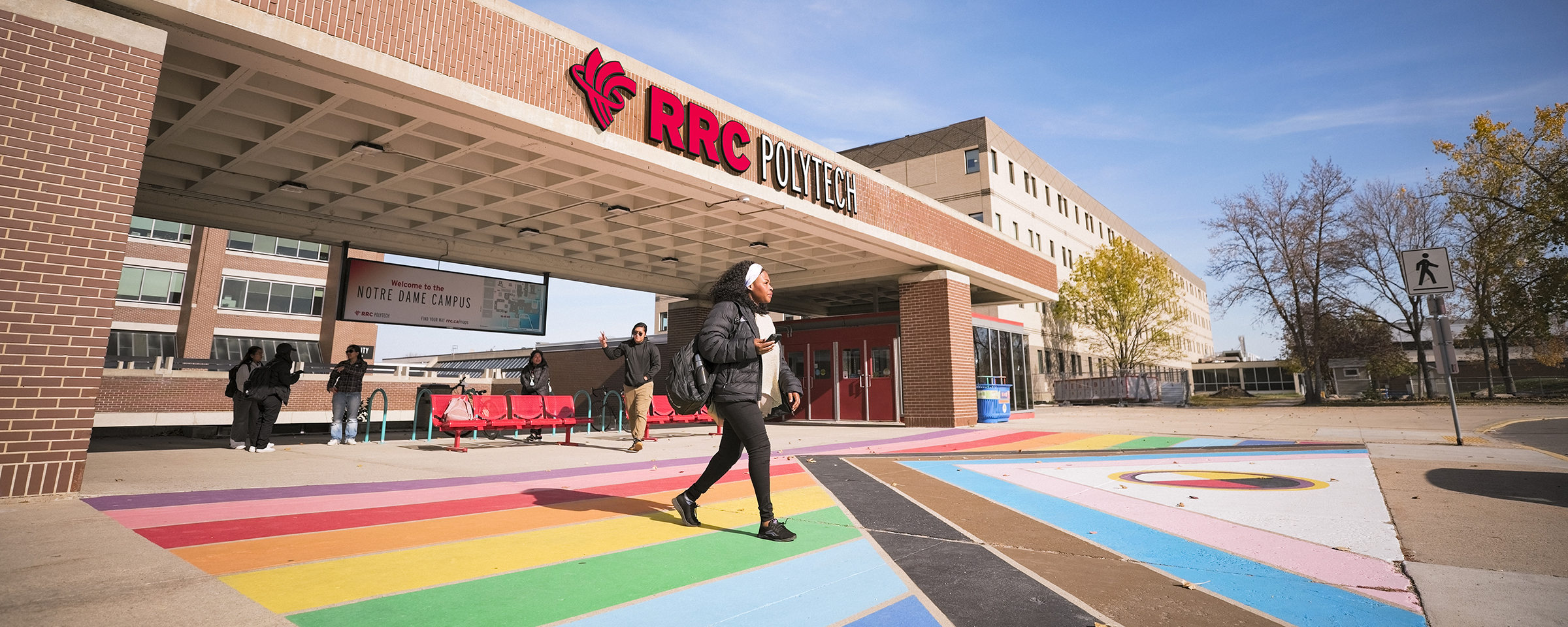
Woman walking in front of RRC Polytech's Notre Dame Campus

News

Students

Spring ceremony marks opening of sweat lodge for RRC students and staff

April 20, 2017

Elders, leaders and students from Red River College came together today in a special ceremony to mark the official opening of the College’s first sweat lodge.

Led by Elders Jules Lavallee and Mae Louise Campbell, the event involved more than 20 participants, many of whom had never taken part in this type of sacred ceremony before.

“Today is a very important day as we continue our work to infuse Indigenous culture, knowledge and teachings across our College,” said RRC President Paul Vogt. “Indigenous student success is a priority at Red River College, and that means providing culturally relevant student supports to help remove barriers and create more pathways to success for our Indigenous learners.”

“We have a significant Indigenous student population at Red River College and this important addition to our ceremonial grounds will have an amazing impact for many years to come.”

The dome-shaped structure represents the womb of Mother Earth, and was made out of willow trees that were collected and prepared last November. Once the branches were in position, they were tied together and the frame was covered with canvas.

Each sweat lodge ceremony has a different purpose, and is led by an Elder or spiritual leader who provides teachings and songs. Through this profoundly personal experience, the body is cleansed, which aids in removing stress and improves participants’ mental, emotional, physical and spiritual well-being. Sweat lodge ceremonies are used to give thanks, to heal, to seek wisdom, and to purify the mind, body, and soul. Read More →

Teacher Education grads boost applied learning capabilities for students in Steinbach

April 19, 2017

Selkirk Regional Secondary School staff

James Gibson knows the value of hands-on education.

For one, the vice-principal of Steinbach Regional Secondary School sees his students learning by doing every day – whether they’re chiseling timber frames, installing electrical outlets or painting vehicles in some the school’s 10 vocational areas.

But Gibson (shown above, at centre) also understands how crucial it is for some students to get out from behind their desks – because he was once one of those students himself.

“I’m not a big ‘in the regular classroom’ kind of guy,” says the Red River College graduate. “I like to be up and moving around and doing things with my hands.”

RRC’s Teacher Education program allowed Gibson to do just that. Specializing in Industrial Arts, he was able to expand his knowledge and experience in woodworking and welding, among other areas. Along with the Industrial Arts diploma he received from RRC in 2004, he earned a Bachelor of Education from the University of Winnipeg in 2005, thanks to a joint program between the schools.

“The program gives you the confidence to be able to take something apart and fix it and not be scared about it anymore,” says Gibson, who was born in England and moved to Winnipeg at the age of 13.

After teaching Industrial Arts in Elie, Man., for a couple of years, he moved to Steinbach in 2007 to teach junior high. He later took at position at SRSS teaching carpentry, and more recently stepped into the administrative role of vice-principal.

Even though he’s behind a desk more often than not, Gibson can rest assured the school’s vocational students are receiving top-notch training. That’s because a majority of the hands-on instructors at SRSS are Teacher Education grads, just like him. Read More →

RRC grad awarded inaugural Disability Studies scholarship from University of Winnipeg

April 18, 2017

A Red River College grad who’s now completing a joint honours degree at the University of Winnipeg is the inaugural winner of that institution’s Disability Studies scholarship.

Evan Wicklund, who completed RRC’s Disability and Community Support program in 2013, is now in his final year of study in UWinnipeg’s Disability Studies program. He’ll be the first student to complete the program with an honour’s degree.

Having explored several sub-sectors of the disability field over the years, Wicklund believes the critical engagement made possible by the joint program is key to understanding alternatives to disability as a bio-medical phenomenon.

“If we contextualize ‘disability’ through rights, social constructionist, or intersectional frameworks, we will be afforded the opportunity to think about disability in new and imaginative ways,” he told UWinnipeg.

“As someone engaged with community organizations as well as the academy, I advocate for disability studies because it acknowledges the value of critical thinking and reflexivity, while maintaining the fundamental values of diversity and human rights.”

Wicklund presented his work at the International Initiative on Disability Leadership Conference in Vancouver in 2015, and has a paper accepted at this spring’s annual meeting of the Canadian Disability Studies Association.

He also works as a special projects officer for the Canadian Centre for Disability Studies, having been hired there after completing his work practicum.

UWinnipeg’s new award was established to recognize students who demonstrate academic excellence and community involvement. The Disability Studies program was established in partnership with RRC in 2010, prior to which there was no way to proceed from RRC’s diploma program to UWinnipeg’s degree.

— Naniece Ibrahim, University of Winnipeg

Olympic-style trades and technology competition draws hundreds of young Manitobans to RRC

April 13, 2017

Cabinet making competition

More than 500 students and apprentices will show off their trades- and technology-related talents at Red River College today, as they compete in hands-on, Olympic-style contests as part of the twentieth annual Skills Manitoba Competition.

Many of the individual competition winners will advance to the Skills Canada National Competition, being hosted this year in Winnipeg from May 31 to June 3.

Today’s provincial event is held by Skills Manitoba Canada to raise awareness of the country’s skilled workforce shortage, and of the merits of post-secondary training in trades and technology.

“The skilled trades offer opportunities for positions with great pay, job security and flexibility,” says Maria Pacella, executive director of Skills Canada Manitoba.

“Manitoba’s economy needs thousands of skilled workers going forward, and colleges will play a huge role in filling this demand,” adds RRC President Paul Vogt.

“Competitions like Skills Manitoba and Skills Canada are extremely important, as they showcase the opportunities that exist for meaningful and rewarding careers in the trades. We are pleased to be supporting Skills Manitoba, and are particularly thrilled to be putting Winnipeg on the national stage when [the Skills Canada competition] comes to Manitoba in June.” Read More →

College opens new project space in Innovation Alley

April 7, 2017

Red River College’s ACE Project Space and North Forge Technology Exchange today celebrated the grand opening of their new Innovation Alley locations, by officially launching several new initiatives aimed at helping startup businesses innovate and grow.

In RRC’s ACE Project Space — part of the College’s thriving Exchange District Campus — Business Information Technology and Business Technology Management students work with entrepreneurs-in-residence on new technologies, product development, and pushing innovation to the edge.

The new space has allowed the program to grow rapidly and more than double its partnerships — to 16 successful projects to date. As well, the space allows students to work closely with non-profit organizations to provide IT solutions for them and the community.

“This is about students working hand-in-hand with private industry on real-world projects in real time,” says RRC President Paul Vogt. “It provides our students with leading-edge, hands-on training and experience, while providing startups with much-needed technical support. This kind of partnership is essential to business growth and job creation in our province.”

Vogt says RRC is thrilled to partner with North Forge Technology Exchange and, together, anchor Winnipeg’s growing Innovation Alley.

“We are constantly working to support innovation on the ground floor and create critical mass for Manitoba’s startup community,” says North Forge President Jeff Ryzner. “The development of our new building at 321 McDermot advances our goals and provides entrepreneurs with a place to work together. It’s about fostering innovation, creating jobs and driving economic growth.” Read More →

Inaugural applied research showcase celebrates student achievements and partnerships

April 6, 2017

Today, Red River College welcomed more than 600 visitors to the first-ever Applied Research & Innovation Day, which celebrated our students’ achievements in applied research and innovation, while also recognizing RRC’s innovative research partnerships.

As part of the event, the College hosted a Student Quick-Pitch Competition where the top four student research projects — as selected by a group of 26 judges at a showcase held earlier in the day — had an opportunity to present their projects to some 200 guests from the College and industry.

“The work demonstrated by our students this year is remarkable, and highlights just how relevant applied learning and research is to preparing our graduates for careers here in Manitoba,” said RRC President Paul Vogt. “Leveraging our in-house expertise not only exposes our students to leading-edge research, but it also helps businesses innovate to create new jobs and career opportunities for our students.”

The students were judged by a panel of experts: Martin Cash (business reporter, Winnipeg Free Press), Jeff Ryzner (president, North Forge), Freyja Arnason (manager of funding programs, Research Manitoba) and Tracey Maconachie (president, Life Sciences Association of Manitoba).

This year’s winners are:

Read More →

New supports launched to enhance mental health programming at RRC

March 24, 2017

Michael Landsberg, TSNRed River College has announced two new support services as part of the Healthy Minds Healthy College initiative aimed at enhancing mental health programming for students, staff and faculty.

The announcement coincided with a broader awareness-raising event, in which TSN’s Michael Landsberg — one of the faces of Bell Let’s Talk Day — brought his #SICKNOTWEAK talk to RRC.

“We’re excited that Michael has joined us to help us announce these new and important initiatives, but to also talk about his personal battle with depression,” says RRC President Paul Vogt. “Michael’s leadership has made a tremendous difference in the lives of many Canadians.”

The two programs being launched by the College include:

The Red River ReliefLine, a 24/7 online peer support service provided free of charge to all students, who can access trained listeners through their computer, tablet, or smart phone. The College has purchased a one-year license for this service with funds from a Program Innovation Fund. The service is available in a variety of languages and gives students access to simple therapeutic exercises that can enhance coping skills.

The Working Mind, an educational workplace mental health and wellness program developed and endorsed by the Mental Health Commission of Canada. The program is designed to promote mental health and reduce the stigma associated with mental health problems and illnesses in the workplace. The training helps individuals identify poor mental health in themselves and others, while building resiliency. RRC has committed to training four internal champions who will in turn deliver the program to others.

“As both an educational institution and employer, RRC recognizes that it has a responsibility to create a safe, responsive and healthy environment that supports mental health and well-being for students, staff and faculty,” says Breanna Sawatzky, Mental Health Coordinator at RRC.

“For students, RRC is where they will learn and practice key competencies that set them up for success in their future workplaces. Learning to support their own positive mental health, and reach out for help when need, are among those competencies.”

CreComm students to host annual telethon in support of Winnipeg Humane Society

March 17, 2017

Red River College Creative Communications students will see months of planning go to the dogs (and cats) next weekend, as they take to the airwaves in support of the Winnipeg Humane Society.

On Saturday, March 25, CreComm students will produce and host the six-hour 1001 Donations telethon, airing live on Shaw (and streaming on the WHS Facebook page) from 11 a.m. to 5 p.m.

The second-year students — representing all four streams of the CreComm program (journalism, advertising, public relations and broadcasting) — have already produced a series of pre-recorded pieces that will air during the telethon, and will also serve as technical crew and on-air talent while broadcasting live from the Humane Society’s facility on Hurst Way.

“Our students are extremely talented, and this telethon will give them a well-deserved opportunity to showcase those talents and help a great cause at the same time,” says CreComm instructor Joanne Kelly.

“We’re always looking for opportunities for students to gain real-life experience so they’ll be that much more prepared for the workforce upon graduation. This telethon also helps teach them the value of being connected to your community, and how important it is to give back.”

Red River College is a proud sponsor of the telethon, which is open to the public and will feature appearances from special guests including Winnipeg Mayor Brian Bowman, Winnipeg Blue Bomber Matthias Goossen, and CTV anchor Maralee Caruso, who adopted her dog Jack from the Humane Society. Read More →

College creates new executive director role to provide leadership on Indigenous strategy

March 16, 2017

On the same day Mayor Brian Bowman called on the city to adopt a municipal Indigenous Accord, Red River College announced the creation of a new executive director position to provide leadership on advancing Indigenous education.

The role of the executive director, Indigenous strategy will include providing direction on how best to expand programs and supports for Indigenous students, and to build partnerships with Indigenous leaders and the community.

Advancing Indigenous achievement is one of the top priorities in RRC’s Strategic Plan (2016-2021), as well as a key goal of the Academic Division, which is committed to enhancing the environment supporting Indigenous student success. RRC is also a signatory to the Manitoba Indigenous Education Blueprint (2016) — one of nine post-secondary institutions in the province — following the final report of the Truth and Reconciliation Commission of Canada.

“The TRC report is clear — Indigenous Canadians need access to post-secondary education and supports while in school if we are to close the income and employment gap in our country,” says RRC President Paul Vogt. “One of the specific calls to action is to establish senior level positions in order to elevate the priority of Indigenous programming and forge new pathways to success. Today’s announcement is a major step in this direction.”

Christine Watson, RRC’s vice-president Academic, said the new executive director, Indigenous strategy will play a key role in helping RRC meet its strategic and academic goals. The new ED will work with and provide advice to all deans, academic divisions and student support services, as well as lead on enhancing relationships with the Indigenous community and the College’s recently-formed Indigenous Achievement Strategic Council.

The overall goal will be to improve and expand the College’s academic programming and supports for Indigenous students — building on recent recommendations from College staff and faculty during consultations on the Strategic Plan and through such forums as RRC’s Open Cafés.

“RRC has a significant and growing Indigenous student body and it is important that we are proactive in taking steps to ensure student success, to address historic barriers and to fill gaps that have been identified,” Watson says. “We are fortunate to have our Elders and an incredibly engaged, dedicated and experienced staff and faculty group who will provide leadership and a strong foundation for enhancing Indigenous education as we move forward.” Read More →

College partners with province on new training program for refugees

March 7, 2017

A new program at Red River College is providing essential language and construction skills training to newcomer refugees who have arrived in Manitoba over the last year.

Announced today, the new Pathway Program to Construction Skills is one of four pilot employment projects launched recently by the Manitoba government under the Refugee Employment Development Initiative (REDI) for newcomers.

“Red River College is proud to play such an important role in supporting Manitoba’s international, immigrant and refugee community,” says Red River College president Paul Vogt. “This new program is a first in Manitoba and it will not only help our newcomer refugees develop their language and literacy skills, it will also provide them access to trades training and jobs in sectors where our partners have a need for more trained workers.”

The four-month program will help participants develop essential language skills, safety training and basic construction skills training in the areas of drywalling, masonry and flattop roofing. After completing the program, students will participate in a month-long, paid work placement to further refine their skills and gain essential on-the-job experience.

“As we’ve seen in recent months, there’s a growing need to provide support for refugees in a variety of ways, including direct employment and labour market programming,” says Education and Training Minister Ian Wishart. “We commend Red River College for its vision in developing this important program, which will link newcomers with employment opportunities and allow them to develop the skills needed to succeed in the workforce.” Read More →

RRC Polytech campuses are located on the lands of the Anishinaabeg, Ininiwak, Anishininwak, Dakota Oyate, and Denésuline, and the National Homeland of the Red River Métis.

We recognize and honour Treaty 3 Territory Shoal Lake 40 First Nation, the source of Winnipeg’s clean drinking water. In addition, we acknowledge Treaty Territories which provide us with access to electricity we use in both our personal and professional lives.