Microgrid, maximum results: RRC Polytech receives more than $4 million in federal and Research Manitoba funding to support reliable energy infrastructure, prefabricated housing, and human-centered design solutions
A microgrid testbed, a prefabricated housing construction project, and an upgraded user experience/user interface (UX/UI) research lab at RRC Polytech are set to benefit from more than $2 million in federal funding, according to an announcement yesterday from the Canada Foundation for Innovation (CFI).
RRC Polytech was the only institution to be awarded the maximum of three projects. These projects will receive funding from CFI’s College Fund and represent three out of 23 projects to receive the support nationwide. The College Fund is part of a larger investment of more than $118 million that will support 357 research infrastructure projects at 68 institutions throughout the country.
The projects will also receive additional matching funds thanks to Research Manitoba, totaling $2,079,656. These investments strengthen Manitoba’s research infrastructure and support world-class innovation across a range of disciplines. Funding for these key infrastructure projects is possible thanks to increased funding for Research Manitoba from the Government of Manitoba.
“This new funding expands RRC Polytech and its Research Partnerships and Innovation department as a national leader in renewable energy research and development, sustainable construction, and digital technologies,” said Dr. Jolen Galaugher, Executive Director, Research Partnerships & Innovation, RRC Polytech. “Thanks to CFI, our existing research infrastructure will receive the support needed to confront the very real challenges our region is facing.”
The funding will support the development of Microgrid Testbed facilities on the RRC Polytech campus – technology that will enable communities to develop energy sources and grid resilience in northern and Indigenous communities across the province.
Through RRC Polytech’s Vehicle Technology & Energy Centre, the microgrid testbed will expand applied research capabilities related to vehicle-to-grid and battery energy storage. The microgrid will enable exploration of optimal performance, reliability, and resiliency of multiple Distributed Energy Resources (DERs), including storage (battery and thermal), a solar emulator, a diesel genset, and various additional assets such as electric vehicles and chargers. The technology facilitates research into energy efficiency, performance, and optimization, strengthening the Manitoba Cluster and fostering research, skills development, education, and the commercialization of technologies.
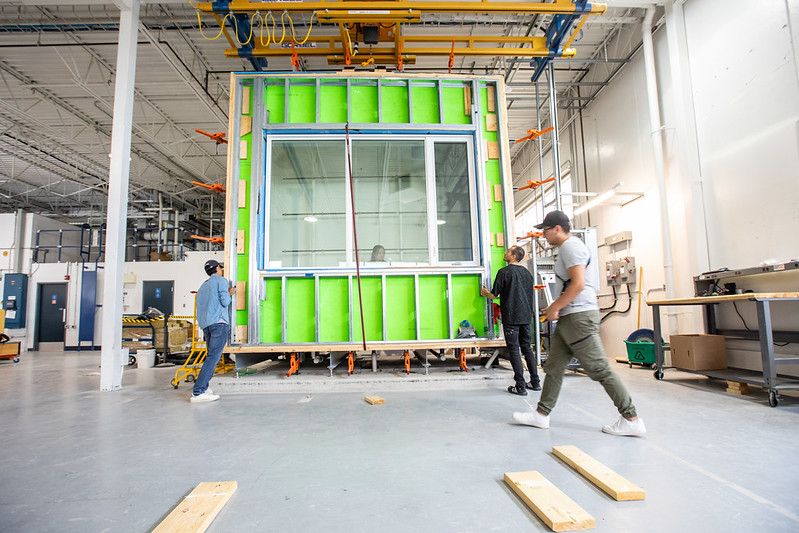
The CFI funding will also establish the new Prairie Prefab Lab, an energy-efficient prefabricated (prefab) housing project spearheaded by RRC Polytech’s Building Efficiency Technology Access Centre (BETAC). Modular and prefab construction provide an innovative solution to Canada’s affordable housing crisis, offering a scalable, cost-effective solution – particularly for remote communities across the prairies.
“This investment creates critical infrastructure that enables the construction industry to demonstrate, test and validate full-scale prefab and modular building solutions.,” continued Galaugher. “By reducing barriers to innovation and commercialization, we are helping accelerate the next generation of resilient community infrastructure for the prairie region.”
The funding allows BETAC to acquire a full-size structural testing system, enabling the enterprise to evaluate complete building assemblies under real-world conditions. The new equipment was identified through extensive industry consultation, including 10 in-depth interviews with sector leaders and will allow BETAC to evaluate complete building assemblies under real-world conditions.
The College Fund support will also support RRC Polytech’s Applied Computer Education (ACE) Project Space to acquire specialized equipment that will expand its UX/UI Research Lab into a nationally recognized hub for human-centered design. Featuring enhanced testing and observation spaces, including a dedicated control room, the lab will bring together researchers, students, industry, Indigenous and community partners to co-create solutions that address challenges in climate resilience, health equity, digital inclusion, workforce development, and sustainable technologies.
The upgraded facility will support the development of practical, culturally responsive tools and services for sectors such as healthcare, education, and smart cities, advancing innovation while strengthening RRC Polytech’s commitment to sustainability, reconciliation, and community impact.
Applied research colleges play a unique role in Canada’s innovation ecosystem by working in collaboration with industry and end users to solve real world challenges. These investments strengthen RRC Polytech’s ability to test, validate and demonstrate new technologies accelerating their path to adoption.
CFI’s College Fund supports applied research and technology development with Canadian industries and communities to strengthen Canada’s economy and improve our quality of life. A full list of funded projects is available at Innovation.ca.