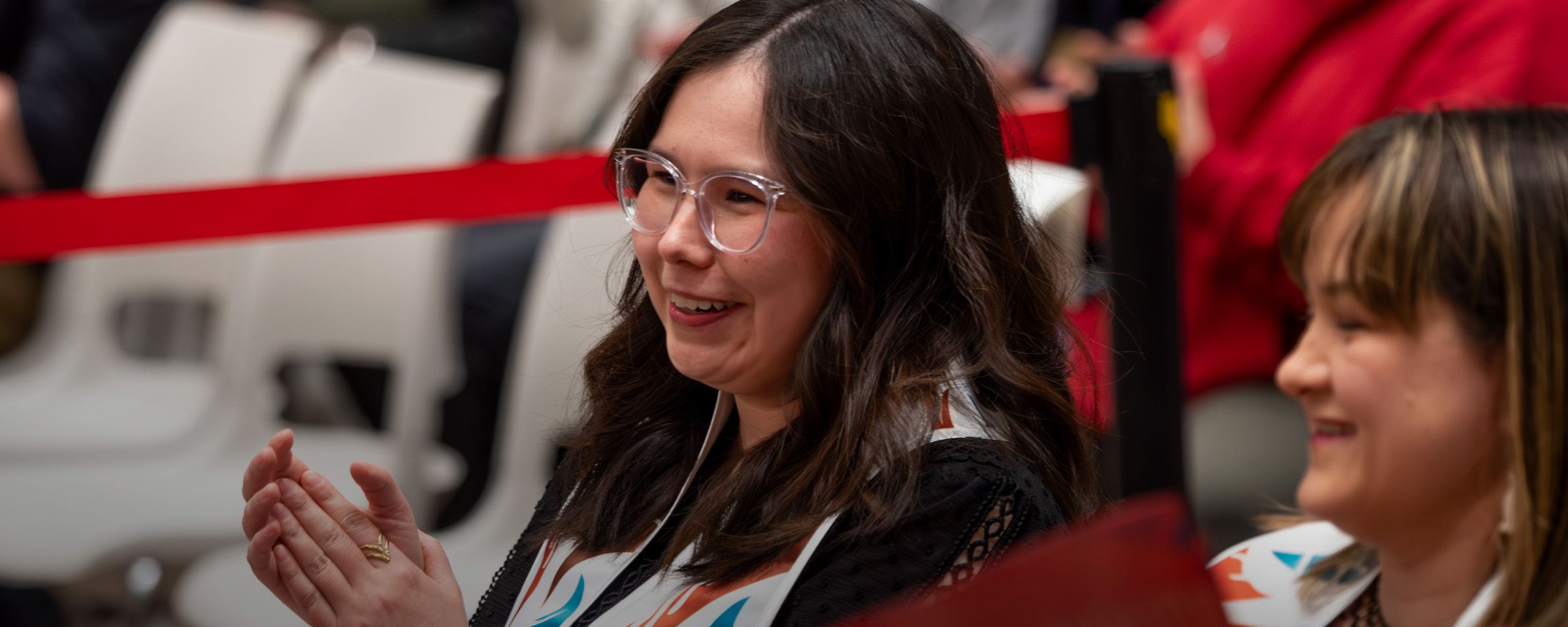
woman wearing an Indigenous Education sash

Indigenous Education

Events

Movement & Wellness with Dawn Chartrand – POSTPONED
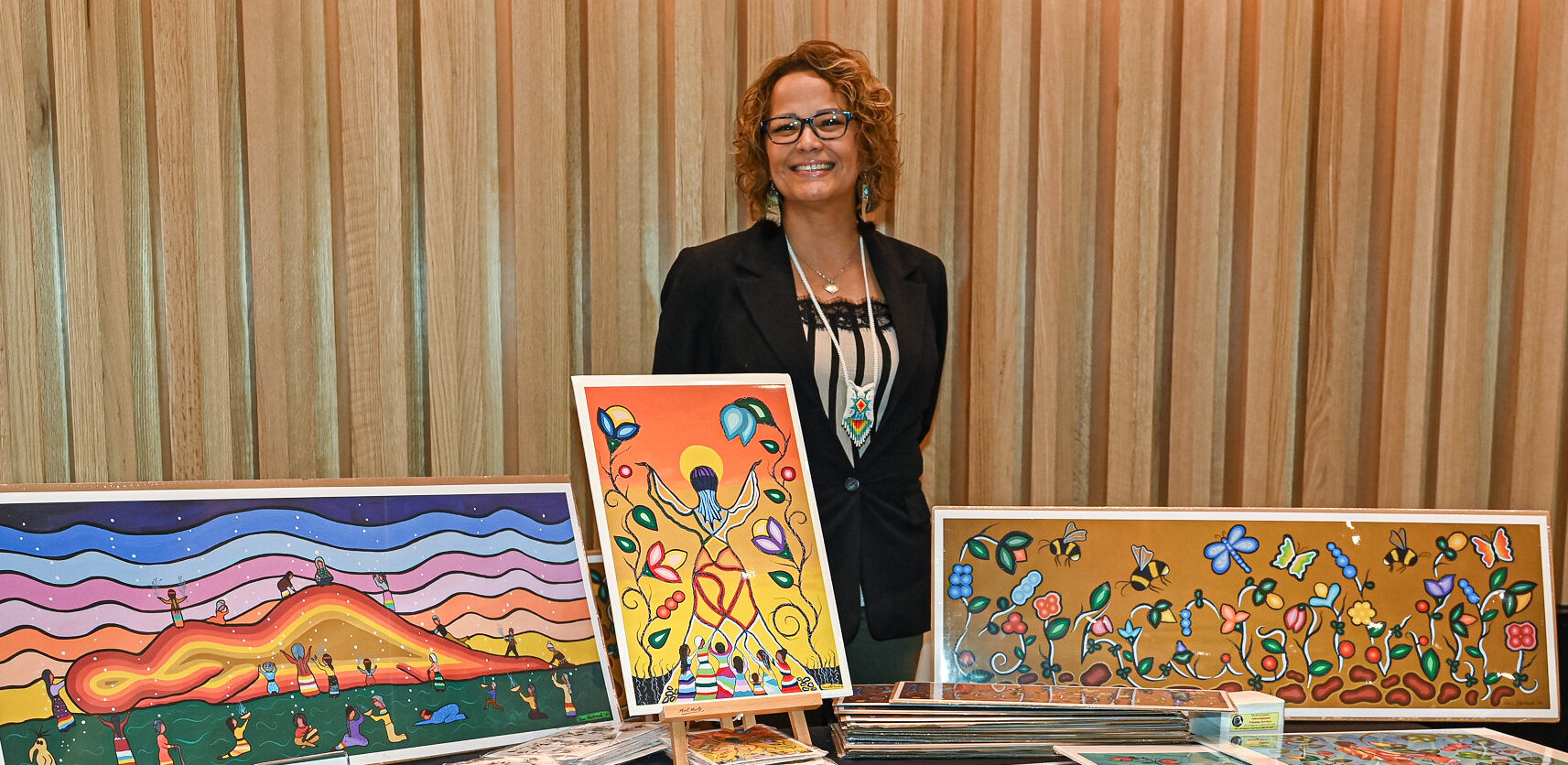
November 9, 2022

Are you looking for new ways to engage your body?

Join Indigenous Yoga instructor Dawn Chartrand for a family-fun night of Yoga with an Indigenous infusion! Her practice focuses on introducing Indigenous people to healing and wellness through art and Yoga.

  • Wednesday, Nov. 30, 2022 6pm – 8pm
  • Roundhouse Auditorium, Manitou a bi Bii daziigae, Exchange District Campus

All attendees can register by emailing Terri-Lynn Anderson at tlanderson@rrc.ca. Register now – space is limited!

About Dawn Chartrand

Dawn Marie Chartrand is a visual artist, musical entertainer, and yoga instructor.  She is a proud wife, mom of 4 and grandmother of 9, and is a member of Rolling River First Nation in Manitoba.

Dawn started painting in 2017 and was immediately drawn to creating Indigenous themed art. Dawn considers painting to be a very special form of wellness and self-care, and she has sold many of her paintings throughout Canada. Dawn offers painting and wellness workshops as a means of introducing others to the healing properties of creating art.

After 10 years of practicing yoga and driven by the low representation of Indigenous people in mainstream yoga classes, Dawn studied to become a yoga instructor and completed her training in May 2022. She has now launched her own yoga business, “OM-Digenous Yoga & Wellness”, and teaches several yoga classes per week with special focus on drawing Indigenous participants. Dawn’s intention is to create a safe and accessible environment where Indigenous people can feel welcome to participate, learn, and benefit from regular yoga practice.
From the North to Now

November 7, 2022

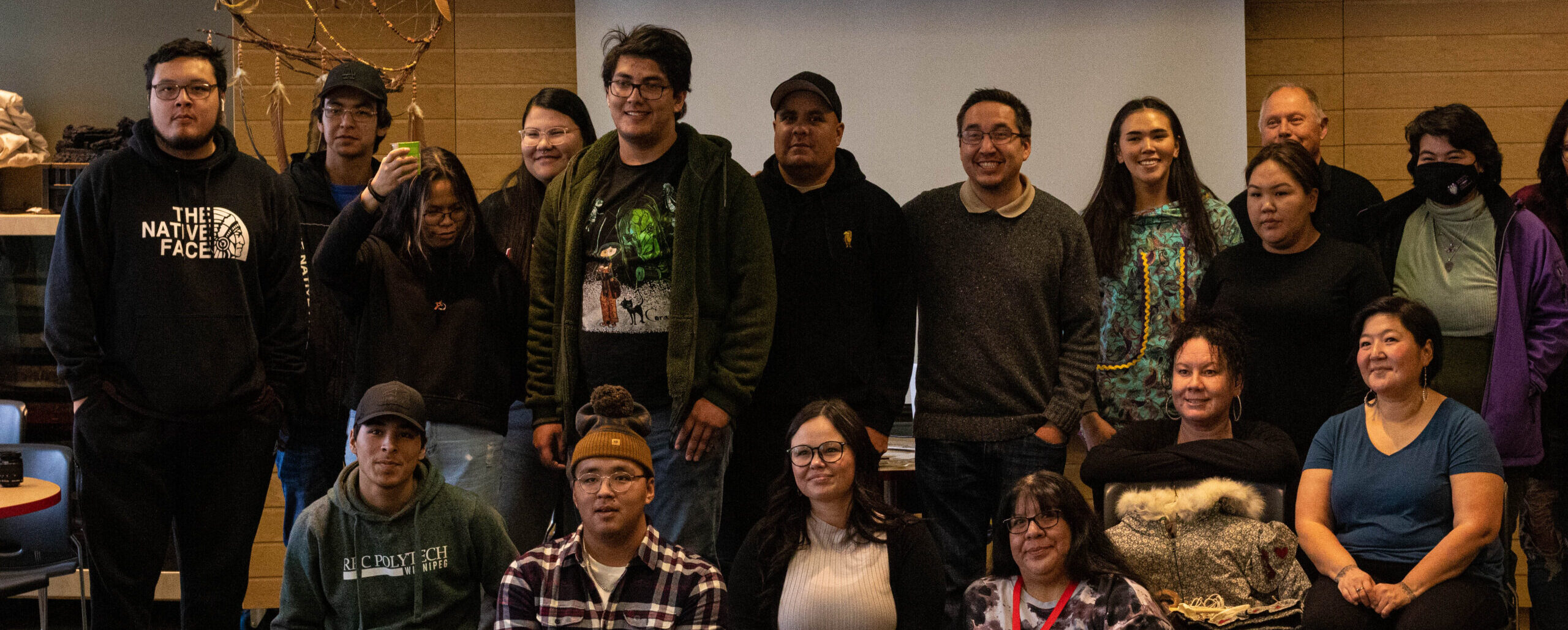
Today, RRC Polytech celebrated International Inuit Day with students, staff, faculty, and members of the Manitoba Inuit Association.

The event was livestreamed from Notre Dame Campus’s Indigenous Support Centre to the Exchange District Campus’s Indigenous Support Centre, where folks from both campuses enjoyed a pizza lunch, group activities, presentations, and a performance.

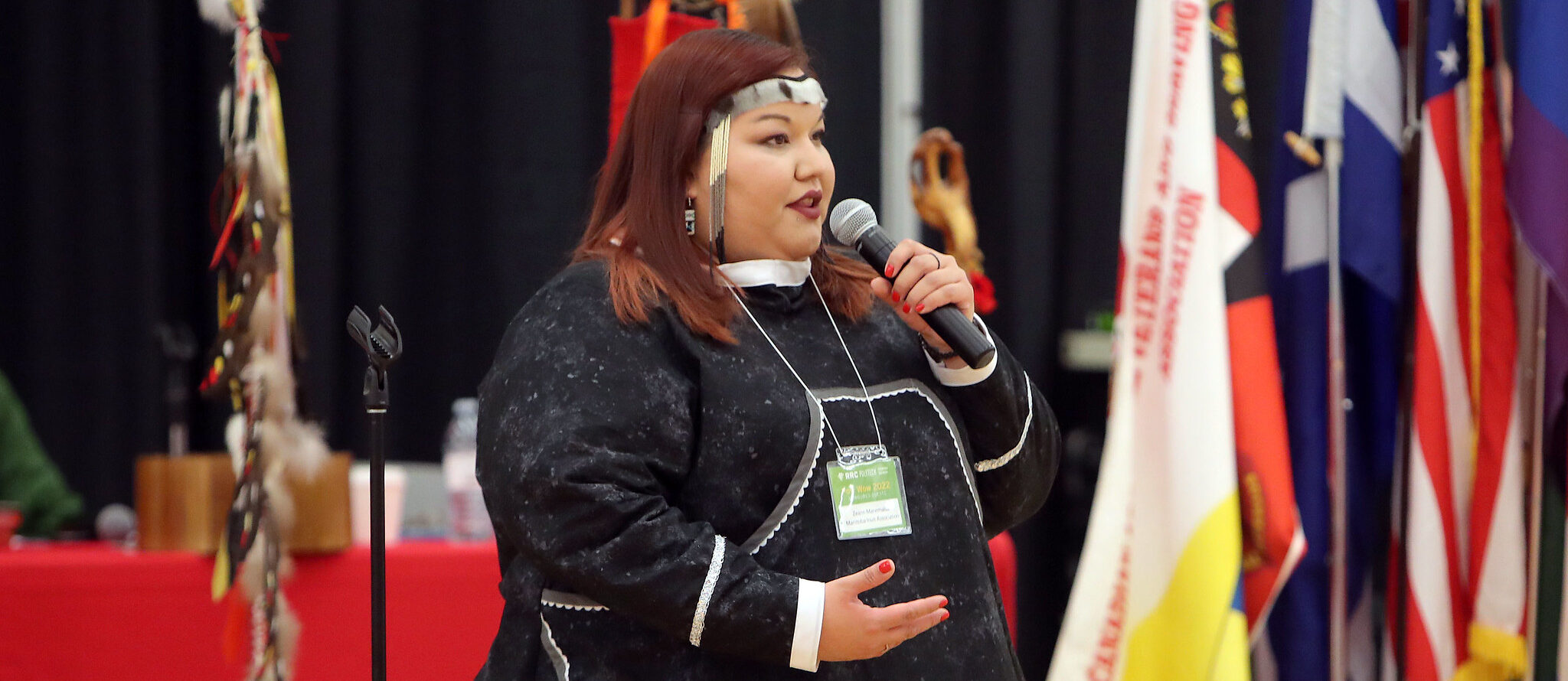
The celebration started with a three-song performance by Inuit throat singer Zeann Manernaluk. She explained that throat singing was invented by Inuit women while men were out hunting, and traditionally two women would throat sing together until they laughed or got tired.

Victoria, an Inuit Student Support Worker with the Manitoba Inuit Association, kicked off the group activities with a rundown of their role as an organization in Manitoba: a resource that supports any Inuit people in Manitoba and connects them with services to meet diverse and ever-evolving needs. Victoria presented traditional Inuit clothing and tools and the stories behind them. She demonstrated and invited everyone to compete in Inuit games to win prize packs from the Manitoba Inuit Association.

College Transition students Luke Kusugak and Andrew Owlijoot said a few words about being young Inuit men coming from Rankin Inlet, Nunavut: they’re learning to be more open about their emotions, coming from a place that doesn’t have the infrastructure to focus supports around mental wellbeing.

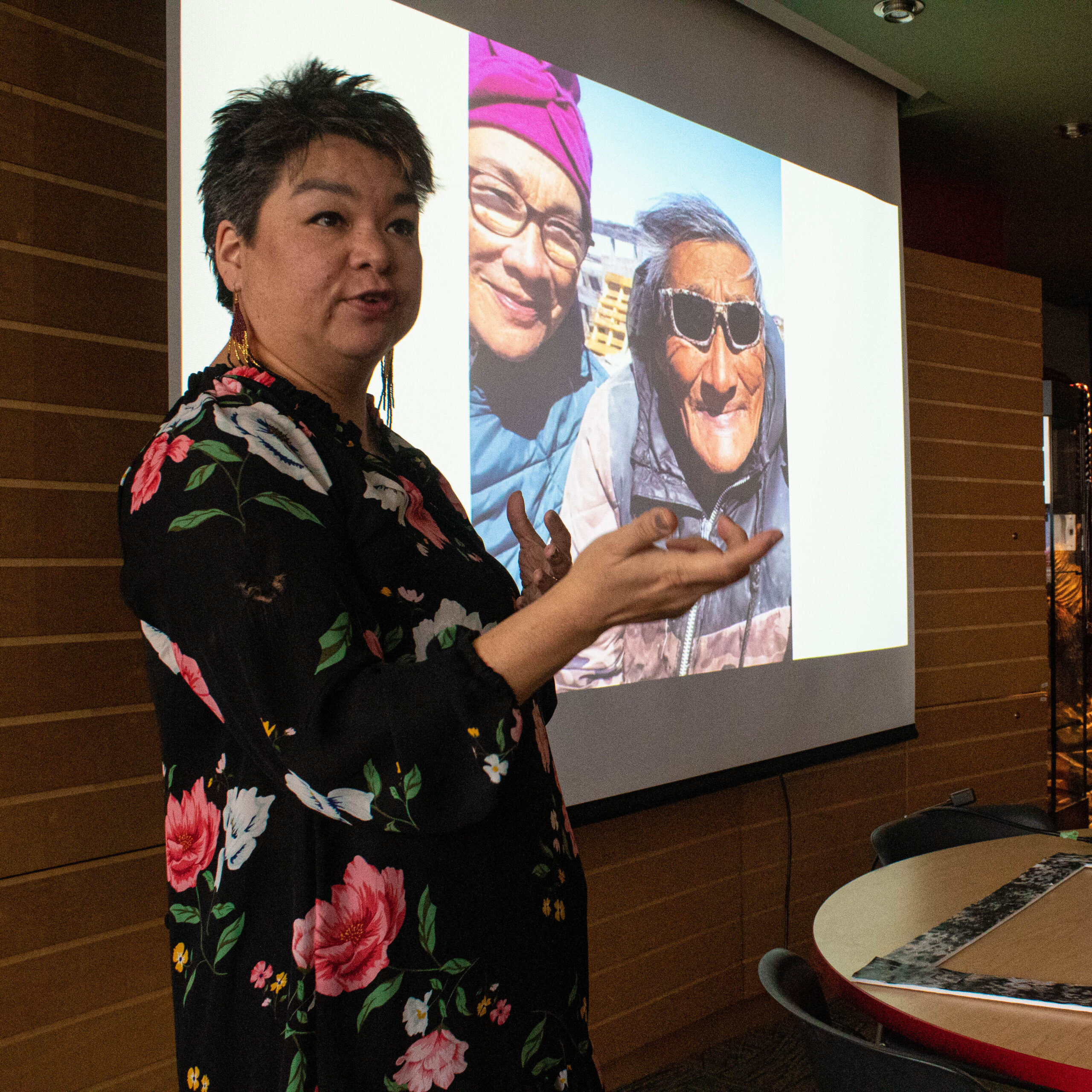
Chase Powell, another Inuit student in the College Transition program, prepared a PowerPoint presentation to share a brief history of his home Rankin Inlet, Nunavut and his life growing up on the west coast of the Hudson Bay. His mother Esther, who happened to be in Winnipeg for a medical appointment, joined him and shared a short family history and the nature of Inuit life before colonization. PowerPoint pictures depicted the landscape of the north, Chase’s cabin on the coast, caribou on their mating grounds, roads enveloped in blowing snow, and old black-and-white pictures of Chase’s and Esther’s ancestors.

Esther Chase, an Inuit woman from Rankin Inlet, points to a PowerPoint slide of a photo of her family members.
Esther sharing her family history.

Chase explained that the education in Rankin Inlet didn’t meet his expectations. Teaching was not based on students’ needs, but rather was based on the resources that were available. And resources were basic – there were no supports for students with special needs. The schools had some Inuktitut language classes but didn’t have any Inuit culture classes.

After high school, Chase decided to pursue education. Originally he had planned to attend the University of Winnipeg for a Bachelor’s Degree in Education, but his high school grades weren’t satisfactory. A guidance counsellor at his high school suggested that he try the College Transition program at RRC Polytech, because it would help him get his grades up and prepare him for college life in the south. He applied and has since started on his path to his future goals.

Chase hopes to get his master’s degree in education so he can become a principal. He explained that southerners come up to the north and fill up high-ranking positions in organizations and in government because they had easier access to quality, focused education. Chase wants to change that—having local representation in these positions is important because people who have grown up in the north have a lived experience that can more effectively contextualize the unique needs of learners in Nunavut. He wants to influence change in Nunavut’s education system as a future administrator, to help the learners of future generations obtain the education they need to get into these high-ranking, decision-making, community-impacting positions.

For now, Chase, Luke, Andrew, and their colleagues will continue with the College Transition program and work toward their professional and personal goals. We can’t wait to see where they’ll go!

Indigenous Language and Bannock Making – Nov. 2

October 27, 2022

Have you ever heard the term “Miigwech” being used by our Anishinaabe friends and wondered what it meant?

Or maybe you would like to learn how to say a simple greeting in Anishinaabemowin?

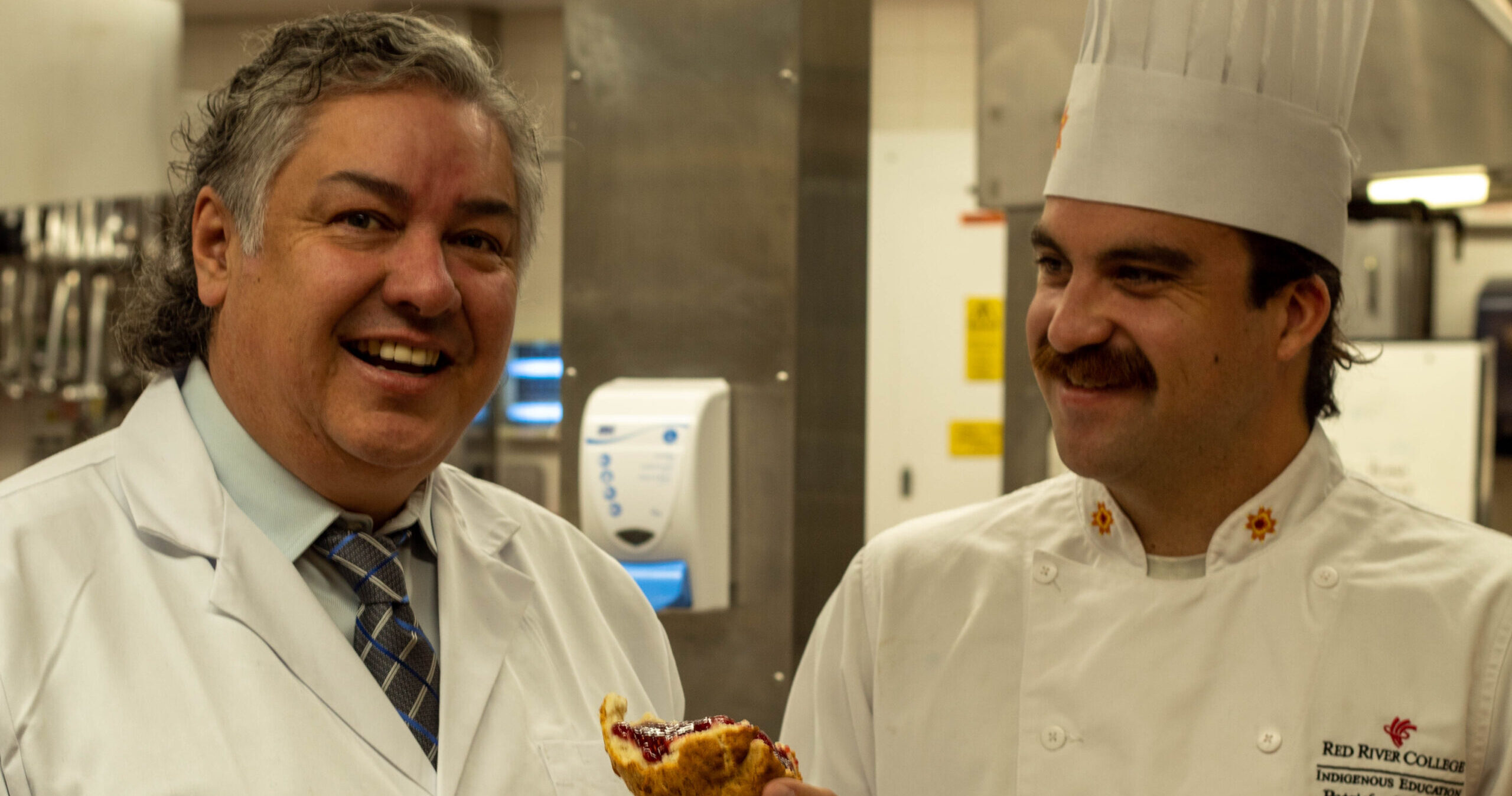
Join us next Wednesday to learn how to make bannock, a type of bread that is a staple and sometimes a treat with jams, butter or honey for Indigenous people, with Instructors Corey Whitford and Chef Patrick Anderson as part of Inclusion Week!

  • Wednesday, Nov. 2, 2022 3:30pm – 5pm
  • F209 Notre Dame Campus

Register for this fun, interactive workshop in which Indigenous Languages Instructor Cory Whitford shares his very own bannock recipe while simultaneously immersing participants in the basics of Anishinaabemowin.

Take-home bannock making supplies will be provided for participants. Space is limited, so register early!

International Inuit Day – Nov. 7

October 25, 2022

All staff and students are invited to join us to celebrate International Inuit Day!

Four College Transition students from Rankin Inlet, Nunavut — Chase Powell, Andrew Owlijoot, Luke Kusugak, and Logan Siksik — will be sharing stories about Inuit culture, teaching a few words in Inuktitut, and leading us in some traditional Inuit games.

We’re excited to welcome guests from the Manitoba Inuit Association, who will be joining in the celebration.

The event will be livestreamed from NDC (F209) to EDC (P407), so students at both campuses can take part.

  • Monday, Nov. 7, 202211am – 1pm
  • F209 Notre Dame CampusP407 Exchange District Campus

Pizza will be provided for lunch!

If you have any questions, please contact Terri-Lynn Anderson at tlanderson@rrc.ca.

Halloween Costume Contest – Oct. 31

October 25, 2022

Are you ready for Halloween?

Drop by one of the Indigenous Student Support Centres on either campus and see Terri-Lynn Anderson or any support staff to enter the Costume Contest!

  • Monday Oct. 31, 20228:30am – 4pm
  • F209 Notre Dame Campus • P407 Exchange District Campus

Choose your category:

  • Single costume
  • Duo costumes
  • Group costumes

Juices boxes, coffee, and candy will be available throughout the day.

Names of winners for the costume contest will be posted in the centre and they will be contacted.

Welcome Celebration 2022

September 29, 2022

Come and join us for a fun-filled day of activities, entertainment, and food, while having the opportunity to meet the Indigenous Student Supports Team, fellow students, and to win prizes!

Our Indigenous Support Centres at the Notre Dame Campus and Exchange District Campus will be open for the celebration with baked goods, coffee, pizza, and pop all throughout the day. Special entertainment includes the Walking Wolf Singers from 12:00 to 1:00 p.m. at the Notre Dame Campus.

The event is free of charge and open to all RRC Polytech students.

For any questions, please contact Event Coordinator, Terri-Lynn Anderson at tlanderson@rrc.ca.

MMIWG2S Red Dress Pin Workshop

September 26, 2022

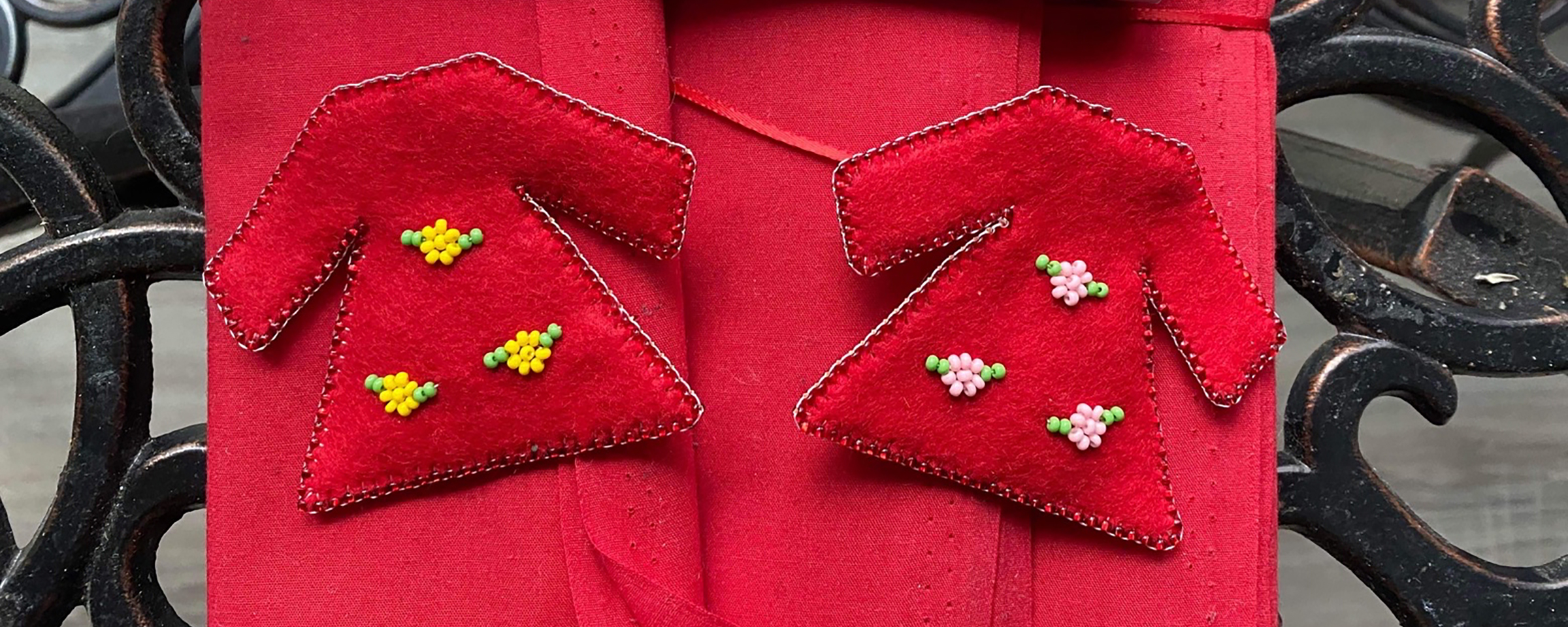
Join us for an evening workshop at the Indigenous Student Support Centre, to create a red dress pin with Gerri-Lee Pangman. The event is intended as a way to connect while opening up a dialogue around Missing and Murdered Indigenous Women, Girls and Two Spirit (MMIWG2S) folx.

Participants will complete a red dress pin to wear on October 4, to recognize and bring awareness to MMIWG2S.

The event is free of charge and open to RRC Polytech employees and students.

  • Date: October 3, 6pm-9pm
  • Location: Indigenous Student Support Centre, F209, Notre Dame Campus. Click here for a map.

Food and refreshments will be provided for participants. Advance registration is required as capacity is limited to 20 participants.

For any questions about the workshop, please contact Terri-Lynn Anderson at tlanderson@rrc.ca.

About the facilitator:

Gerri-Lee Pangman (McPherson) is a member of the Pegius First Nation. She was born and raised in the heart of Winnipeg, Manitoba. She is a wife and mother of four beautiful children, two sons, and two daughters and just recently became a Kohkum last July to a healthy beautiful grandson.

In 2013 Gerri-Lee and her family tragically lost her sister Jennifer Dawn McPherson who lived on Hanson Island, BC., and also, her Aunt Jennifer Johnston in 1980 in Winnipeg. After the great losses in her family to murder, she is now fully aware of the tragedies and injustices faced by our Indigenous Women, Girls and Two Spirit. She works hard to heal and bring light to the issue of Missing and Murdered Indigenous Women, Girls and Two Spirit (MMIWG2S).

During her grieving and trauma after losing her sister, Gerri-Lee found the strength to cope with her sister’s loss by healing through art-making, earrings, ornaments, dreamcatchers, and stained glass to honor her beloved sister’s memory. She honors her sister’s spirit through J.D.M. Indigenous Designs with her older sister Kim. She also participated in community activities and programs such as Medicine Bear Counseling by facilitating weekly beading circles with other MMIWG2S families for five years as well as in schools and community centers, and also traveled across Canada with the National Inquiry into Missing and Murdered Indigenous Women and Girls to do healing through beading sessions with MMIWG family members and the staff of the Inquiry.

She has turned to and introduced her family to traditional ceremonies such as Sundance, and has completed five years. She also shares her sister Jennifer’s story while teaching how to make red dress pins from coast to coast to coast on Zoom sessions to help in breaking the cycle of violence towards MMIWG2S and colonization.

We recognize that this workshop may trigger strong emotions, especially for those with lived experiences. It is recommended that we all check in on ourselves and access the resources available to us to ensure we are taking good care of our mental health.

Mental health and self-care resources:

If you need help, please don’t hesitate to reach out or access any of the following resources:

Self-care is a powerful tool to help us work through emotions and take better care of our minds, bodies and spirits and can come in many forms and is not one-size-fits-all.

  • Here are some recommendations:
  • Spend time with a loved one
  • Phone a friend
  • Ask a loved one for a hug
  • Read a book, watch a favourite movie, or listen to music
  • Go for a walk, do yoga, or exercise
  • Take a warm bath or shower
  • Cook yourself a nice meal
  • Meditation or prayer
  • Download a meditation app
  • Write in a journal
  • Get proper sleep

Can’t attend the workshop?
Leave a message of hope and remembrance on a red dress cutout by visiting the Indigenous Student Support Centre, F209, during Truth and Reconciliation Week, or stop by the Community Kitchen Party from 12:00 to 1:00 p.m. outside of the Notre Dame Library on Wednesday, Sept 28.

Orange Shirt Day: Every Child Matters

September 26, 2022

Orange Shirt Day: Every Child Matters, takes place annually on September 30 to recognize Residential School survivors as well as those who never made it home. It’s a day to acknowledge this horrific history and move forward on a healing journey as we continue to commit to Truth and Reconciliation.

The “orange shirt” in Orange Shirt Day refers to the new shirt that Phyllis Webstad, Residential School survivor and creator of Orange Shirt Day, was given to her by her grandmother for her first day of school at St. Joseph’s Missions Residential School in British Columbia. When Phyllis got to school, they took away her clothes, including her new shirt.

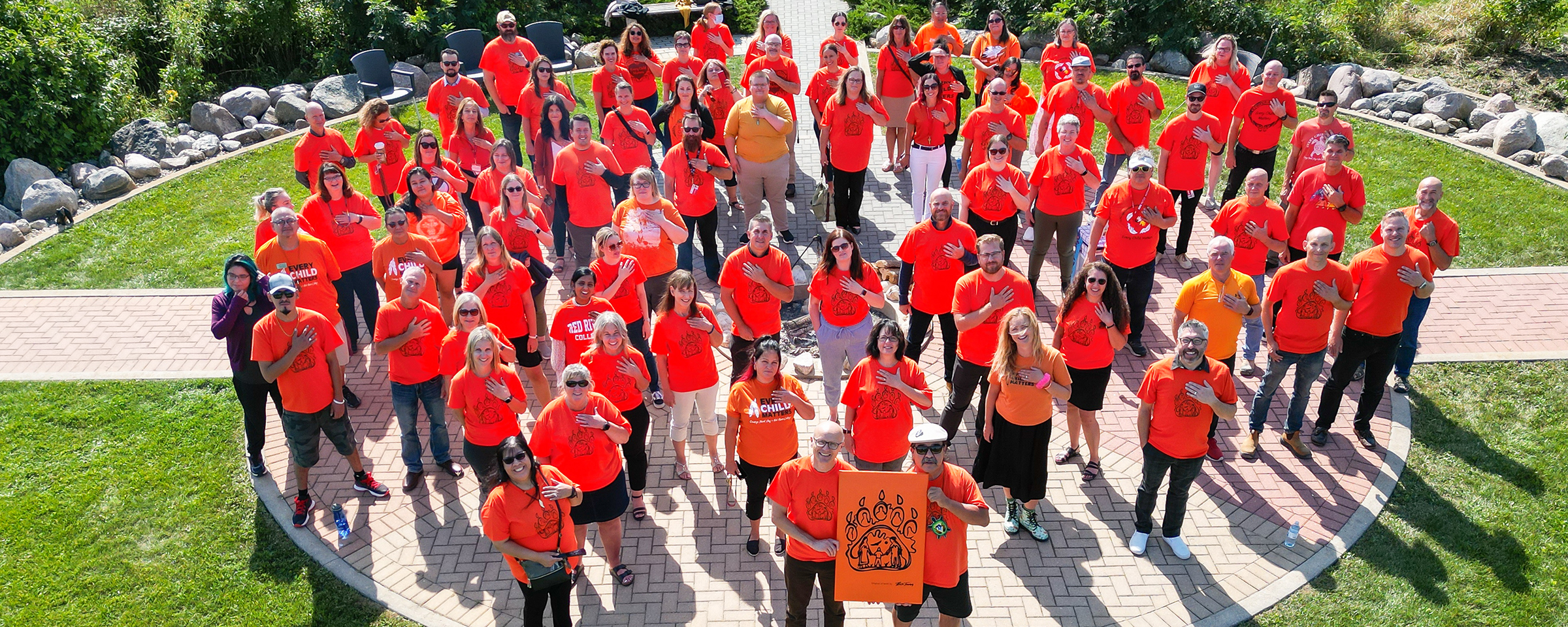
RRC Polytech staff and students are pictured wearing their orange shirts to honour the Indigenous children, like Phyllis, who were forcibly taken from their homes and the intergenerational impacts of Residential Schools.

This year, orange t-shirts, featuring a design by local artist, Peatr Thomas, were created in partnership by RRC Polytech’s School of Indigenous Education and the Campus Store. The t-shirts are now available at the Exchange District and Notre Dame Campus Stores, with all proceeds going directly to the Mínwastánikéwin Truth and Reconciliation Award, which provides bursaries for Indigenous students studying at the College. Orange shirts sell out every year, so get yours now and wear it on Sept 30.

Fall Equinox Celebration

September 16, 2022

All students and staff are welcome to join us for a traditional Pipe Ceremony and Feast to celebrate and give thanks for the Harvest season. We invite all Pipe Carriers to take part in the Pipe Ceremony. Following the Pipe Ceremony, join us for a Feast to honour the name of our newest building Manitou a bi Bii daziigae – Where Creator Sits • Brings Light.

Thursday, September 22, 2022
Manitou a bi Bii daziigae, Exchange District Campus
Pipe Ceremony – 10:00 a.m.
Feast – 12:00 p.m.


Advance registration is not required.

Truth and Reconciliation Week 2022

September 9, 2022

Schedule of Events

All RRC Polytech students and staff are invited to participate in our fourth annual Truth and Reconciliation Week, September 26-29, 2022.

Through a mix of in-person and virtual events offered by departments from across the College, immerse yourself in Indigenous teachings, story-telling and experiences to evolve your understanding of history and current issues impacting Indigenous people, reconciliation efforts and society as a whole. Help spark a conversation around Truth and Reconciliation and contribute to understanding, healing and stronger relationships.

Truth and Reconciliation Week – Daily Activities

TRC Immersion Room Experience
In-Person – Emerging Media and Production Studios, GM-33, Mall Level, Notre Dame Campus

Presentations on the hour, every hour from 9 AM – 3 PM daily from September 26th through the 29th. Limited to 14 people per presentation.

Immerse yourself in an introductory story of Truth and Reconciliation, from the relationship with “Earth Mother” to the experience of Residential Schools. This 10-minute installation is about healing and respect. Brought to you from the Emerging Media and Production Immersion Room, this 360° media-rich installation provides an opportunity to learn, discuss, and share thoughts and experiences related to Truth and Reconciliation.

Assiniboia Residential School Exhibit
In-Person – RRC Polytech Notre Dame Campus Library

Library and Academic Services is pleased to host the Assiniboia Residential School Exhibit.  On loan from The City of Winnipeg this exhibit was developed as a part of their Journey of Reconciliation. On display at Red River College Polytechnic from September 26 to October 7, the Assiniboia Residential School Indigenous Exhibit is a reconciliation project that provides an opportunity for RRC Polytech staff and students to learn about Indigenous history with a goal of renewed perspectives and understandings that will strengthen relationships with Indigenous and non-Indigenous peoples.   

The Assiniboia Residential School Exhibit was created in consultation with Assiniboia Residential School Survivors Committee from the National Centre for Truth and Reconciliation and the Indigenous Exhibits Working Group.   

For more information please visit https://winnipeg.ca/indigenous/reconciliation/AssiniboiaResidentialSchoolExhibit.stm 

About Assiniboia Residential School 

There were 17 Indian Residential Schools in Manitoba which included one location in Winnipeg known as the Assiniboia Indian Residential School. Federally funded and operated by the Grey Nuns and Oblate Fathers, the Assiniboia Indian Residential School was part of the Federal government’s educational system under the Indian Act. The school operated from 1958 until June 1973 and the school still stands today and now functions as the Canadian Centre for Child Protection including Child Find Manitoba located at 615 Academy Road in River Heights. 

Please take time to visit the Assiniboia Residential School Exhibit as it will be available for viewing in the Library at the Notre Dame Campus.  

Monday, September 26, 2022

Self-Guided: Ray Coco Stevenson: Opening Honour Song  

Singer and composer Ray “Coco” Stevenson helps us open up the week with a traditional Honour Song to start us off in a good way. You may recognize Coco as our annual Pow Wow arena director, or as a well-known singer and drummer in the community. He was first introduced to drumming and ceremonies over thirty years ago. 

In-Person: Staff Development: Indigenous Research Methodologies with Dr. Shawn Wilson 
9 am – 4 pm – Roundhouse Auditorium, second floor of Manitou a bi Bii daziigae 

Research is an important area at RRC Polytech that helps to guide the work we do. Dr. Shawn Wilson, from Opaskwayak Cree Nation, and author of Research is Ceremony: Indigenous Research Methods will be at the College during Truth and Reconciliation Week to share his knowledge about Indigenous research methodologies. We invite you to join us on a learning journey where we will view research through a holistic and relational lens and one rooted in ceremony. 

Shawn will share with us the elements of an Indigenous research paradigm, OCAP and FPIC principles, and how to weave Indigenous traditions and practices into a research process and share with us the specific principles that need to be considered and applied when entering into research with Indigenous Peoples and Nations. 

Lunch and refreshments will be provided.  

Virtual Live: Student Anti-Racism training: Module 1
11:00 am – 1:00 pm

When we think and talk about racism, most people reference examples of interactions between people, but racism is also maintained by institutions and society through the implementation of policies, practices, and programs. This two-hour training will provide an introduction of how privilege and racialization contribute racism    and provide a starting point for challenging systemic racism in Canada.

Module 1 of the Anti-Racism training will provide participants with an introduction to how racism functions as an interconnected system. Using videos and data reflecting both historical and current evidence of systemic racism, this training will help develop the awareness and skills needed to challenge systemic racism in Canada. 

This presentation is brought to you by the Academic Success Centre (ASC) Diversity team and the Centre for International Education and Global Partnerships (CIEGP).

Tuesday, September 27, 2022

Self-Guided: The Importance of Indigenous Languages

There is more to language than just words: it’s culture, context, history and even humour. Indigenous languages need to protected. RRC Polytech Indigenous Language Instructor Corey Whitford from the School of Indigenous Education invites you to a discussion on Indigenous languages where you will also learn some phrases in Anishinaabemowin (Ojibwe), one of the most common Indigenous languages in Manitoba.

In-Person – Staff Development: Indigegogy
12:00 pm – 1:00 pm, Indigenous Support Centre, F205 Notre Dame Campus

In this session, Joanna White, Indigenous Curriculum & Cultural Advisor for the Department of Community Services, will lead faculty through a experience of holistic learning through Indigegogy, while unpacking the important role Indigegogy can and should play in the future of teaching and learning at RRC Polytech.

Participants will leave this session with a better understanding of the following questions:

  • What is Indigegogy?
  • Why should Indigegogy be incorporated into post-secondary programming?
  • How is Indigegogy an act of reconciliation?
  • What could Indigegogy look like in a post-secondary program?
  • How can we create more holistic learning opportunities in our classes?
  • How can we better use physical spaces to promote learning?
  • What does Indigegogy look like in online teaching?
  • What is the difference between honouring Indigenous ways of teaching and learning and appropriation?
  • What are resources for further learning?

Snacks and refreshments will be provided.

Wednesday, September 28, 2022

Self-Guided: 1200+
Raising awareness to the issue of Missing and Murdered Indigenous Women and Girls in Canada

1200+ is a documentary film Featuring Indigenous Leader Sheila North, Directed by Leonard Yakir and Co-produced by Sheila North and Leonard Yakir.

“This film is important for us and our Indigenous communities as we need to raise awareness and bring international attention to the issue of Missing and Murdered Indigenous Women and Girls in Canada. We invite those to see the film, to learn more about the issue of MMIWG in Canada and how it is impacting our communities and families across the country. I know those dark corners of Canada’s town and cities that need more light, that need more helping hands reaching in, and that’s a big reason we made this documentary. I hope people are inspired to make change.” – Sheila North, Film Co-Creator.

Self-Guided: National Film Board of Canada Selections
Finding Dawn

Acclaimed Métis filmmaker Christine Welsh brings us a compelling documentary that puts a human face on a national tragedy – the epidemic of missing or murdered Indigenous women in Canada. The film takes a journey into the heart of Indigenous women’s experience, from Vancouver’s skid row, down the Highway of Tears in northern BC, and on to Saskatoon, where the murders and disappearances of these women remain unsolved.

Self-Guided: National Film Board of Canada Selections
Second Stories – Deb-we-win Ge-ken-am-aan, Our Place in the Circle
Lorne Olson

Lorne Olson’s short documentary presents a vision he had of two-spirited people dancing, laughing, and smiling. His vision spurs him to rediscover the strength of the past to better face the challenges of today. This funny and buoyant film documents his touching journey.

Self-Guided: Fierté Canada Pride
Stories of Two-Spirit Indigenous LGBTQ+ Indian Residential and Day School Survivors

Canada’s Indian Residential Schools (IRS) caused irreparable harm to First Nations families across many generations. 2Spirit (Indigenous LGBTQ) people were among those impacted, however their stories have rarely been heard, documented, or shared in the general discourse about this era. Following the closure of the last IRS in Ft. Qu’Appelle, Saskatchewan, in 1996, there is a generation of 2Spirit former students who are available to engage in this project. The 2Spirit Council of Fierté Canada Pride lead the engagement of 2Spirit survivors and assisted and supported them to tell their stories.

The goal of this project was to recruit eight 2Spirit Indian Residential School Survivors (Story Tellers) to participate in a speaker series project in order to preserve and share their stories. Our Project Coordinator worked with Story Tellers through a series of storytelling workshops, and support them in documenting and sharing their story through the project.

In-Person – Community Kitchen Party
12:00 pm – 1:00 pm – Library Hallway, Notre Dame Campus, Mall Level

Truth and Reconciliation Week contains many emotionally sensitive and often painful topics and it’s important that we take time for joy, community and taking care of our spirits to help us along in this journey. Join us for a community celebratory gathering and enjoy some Bannock, rice pudding, and performances by Morgan Grace, fiddling, and Peyton Habinski-Anderson, jigging.

Morgan Grace

Morgan is a 15 year old youth fiddler from east Selkirk. She is Coming off a very busy summer playing many festivals and other significant events. This year she also launched her first self-titled album. Morgan’s style originates from the vast amount of amazing fiddle teachers and fiddle players she has been fortunate to be around.

Peyton Habinski-Anderson

Peyton Habinski-Anderson is a proud, 13-year-old Métis performer. At age 7, she started jigging lessons with Dean Davis and quickly fell in love with the cultural dance.  Since then, she has performed at several different Métis events and was this year’s female youth ambassador for the Métis Pavilion at Folklorama. Peyton’s goals are to continue performing at different Métis events throughout the community and spread cultural awareness.

Virtual Live & In-Person: Immersive Stories
Story Teller: Corey Whitford
12:00 pm – 1:00 pm
EMP Studio, Connected Classroom

The Immersive Stories Program is designed to give students, faculty, and staff a first-hand opportunity to gain knowledge and understanding about multi-layered socio-cultural identities and lived experiences. As outlined in our new Strategic Plan, this program is part of the College’s commitment to Truth and Reconciliation, and the pursuit of equity, diversity and inclusion in everything we do.

Participants will develop skills that will allow them to regularly check their personal, social, and cultural assumptions so that they can avoid making quick conclusions and judgments. This in turn will help to foster a diverse and inclusive College environment for students and faculty. 

Each session in the Immersive Stories Program will involve a discussion with a member of our RRC Polytech community, during which they will share their unique lived experiences, and invite participant questions and dialogue. These conversations will provide participants an opportunity to gain insights into the lived experiences of our diverse community and will assist in becoming aware of our own biases.

About Corey Whitford

Corey Ralph Whitford

Corey Ralph Whitford has been teaching at RRC Polytech in the Indigenous Languages Program for five years, teaching through activities that shape a better understanding of Anishinaabemowin. Corey is eager to share his knowledge and provide guidance in all class activities to his students.

Corey was born in Portage la Prairie, and raised in Sandy Bay. His parents are from Long Plain and Sandy Bay, and both were fluent Anishinaabeg. Corey’s family spoke/speaks Anishinaabemowin, so he naturally picked it up along the way.

Corey is passionate about what he does, continuing to serve his community and fill the vacuum for Anishinaabemowin knowledge at the College level.

Thursday, September 29

Self-Guided: Elder Paul Guimond: Closing Honour Song

Elder Paul Guimond, RRC Polytech Elder-in-Residence helps us close the week with an honour song dedicated to MMIWG2S in advance of the National Day of Action for Missing and Murdered Indigenous Women, Girls and Two Spirit on October 4.

It is estimated more than 4,000 Indigenous women and girls in Canada have gone missing or been murdered since 1980. According to Statistics Canada, Indigenous women and girls make up four per cent of the total Canadian female population, represent 10 per cent of missing women and, on average, 16 per cent of female homicide cases, a number that fluctuates and was as high as 21 per cent in 2014.

In-Person: Assiniboia Residential School Panel Talk 
11:00 am – 12:00 pm, Notre Dame Campus Library, CM18 

Murray Peterson

Join Murray Peterson, Historian with the City of Winnipeg, in a talk about the Assiniboia Residential School Exhibit and the effort of the hundreds of people it took to put the panels together. 

About Assiniboia Residential School 

There were 17 Indian Residential Schools in Manitoba which included one location in Winnipeg known as the Assiniboia Indian Residential School. Federally funded and operated by the Grey Nuns and Oblate Fathers, the Assiniboia Indian Residential School was part of the Federal government’s educational system under the Indian Act. The school operated from 1958 until June 1973 and the school still stands today and now functions as the Canadian Centre for Child Protection including Child Find Manitoba located at 615 Academy Road in River Heights. 

Please take time to visit the Assiniboia Residential School Exhibit as it will be available for viewing in the Library at the Notre Dame Campus from September 26 to October 7. 

In-Person: Immersive Stories
Story Teller: Brittany Ross
12:00 pm – 1:00 pm, Multi-purpose Round Room, E155, Manitou a bi Bii daziigae, Exchange District Campus

The Immersive Stories Program is designed to give students, faculty, and staff a first-hand opportunity to gain knowledge and understanding about multi-layered socio-cultural identities and lived experiences. As outlined in our new Strategic Plan, this program is part of the College’s commitment to Truth and Reconciliation, and the pursuit of equity, diversity and inclusion in everything we do.

Participants will develop skills that will allow them to regularly check their personal, social, and cultural assumptions so that they can avoid making quick conclusions and judgments. This in turn will help to foster a diverse and inclusive College environment for students and faculty. 

Each session in the Immersive Stories Program will involve a discussion with a member of our RRC Polytech community, during which they will share their unique lived experiences, and invite participant questions and dialogue. These conversations will provide participants an opportunity to gain insights into the lived experiences of our diverse community and will assist in becoming aware of our own biases.

About Brittany Ross

Brittany Ross

Brittany Ross is a Métis woman and mother of two sons. She was born and raised in Winnipeg, and has spent over 10 years supporting, advocating and mentoring Indigenous students in the adult education, and post-secondary education sectors. Through Brittany’s previous experience, she has a fundamental understanding of the importance of creating safe, respectful and positive environments.

Brittany has developed, engaged, and maintained relationships with various stakeholders including; community organizations, school divisions, health professionals, and various levels of government. In addition, she has years of training to aide her in her new position, such as Mental Health First Aid, Indigenous Suicide Prevention, PTSD in Indigenous Adults, to name a few.

As a Navigation Coach within the School of Indigenous Education at RRC Polytech, Brittany is passionate about making a significant difference in student’s lives, and connecting with students through her open-minded, empathetic, and caring nature. She loves playing a role in supporting the successes of Indigenous students here at Red River College Polytechnic.

Virtual Live & In-Person: Residential School Thriver
Story Teller: Elder Betty Ross
12:00 pm – 1:00 pm EMP Studios, Connected Classroom

Join Elder Betty Ross as she shares her story about her experience in Canada’s Residential School System.

About Elder Betty

Elder Betty Ross originates from Pimicikamak Cree Nation and has lived in Winnipeg, MB, since the early 1960s. Betty is a Residential School Survivor of two systems St Joseph’s Residential School in Cross Lake and Assiniboia Residential School in Winnipeg, MB. She is very immersed in her Indigenous heritage and speaks Cree language fluently. She’s a mother, grandmother, great grandmother of two sons and two daughters, 15 grandsons, 12 grand daughters, and 10 great grand generations and counting.

Elder Betty worked as a Cree Interpreter and Resource worker for 11 years at the Health Science Centre. She also worked for the Winnipeg Regional Health authority as a Spiritual and Cultural Care Provider for Indigenous Health/Cultural for 10 years. Betty retired in 2018 to relax and rejuvenate before traveling to Albuquerque, New Mexico to attend the gathering of Nations where she danced Traditional for Canada. Shortly after coming back from the gathering, she was recruited by the Seven Oaks School Division as an Elder-in-Residence and works there to this day. She teaches cultural initiatives in three different schools connecting with over 3000 students weekly from all walks of life.

Betty has been very busy connecting with various community organizations in Winnipeg sharing the true story of Residential Schools as depicted in her stories Sugar Falls and Did You See Us. Elder Betty continues to walk from the best of both worlds, looking after a nurturing the great Circle of Life with honour and respect to this day.

For those joining virtually, click here for the livestream during the event.

In-Person: Fan Down
2:30-4:30 pm, Indigenous Student Support Centre (F209)

Marshall Richard, Indigenous Liaison Advisor and Scaabe, invites you to be fanned down to let go and head into the weekend with a light heart and spirit. A fan down is a smudging ceremony and a beautiful way to take in some good medicines. No prior knowledge required, just drop in!

Resources for Beyond TRC Week

Truth and Reconciliation Community of Practice

The Truth and Reconciliation Community of Practice will create opportunities for participants to extend and apply their learning, and to take action to advance Truth and Reconciliation and anti-racism. This experience will guide participants on a journey through the Medicine Wheel and will provide experiential learning around Indigenous ways of teaching and learning. Participation in the TRCP will involve a minimum commitment of 8 hours throughout Fall 2022, including joining the Immersive Stories events.

If you are interested in learning more about the Truth and Reconciliation Community of Practice, visit us online or join the information session on Tuesday, Sept 20, from 12:00 to 12:45 pm, which you can register for here.

If you are ready to join the Truth and Reconciliation Community of Practice, you can apply to the first iteration of this program here. (Don’t forget to register for the Immersive Stories sessions as well, which accompany this learning community!)

RRC Polytech campuses are located on the lands of the Anishinaabeg, Ininiwak, Anishininwak, Dakota Oyate, and Denésuline, and the National Homeland of the Red River Métis.

We recognize and honour Treaty 3 Territory Shoal Lake 40 First Nation, the source of Winnipeg’s clean drinking water. In addition, we acknowledge Treaty Territories which provide us with access to electricity we use in both our personal and professional lives.