Integrating Indigenous Perspectives in Language Education at CNI
As we mark National Indigenous History Month, the Centre for Newcomer Integration at RRC Polytech continues its commitment to advancing truth, understanding, and respectful relationships with First Nations, Inuit, and Métis Peoples. This month highlights the importance of learning from history and listening to Indigenous perspectives – work that is happening across our Polytech community. Over the past year, CNI Instructor Sherry Seymour has demonstrated how this learning can be brought to life in the classroom through intentional, experiential, and relationship‑centred teaching.
After participating in the Indigenous Residential School Museum Tour last August, Seymour has been integrating Canada’s colonial history and Indigenous perspectives into her classes even more over this past year.
In the fall term, she took her CLB 5/6 class on a field trip around the downtown area, stopping and discussing murals like Carly & Diana Morriseau’s “We are still here,” written in Ininimowin (Cree) syllabics, and Stephen Gladue’s depiction of Brian Sinclair, an Indigenous man who died from a treatable infection while waiting 34 hours for care at an emergency room in Winnipeg. While on the tour, students witnessed first-hand how the Residential School system and Canada’s colonial frameworks have left many people in poverty and without housing.
Seymour’s CLB 5/6 students learned about Askii Akawa Asotamaatowin (Land & Treaties) and Gawiin Bimikawesiwan (Assimilative Policies) from the Indigenous Orientation Toolkit. These modules are excellent steppingstones into learning about Treaty Rights, unceded territory, and discriminatory policies like the Indian Act and the pass system.
Seymour contextualized the learning by sharing stories of how WW2 veterans were treated differently if they were Indigenous, in contrast to the benefits her serving grandfathers were eligible to receive. Students learned about local Indigenous veterans Sergeant Tommy Prince and Corporal Joe Keeper to connect with the City of Winnipeg and the streets named in their honour.
At the end of the term, two guests were invited to further humanize and contextualize what students had learned in the course. Elder Paul Guimond shared cultural teachings and some of his experiences from Residential School. On another occasion, Corey Whitford shared his experiences in Residential School and taught students the Anishinaabemowin terminology to make bannock. A visit to the Indigenous Student Support Centre was also arranged, and learners were introduced to smudging and four sacred Medicines: Cedar, Sage, Tobacco, and Sweetgrass. Some students commented that they used some of the same Medicines in their cultures.
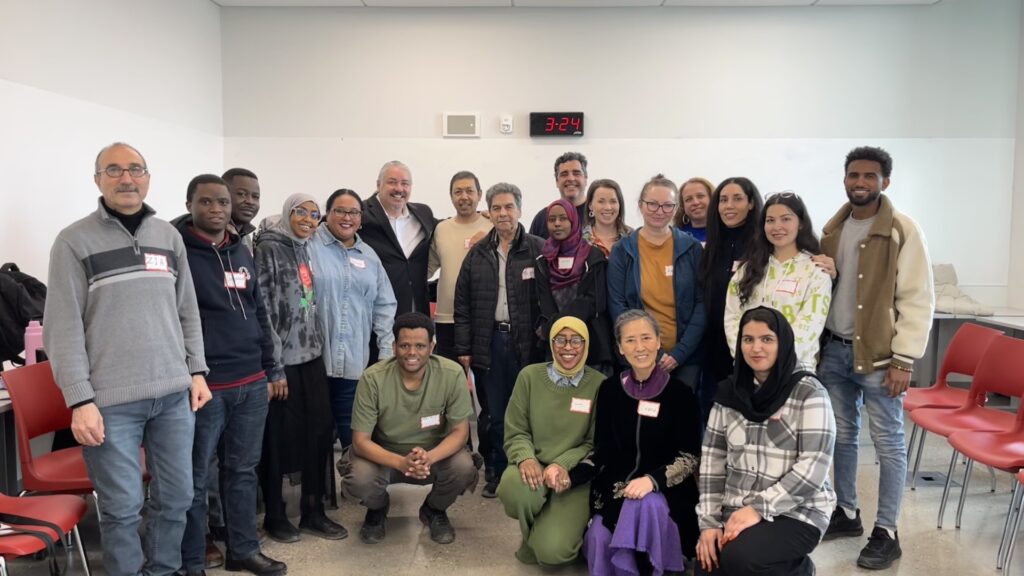
Seymour has just finished a term teaching two CLB 4 classes. Her students explored land acknowledgements through a Reconciliation Awareness module developed by the Immigrant Services Society of British Columbia entitled “Welcome to Our Homelands.” Students connected to the content by composing their own land acknowledgments. In the closing Sharing Circle, students shared that they better understand Indigenous Peoples and the intergenerational trauma that impacts their experiences. They also said that they would really like to learn more.
To build relationships and understanding, Elder Paul was invited to share his knowledge about traditional Medicines. Students enjoyed this experiential, hands-on learning, where they could smudge, taste, feel, and smell different local medicines.
Finally, over the past month, Seymour has been honoured to pilot The Tools and Knowledge Left for Us by Our Ancestors, a course developed in-house by Maxine Fehr, where students learn to “evaluate the need to honour Indigenous worldviews in modern-day as well as the contributions of Indigenous Peoples” and “listen to stories recounted by Residential School Survivors.” A feast was held in conjunction with Maxine Fehr’s pilot cohort to celebrate their learning on June 25th.
As an instructor, Seymour says that she is learning alongside her students. She is still in the midst of understanding her own positionality, while seeking the truth and learning to listen to more Indigenous voices, and more often. She hopes that more instructors will feel the call to learn and discover their why in terms of reconciliatory education.