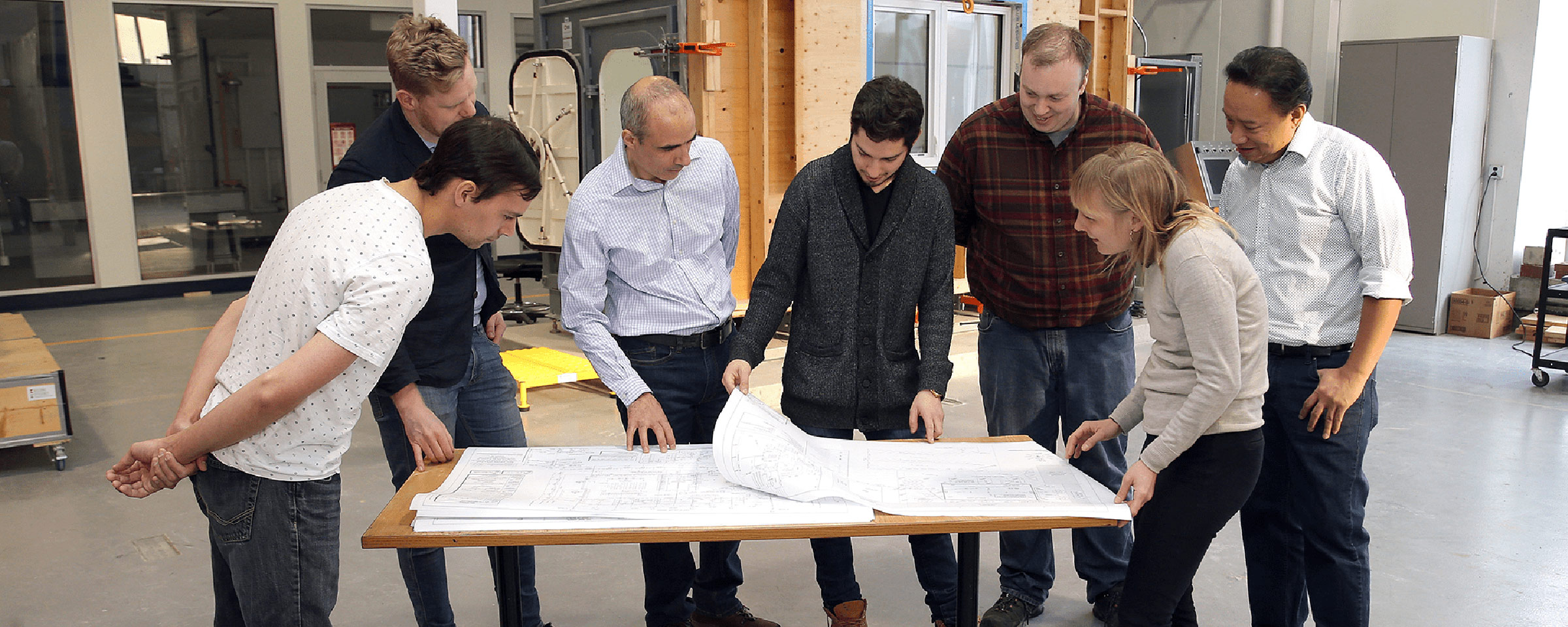
The Building Efficiency Technology Access Centre (BETAC) provides a multidisciplinary environment to facilitate advancements in technology primarily for durability and energy efficiency of buildings, while addressing the building’s components and assembly, intended use, life service and climate zone location.
As a measure of the innovative capacity housed within BETAC, the Centre’s staff were among the recipients when the Natural Sciences and Engineering Research Council of Canada (NSERC) presented a Synergy Award for Innovation to the partnership of Manitoba Hydro and RRC Polytech in February 2016.
RRC Polytech’s BETAC also won a bronze award for Innovation in Applied Research during the closing gala of College and Institute Canada’s (CICan) annual conference in 2015. The award also celebrates the College’s dynamic applied research partnership with Manitoba Hydro.

Established in April 2015 at RRC Polytech, BETAC is a part of the Natural Sciences and Engineering Research Council of Canada’s (NSERC) Technology Access Centre (TAC) program. The network of all TACs in Canada is known as Tech-Access Canada.
The TACs were designed to enhance the ability of local companies, particularly small- and medium-sized enterprises (SMEs), to become more productive and innovative by enabling them to readily access college expertise, technology and equipment.
BETAC operates out of the Centre for Applied Research in Sustainable Infrastructure (CARSI) at RRC Polytech.
Our people are a bridge between the laboratory and the built environment. BETAC also has the ability to engage faculty, students and external associates in the delivery of its services.

Alireza Kaboorani has been serving as the Director of the Building Efficiency Technology Access Centre at RRC Polytech since November 2019.
With over 25 years of experience, he has excelled in planning and spearheading research initiatives in diverse academic and industrial settings.
His areas of expertise encompass building envelope, building science, and the development of advanced building materials and biomaterials.

With a background in structural engineering, Chang leads applied research into building performance, energy efficiency, indoor environmental quality, and building enclosure testing.
Motivated by a commitment to sustainable and resilient buildings, she partners with industry, government, and academic stakeholders to translate research into practical, data-driven solutions — improving how buildings perform and endure over the long term.

Silvia Almeida is a Research Technologist advancing sustainable infrastructure through her Bachelor of Science in Mechanical Engineering from the University of Manitoba. Her work bridges HVAC and building efficiency with alternative energy, from designing industrial biomass boilers to developing eco-friendly wastewater purification processes, backed by expertise in computational fluid dynamics and performance monitoring. Beyond the lab, she is an advocate for women in STEM, a mentor with Circle of Friends, and the departmental health and safety co-chair.
Owen holds a diploma in Mechanical Engineering from RRC Polytech, with hands-on experience in building diagnostics, whole building airtightness testing, and site survey work involving sensor deployment across multi-unit and multi-building projects. He works closely with inspection and measurement equipment. He is well-versed in CAD and has entry-level knowledge of DAQ systems and data analysis.







RRC Polytech campuses are located on the lands of the Anishinaabeg, Ininiwak, Anishininwak, Dakota Oyate, and Denésuline, and the National Homeland of the Red River Métis.
We recognize and honour Treaty 3 Territory Shoal Lake 40 First Nation, the source of Winnipeg’s clean drinking water. In addition, we acknowledge Treaty Territories which provide us with access to electricity we use in both our personal and professional lives.