Research Partnerships and Innovation

Research Partnerships & Innovation

News

Labs4 Launches: Canada’s Applied Research Commercialization Engine will Support Innovation Ecosystem

June 23, 2025

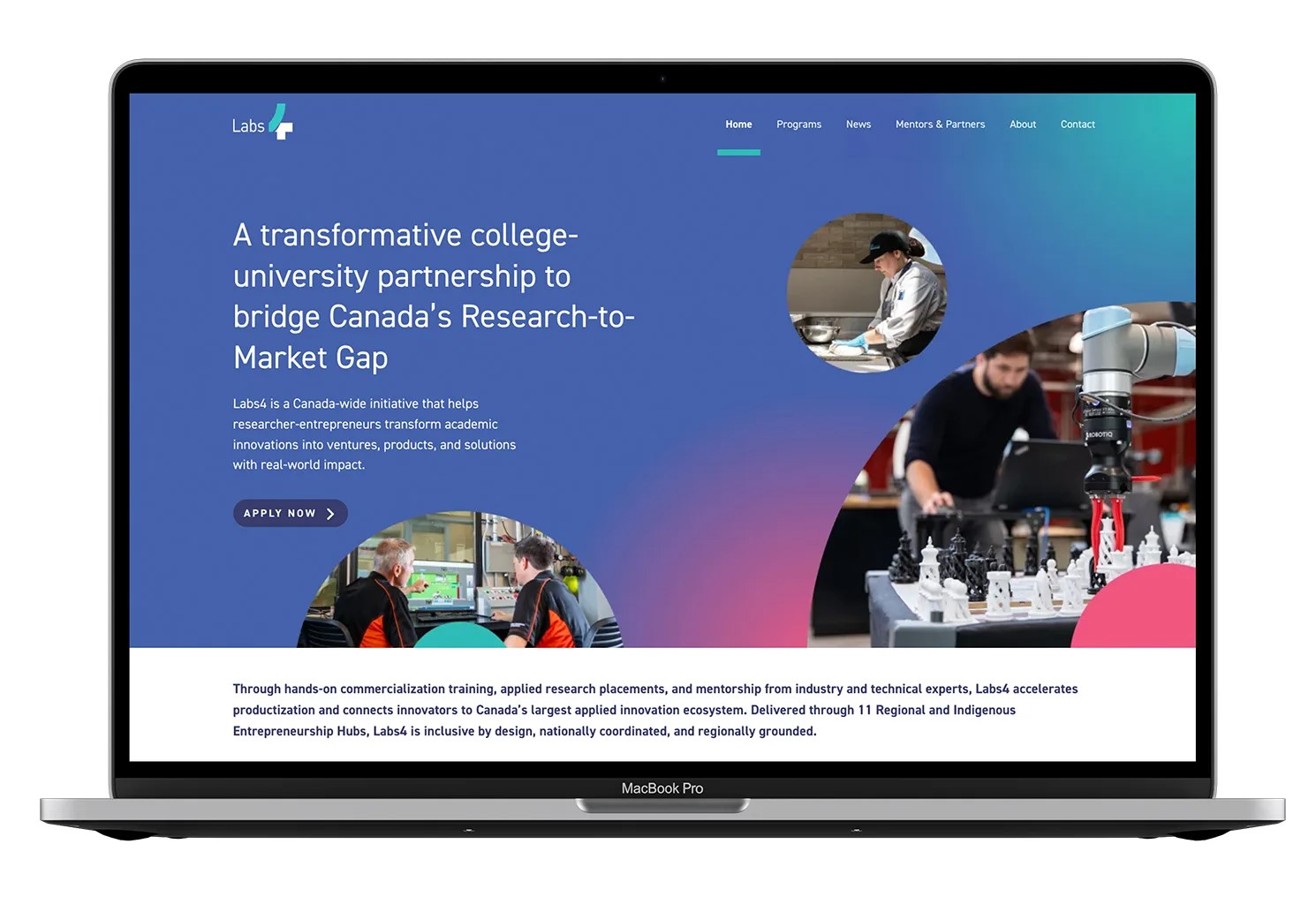
Winnipeg, MB on Treaty No. 1 Territory and the National Homeland of the Red River Métis – Today, RRC Polytech and its post-secondary partners across the country are proud to launch the website www.labs4.ca to officially introduce and establish Labs4 – a national applied research commercialization engine designed to support entrepreneurs and accelerate Canada’s innovation economy.

Primary Logo

Labs4 brings together 38 polytechnics, colleges and universities across Canada in an aligned effort to collaborate with businesses, entrepreneurs, and communities to transform more research into real-world solutions.

Initially known as the College-University Lab to Market Network for Entrepreneurship and Research Commercialization, Labs4 will develop and deliver hands-on entrepreneurship training, product development support, and mentorship through eight Regional Hubs and three Indigenous Entrepreneurship Hubs that stretch from coast to coast.

Labs4 is built for impact. This is innovation with purpose, delivered across every region and rooted in community,” says Dr. Jolen Galaugher, Executive Director of Research Partnerships & Innovation at RRC Polytech and Chair of the Labs4 Executive Committee.

“We operate at the intersection of academia and industry to translate applied research into practical solutions. By teaching researchers and businesses how to work with each other, building stronger relationships with Indigenous communities, and scaling innovation with intentional speed and purpose, we’ll equip entrepreneurs to quickly move from insight to action to benefit all Canadians.”

Funded by NSERC, Mitacs, and its institutional partners, Labs4 is a $55 million initiative created to close Canada’s persistent gap between research and commercialization across all sectors, while reducing barriers faced by equity-seeking groups and strengthening Indigenous and regional innovation. Leveraging the state-of-the-art facilities and subject-matter expertise available at network institutions will expedite entrepreneurs and creators’ ability to take new products and processes to the market and therefore make both economic and social impacts sooner.

Three signature pillars differentiate Labs4:

  • Indigenous Entrepreneurship Hubs: Incubators in Saskatchewan, Manitoba and Ontario provide culturally grounded programming, mentorship, and wraparound supports tailored to First Nations, Métis and Inuit researcher-entrepreneurs. Programming is led by Indigenous institutions and rooted in self-determined goals, ceremony, and community priorities.
  • Technology Readiness Level-Up (TRL) program: A four-month placement in polytechnic/college -based applied research facilities where researcher-entrepreneurs receive $10,000 stipends to develop, test, and validate prototypes with expert mentorship.
  • Market to Lab (MtL) program: A two-month simulation in which researcher-entrepreneurs lead student teams to solve real-world commercialization barriers. With mentorship from business and innovation experts, participants gain leadership experience and build go-to-market strategies.

The TRL program is already underway: applications are now open for the upcoming Fall 2025 cohort.

“We are dedicated to creating pathways for innovation and amplifying the impact of Canadian research on the global stage,” says Nasil Nam, National Director, Labs4. “Whether it’s a prototype in a lab or a venture ready to launch, we meet researcher-entrepreneurs where they are and help them move forward with confidence. Our work is practical, fast-paced, and focused on impact.”

Labs4 is poised to drive measurable national impact and support hundreds of researcher-entrepreneurs to explore the launch of new research-based ventures. The initiative supports not only new ventures and commercial products but also economic development, job creation, and inclusive growth across all sectors and regions.

To learn more about Labs4, its programs, or upcoming events, visit www.labs4.ca.

About Labs4
Labs4 is Canada’s applied research commercialization engine. Delivered through eight Regional and three Indigenous Entrepreneurship Hubs, it provides researcher-entrepreneurs with the tools, training, mentorship, and applied facilities to move innovations from lab to market. Funded by NSERC, Mitacs and over three dozen post-secondary partners, Labs4 is designed to deliver rapid, equitable, and outcome-driven commercialization across Canada’s innovation ecosystem.


Lancement de Labs4 : l’initiative canadienne de commercialisation de la recherche appliquée pour appuyer l’écosystème de l’innovation

Winnipeg, MB sur le territoire du Traité no 1 et la patrie nationale des Métis de la Rivière-Rouge : Aujourd’hui, RRC Polytech et ses partenaires postsecondaires à travers le pays sont fiers de lancer le site web www.labs4.ca qui marque le lancement et l’établissement officiel de Labs4, une initiative nationale de commercialisation de la recherche appliquée conçue pour appuyer les entrepreneurs et accélérer l’économie d’innovation du Canada.

Labs4 rassemble 38 polytechniques, collèges et universités à travers le Canada dans le but de collaborer avec les entreprises, les entrepreneurs et les collectivités pour transformer davantage de recherche en solutions concrètes. Originalement le College-University Lab to Market Network for Entrepreneurship and Research Commercialization, Labs4 élaborera et mettra en œuvre des formations pratiques d’entrepreneuriat, un appui au développement de produits et du mentorat dans ses huit carrefours régionaux et trois carrefours d’entreprenariat autochtones, situés partout à travers le Canada.

« Labs4 a été conçue pour avoir un impact et concrétiser l’innovation à travers toutes les régions, tout en étant solidement enracinée dans les communautés », a expliqué Jolen Galaugher, Ph.D., directrice administrative des partenariats de recherche et de l’innovation de RRC Polytech et présidente du comité de direction de Labs4. « Nous évoluons à l’intersection du milieu universitaire et de l’industrie dans le but de traduire la recherche appliquée en solutions pratiques. En enseignant aux chercheurs et aux entreprises à travailler ensemble, en bâtissant des liens plus solides avec les communautés autochtones et en augmentant la rapidité et les objectifs de l’innovation, nous outillons les entrepreneurs à passer rapidement de l’abstrait  à l’action, au profit de tous les Canadiens et Canadiennes. »    

Financée par le CRSNG, Mitacs et ses partenaires institutionnels, Labs4 est une initiative de 55 millions $ créée pour réduire l’écart persistant entre la recherche et la commercialisation à travers tous les secteurs du Canada, tout en réduisant les obstacles auxquels font face les groupes en quête d’équité et en consolidant l’innovation autochtone et régionale. La mise à profit des installations à la fine pointe et de l’expertise en la matière qui existe au sein des établissements du réseau accélérera la capacité des entrepreneurs et des créateurs à commercialiser de nouveaux produits et processus et ainsi, d’avoir un impact économique et social plus rapide.

Les trois piliers qui distinguent Labs4 :

  • Carrefours d’entreprenariat autochtones : Des incubateurs d’entreprises au Saskatchewan, au Manitoba et en Ontario fournissent une programmation fondée sur la culture, du mentorat et des services de soutien adaptés aux chercheurs-entrepreneurs des Premières Nations, Métis et Inuit. La programmation est dirigée par des établissements autochtones et est ancrée dans l’auto-détermination, la cérémonie et les priorités communautaires. 
  • Programme de niveau de préparation technologique (Technology Readiness Level-Up ou TRL) : Un stage de quatre mois dans une installation polytechnique ou collégiale de recherche appliquée où des chercheurs-entrepreneurs reçoivent une allocation de 10 000 $ pour développer, tester et valider des prototypes, tout en étant accompagnés par  des experts.  
  • Programme du marché au labo (Market to Lab ou MtL) : Une simulation de deux mois au cours de laquelle des chercheurs-entrepreneurs dirigent des équipes d’étudiants dans le but de surmonter des obstacles à la commercialisation. Grâce au mentorat d’experts du monde des affaires et de l’innovation, les participants acquièrent une expérience de leadership et élaborent des stratégies de mise en marché.

Le programme TRL est déjà en cours ; les candidatures sont maintenant acceptées pour la prochaine cohorte de l’automne 2025.

« Nous nous engageons à créer des voies d’accès à l’innovation et à amplifier l’impact de la recherche canadienne à l’échelle mondiale », a déclaré Nasil Nam, directrice nationale, Labs4. « Qu’il s’agisse d’un prototype en laboratoire ou d’un projet prêt au lancement, nous allons à la rencontre des chercheurs-entrepreneurs et nous sommes là pour les aider à aller de l’avant en toute confiance. Notre travail est pratique, dynamique et axé sur les résultats. »

Labs4 est positionnée pour produire des retombées quantifiables à l’échelle nationale et appuyer des centaines de chercheurs-entrepreneurs dans l’exploration du lancement de nouvelles entreprises de recherche. L’initiative appuie non seulement les nouvelles entreprises et nouveaux produits commerciaux, mais aussi le développement économique, la création d’emplois et la croissance inclusive à travers tous les secteurs et régions.

Pour en apprendre davantage au sujet de Labs4, ses programmes, ou ses événements à venir, visitez www.labs4.ca.

À propos de 4Labs
Labs4 est l’initiative de commercialisation de la recherche appliquée du Canada. Par l’entremise de huit carrefours régionaux et de trois carrefours d’entreprenariat autochtones, Labs4 procure aux chercheurs-entrepreneurs les outils, la formation, le mentorat et les installations appliquées permettant le passage des innovations du laboratoire au marché. Financée par le CRSNG, Mitacs et plus de trois douzaine de partenaires postsecondaires, Labs4 est conçue pour permettre une commercialisation rapide, équitable et axée sur les résultats à travers l’écosystème canadien de l’innovation.

RPI’s Office of Applied Research Services (OARS) welcomes new Director, Dr. Kristen Kindrachuk

June 10, 2025

Research Partnerships & Innovation (RPI) is pleased to welcome Dr. Kristen Kindrachuk as the new Director of the Office of Applied Research Services (OARS). Named the successful candidate through a competitive process, Kristen will lead the administration and support the operation of applied research (AR) at RRC Polytech through OARS – which provides expertise, enables opportunities for researchers and partners, and drives AR excellence across our campuses.

Kristen is a strategic leader with extensive expertise in research administration, funding management, and cross-sector collaboration. Her experience spans pre- and post-award research management, large-scale proposal development, contract negotiation, and project oversight.

Dr. Kristen Kindrachuk profile picture

Kristen received her BSc and MSc from the University of Manitoba and her PhD in Microbiology and Immunology from the University of British Columbia. She trained as a postdoctoral fellow at the National Institutes of Health (NIH) in Bethesda, Maryland and was employed as an Adjunct Professor teaching graduate studies in Pathogenic Microbiology at Hood College. Her experience at Ripple Effect Inc. consulting on projects for the NIH Office of Behavioural and Social Sciences Research and the NIH Office of Extramural Research sparked her interest in pursuing a career in research administration.

Upon returning to Winnipeg in 2016, she joined the University of Manitoba as a Research Facilitator and Business Development Officer to gain experience in funding administration. During the height of the COVID-19 pandemic, she managed response efforts at the Vaccine and Infectious Disease Organization (VIDO) at the University of Saskatchewan where she served as Project Manager and Intellectual Property (IP) Manager.

Since 2022, Kristen has pursued her passion for funding administration at the Canadian Institutes of Health Research Institute of Infection and Immunity (CIHR-III) where she served as the scientific and strategic lead to the CIHR HIV/AIDS and Sexually Transmitted and Blood Borne Infections (STBBI) Research Initiative – a federal research priority that delivers $21M annually in research funding. To continue to hone her leadership skills, Kristen is currently pursuing a part-time MBA with a concentration in Leadership and Organizations at the University of Manitoba.

Her leadership, vision, and passion for research excellence will be invaluable to our community.

College-University Lab to Market Network names National Director to lead its cross-Canada entrepreneurship and research commercialization efforts

June 6, 2025

Nasil Nam profile

The College-University Lab to Market Network, led by RRC Polytech, is pleased to introduce Nasil Nam as its inaugural National Director. The accomplished innovation-driven leader stepped in immediately after being named the successful candidate through a competitive process, to begin mobilizing the network’s collaborative partners who have aligned to accelerate research commercialization and support entrepreneurship across Canada.

Nam will lead the national implementation of programs that support researcher-entrepreneurs across the 38-member network of colleges, polytechnics, and universities. She’ll guide the execution of the network’s vision to deepen partnerships and enhance commercialization outcomes for research-based ventures in health, STEM, social innovation, and the social sciences. 

“Nasil is exactly the kind of leader this initiative needs. We’re thrilled to welcome her to the team as we work to bring industry into greater connection with Canadian research,” said Dr. Jolen Galaugher, Executive Director of Research Partnerships & Innovation at RRC Polytech and Chair of network’s Executive Committee. “Her leadership will be instrumental in leveraging the expertise, capacity, and diversity of Canada’s universities, colleges and polytechnics to support Indigenous entrepreneurs and drive research-based ventures and social innovations that benefit all Canadians.”

With more than a decade of experience in program development, commercialization, and entrepreneurial ecosystem building, Nam brings a unique blend of hands-on entrepreneurial insight and national innovation leadership. She began her journey as a founder of her own ventures before moving into institutional leadership roles, including her most recent position as Associate Director of Start-ups & Commercialization at Dalhousie University. There, she played a key role in the national expansion of the Lab2Market program while developing a regional innovation program called Collide

In addition to her work in postsecondary innovation, Nam has championed inclusive entrepreneurship, serving as Project Lead for the Propelling Women Tech Founders program at the Centre for Women in Business, where she helped support the growth of emerging female entrepreneurs through mentorship and strategic planning. Holding a Master of Education in Psychology and Leadership Studies from the University of Victoria, her approach is grounded in collaboration, strategic execution, and a deep commitment to building sustainable innovation ecosystems that drive both economic and social impact.

“I am passionate about innovation, leadership, and community-building,” said Nam. “The College-University Lab to Market Network’s mission is to transform research into real-world solutions for a stronger, more inclusive innovation economy. Whether it’s leading national-scale initiatives or mentoring early-stage founders, I am dedicated to creating pathways for innovation and amplifying the impact of Canadian research on the global stage.”

Network Institutions:
British Columbia Institute of Technology (BC Hub Lead), Cégep de Sherbrooke, Cégep de Thetford (QC Hub Lead), Cégep de Trois-Rivières, College of the North Atlantic, Concordia University, Dalhousie University, Humber Polytechnic (ON Hub Lead), Lethbridge College, Loyalist College, MacEwan University, Mohawk College, Mount Saint Vincent University, New Brunswick Community College, Northern Alberta Institute of Technology (NA Hub Lead), NorQuest College, Northwestern Polytechnic, Nova Scotia Community College (ATL Hub Lead), Olds College, Red Deer Polytechnic, RRC Polytech (MB Hub Lead), Saint Mary’s University, Saskatchewan Indian Institute of Technologies, Saskatchewan Polytechnic (SK Hub Lead), Selkirk College, Sheridan College, Southern Alberta Institute of Technology (SA Hub Lead), United College – University of Waterloo, University College of the North, University of Alberta, University of Calgary, University of Guelph, University of Lethbridge, University of Manitoba, University of Regina, University of Saskatchewan, University of Yukon, Western University

Read More →

Unlock the Future with RRC Polytech’s TACAM – IRC 5 Programming I Course!

June 6, 2025

Red River College Polytechnic’s Technology Access Centre for Aerospace & Manufacturing (TACAM) invites you to join our IRC 5 Programming I Course — a high-impact training designed to equip industry professionals with hands-on skills in ABB robotics.

As an ABB-certified training institution, RRC Polytech offers in-person instruction led by an ABB Robotics Certified Trainer, ensuring top-tier, industry-relevant learning that you can apply immediately on the job.

TACAM focuses on empowering today’s workforce with real-world, cutting-edge skills. This course dives deep into robot operation and programming using both the teach pendant and RobotStudio Online, ABB’s powerful simulation and offline programming software.

This course is ideal for industry professionals responsible for:

· Starting and operating ABB industrial robots

· Creating and editing robot programs

· Managing robotic systems in real-world manufacturing settings

Participants will gain hands-on experience in:

· Robot system safety practices

· Manual and automatic robot operation

· Event message interpretation

· Program management (load, create, save, delete, check, edit)

· Robot synchronization and calibration

· Tool center point (TCP) creation using the 4-point method

· Input/output instruction management

· Creating and using routines effectively

Upcoming course dates:

· July 14–18, 2025

· September 15–19, 2025

· October 20–24, 2025


Contact Gaganpreet Singh at gsingh199@rrc.ca to secure your spot.

College-University Lab to Market Network launches first program

April 14, 2025

The RRC Polytech-led College-University Lab to Market Network for Entrepreneurship and Research Commercialization has launched its first program – Technology Readiness Level Up (TRL^)!

The new TRL^ Program offers training in commercialization and innovation, helping students and researchers take their work to market. The goal of the program is to provide a new understanding and mindset shift regarding the ‘how-to’ of product development, scale up, and advancing technology readiness level toward commercialization.

The program is built for students, recent graduates and postdocs at Canadian institutions (Colleges and Universities) who have a research-based venture or an idea for a research-based venture and/or are interested in advancing the technology readiness of their invention, technology, product or service in any field. This program will help them better assess and navigate product development and the path towards commercialization.

It provides experiential placement in College and Polytechnic applied research environments, including Technology Access Centres (TACs) and les centres collégiaux de transfert detechnologies (CCTTs).

The TRL^ Program is now accepting Expressions of Interest from qualified applicants who want to participate in its Fall 2025 cohort.

Successful applicants will be awarded a $10,000 stipend over the Fall semester funded in part through applications to the Mitacs Business Strategy Internship program. The TRL^ program will help applicants to navigate this process at every step of the way.

Click here for more information and to access the EOI

The first round of EOIs for this first cohort will be accepted up until May 9, 2025. For questions about this program or to request more information, please contact TRL@rrc.ca

College-University Lab to Market Network begins search for strategic leaders to manage regional hubs

April 14, 2025

Join our team and play a vital role in shaping the future of innovation!

RRC Polytech is seeking a dynamic Program Manager to lead the Manitoba regional hub of its collaborative College-University Lab to Market initiative.

This strategic and leadership position is an exciting opportunity to work closely with other post-secondary institutions and a national network of peers and local innovators to support entrepreneurship training and research commercialization across Canada. The $24.1 million federally funded initiative is led by RRC Polytech’s Research Partnerships & Innovation enterprise and comprised of eight regional and three Indigenous hubs.

Key responsibilities include:

  • administrative leadership
  • program development
  • financial and metrics reporting
  • engaging the entrepreneurial community
  • contributing to national strategies while ensuring program excellence locally
  • collaborating with eight regional hubs and three Indigenous entrepreneurship hubs to drive impactful results

Similar positions at regional hubs across the country are being posted to the links below. Postings at the Indigenous hubs will be announced soon, as the network continues to take shape.

If you’re passionate about innovation, leadership, and community-building, this role is your chance to contribute meaningfully to Canada’s entrepreneurial landscape.

Apply today:

BC Hub – BCIT

AB Hub North – NAIT

AB Hub South – SAIT

SK Hub – Saskatchewan Polytechnic

MB Hub – RRC Polytech

ON Hub – Humber Polytechnic

QC Hub – Cégep de Thetford

ATL Hub – NSCC 

RRC Polytech digs into first initiative with P2INACLE partners in Saskatoon

March 28, 2025

A new polytechnic network created last month to provide industry partners with better access to applied research expertise and facilities is already digging into how it can support the mining and minerals sector across the prairies.

Designed to drive economic growth and diversification through collaboration, the Prairie Polytechnic Innovation Network Accelerating Commercialization for Local Ecosystems or P2INACLE launched its first pilot initiative in Saskatoon in mid-March.

A team from RRC Polytech joined peers from across Western Canada at P2INACLE’S lead institution, Saskatchewan Polytechnic to meet with the International Minerals Innovation Institute (IMII) for some great discussion about the challenges that mining firms are facing and idea generation for ways to address them.

In May, P2INACLE researchers will join a larger group of mining and minerals industry professionals at IMII’s IDEATE 2025 event to connect and explore specific applied research projects that can solve problems for partners in the mining industry.

“This initiative will address key industry challenges and harness the collective expertise of polytechnics and industry partners across the Prairies, driving both economic growth and technological advancements,” said Al Shpyth, Executive Director of IMII, in last month’s PrairiesCan funding announcement. “We look forward to the impactful solutions that will arise from this collaborative effort.”

Although mining is the focus of its first initiative, P2INACLE aims to be a catalyst for wide-spread regional prosperity by providing streamlined access to resources for all industries, including small and medium-sized enterprises as well as larger businesses. By leveraging the expertise and facilities of each polytechnic, P2INACLE offers tailored solutions for commercialization and diversification, fostering innovation and knowledge exchange. Areas of expertise also include clean technologies, digital technologies, value-added agriculture and natural resources.

Manitoba-based partners and businesses are invited to reach out to RRC Polytech’s Research, Partnerships & Innovation (RPI) department to learn more about P2INACLE and how they can connect with the College’s expertise.

rpi@rrc.ca

a large group of researchers standing in front of a College building

RPI’s 20 Stories for 20 Years – Air Testing at Gordon Bell School

February 28, 2025


RPI 20th anniversary logo

RRC Polytech’s Building Efficiency Technology Access Centre (BETAC) has been researching air tightness and methods of testing it since a 2012 pilot project, which means the partners who turn to BETAC for air tightness testing engage some of the province’s leading expertise in the field.

In the fall of 2021, BETAC completed an air tightness test at Gordon Bell High School, whose building features walls and mechanical systems that are more than 50 years old. The results provided insights into cost-effective measures for reducing energy usage at Gordon Bell, prior to its renovation.

Chris Buzunis, the Province of Manitoba’s Senior Energy Engineer and project manager for the Gordon Bell retrofit, says BETAC’s pre- and post-renovation air tightness testing has proven valuable on many projects like this.

“It helps identify problem areas to address at the start of a project and has also been a fantastic quality control tool when construction is complete. We have identified many deficiencies that would have otherwise gone unnoticed.”

BETAC offers a variety of non-destructive tests that target specific building sizes and challenges. The process usually starts with a walkthrough to assess door locations, HVAC intake and exhaust grills, power supply, and whether the building can be isolated.

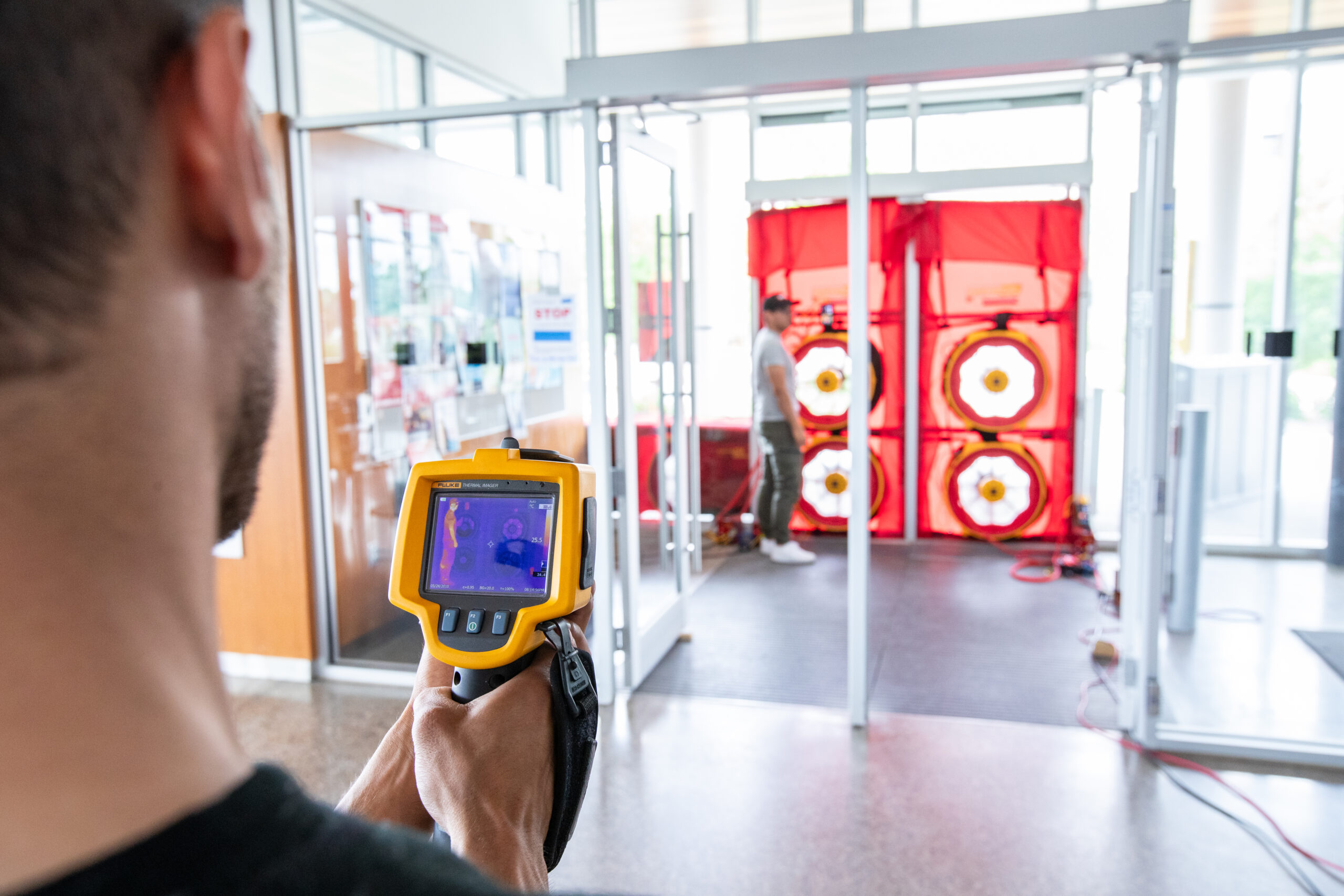
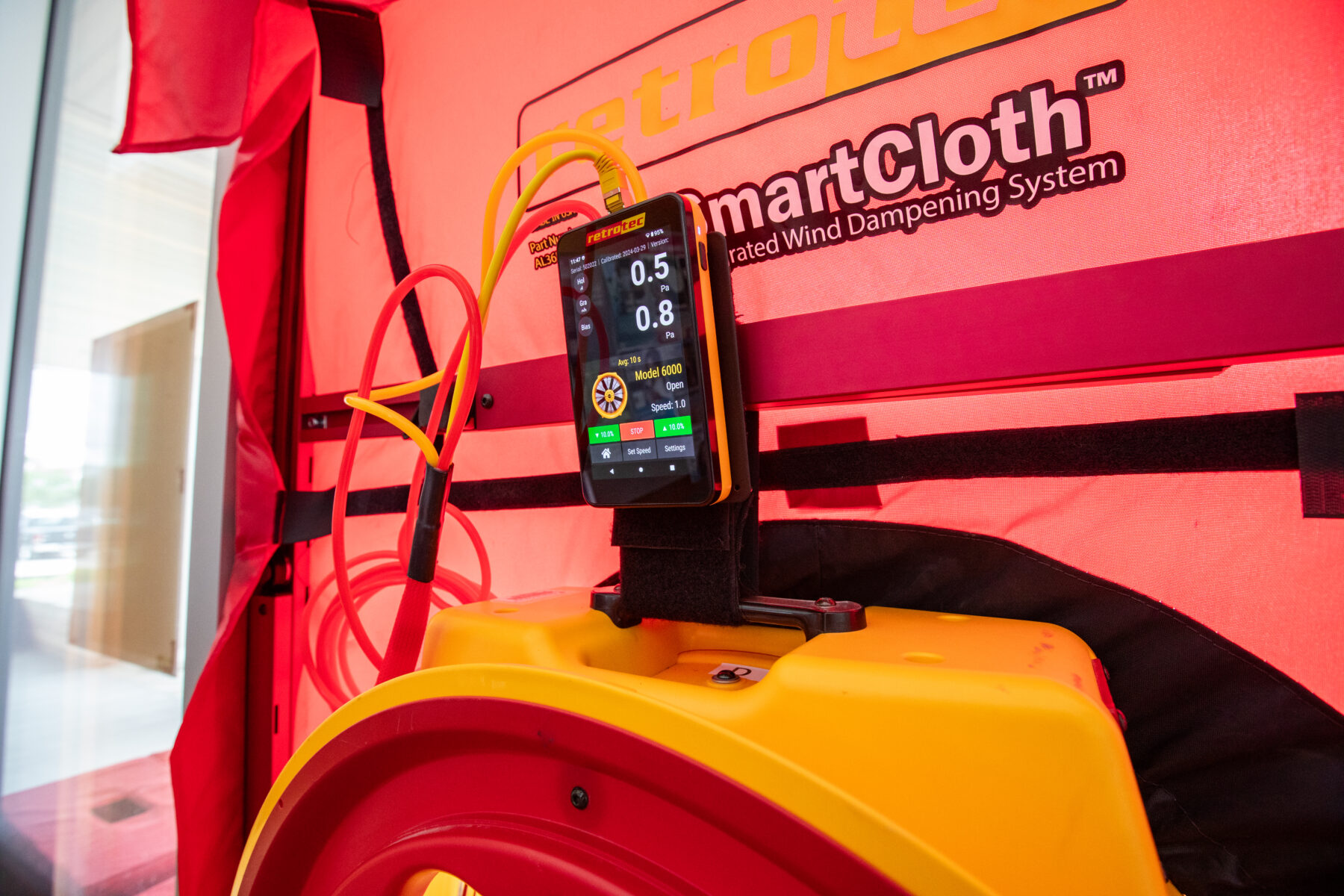
During the test itself, powerful fans pressurize and depressurize the building, while equipment measures how much air is moved into or out of the building and tracks the corresponding pressure difference across the building enclosure. 

exterior of Gordon Bell School

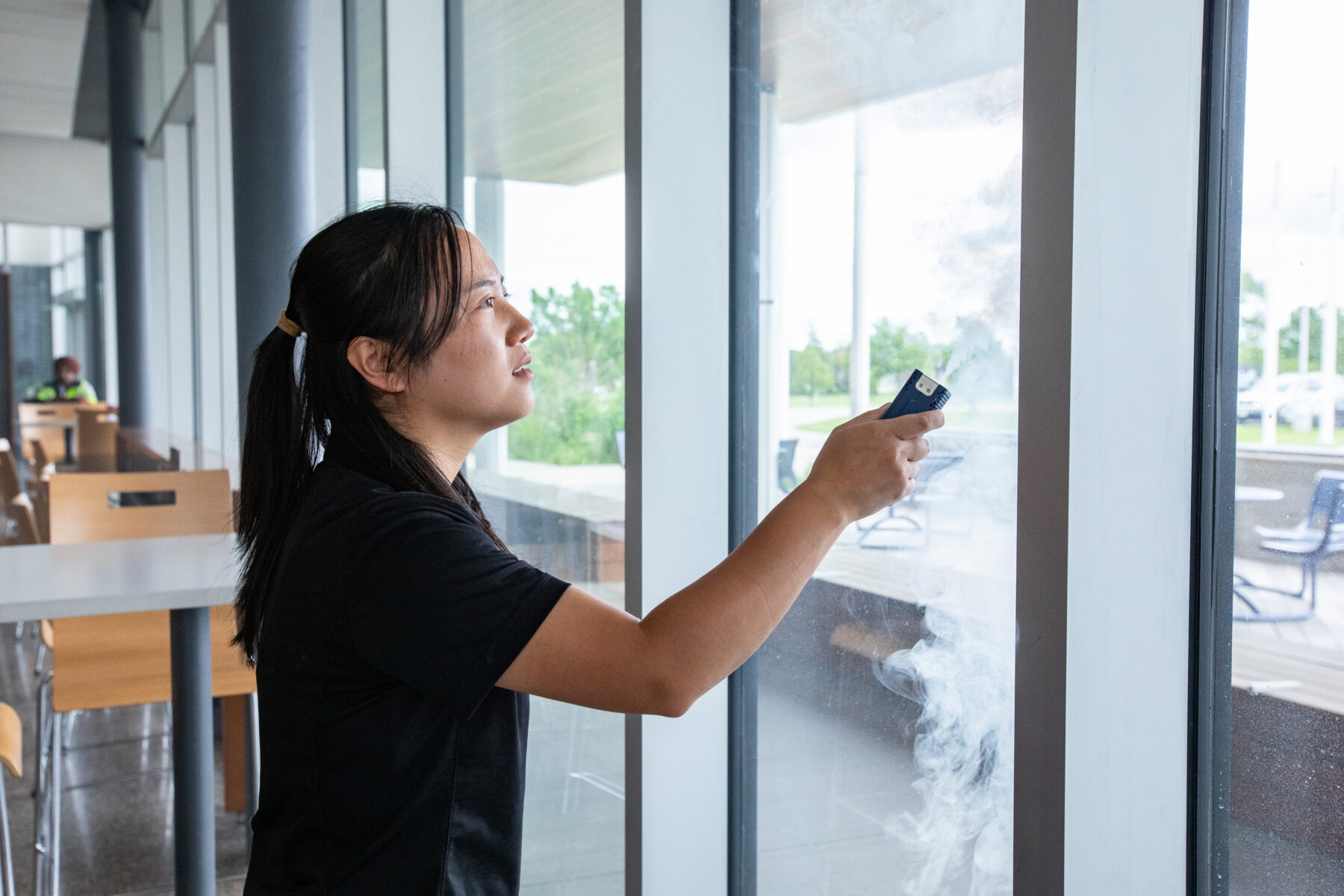
The results of the envelop test speak to the general durability of the building, and the continuity and performance of the air barrier. A second set of tests, conducted with all intentional openings left open, measures the energy performance of the building more directly. At this stage, testers may deploy smoke pencils and infrared thermography cameras to identify specific air leakage pathways.

All together, these tests can take anywhere from several hours to three days, depending on the size and complexity of the building. The results deliver quantifiable data that can help owners of existing buildings locate problem areas and determine the costs and benefits of a retrofit. For new buildings, a final air tightness test can complement air leakage testing performed throughout construction.

“Collaboration and coordination are critical to the success of all projects in the construction sector regardless of size and scope, so BETAC is proud to play any role required to support our partners in reaching their goals of delivering the highest quality results on time and on budget,” said Dr. Alireza Kaboorani, Director of RRC Polytech’s Building Efficiency Technology Access Centre.

Demand for tests like these will only increase as more cities and governments incorporate air tightness and energy efficiency into their building codes and green mandates. In addition to air leak testing, BETAC has committed to ongoing public outreach efforts to share the findings of its research. The results of BETAC’s work continue to inform the Province of Manitoba’s Green Building Policy and low carbon initiatives.

PrairiesCan Provides Nearly $900,000 to Prairie Polytechnics

February 27, 2025

PrairiesCan invests $899,500 in Prairie Polytechnic Innovation Network Accelerating Commercialization for Local Ecosystems (P2INACLE)

Winnipeg, Manitoba on Treaty No. 1 Territory and the National Homeland of the Red River Métis – PrairiesCan is investing $899,500 into the Prairie Polytechnic Innovation Network Accelerating Commercialization for Local Ecosystems (P2INACLE). P2INACLE will drive social, economic and technological innovation across western Canada by providing businesses access to polytechnic facilities, equipment and research expertise. P2INACLE members include Red River College Polytechnic (RRC Polytech), Northern Alberta Institute of Technology (NAIT), Northwestern Polytechnic, Red Deer Polytechnic, Saskatchewan Polytechnic and Southern Alberta Institute of Technology (SAIT) — leading polytechnic institutions on the Canadian Prairies.
 
P2INACLE, led by Saskatchewan Polytechnic, will launch its first pilot with the International Minerals Innovation Institute (IMII) this spring. This pilot will bring together polytechnics and industry partners from across the Prairies to develop a collaborative network that will fund and work on applied research projects. The goal is to identify challenges and develop innovative solutions for the mining and minerals sector in Western Canada.

“Success on the Prairies has always been built on cooperation. That’s why our government is supporting P2INACLE— a partnership bringing Prairie polytechnics together to turn research into practical solutions. By working together to tackle challenges in the mining sector and beyond, P2INACLE is driving economic growth, creating quality jobs, and setting a new standard for how applied research can empower communities far beyond the Prairies,” said the Honourable Terry Duguid, Minister for PrairiesCan.
 
“Thank you to PrairiesCan for funding this polytechnic-powered, applied research network to help grow innovation for Western Canadian industry sectors,” says Dr. Larry Rosia, Saskatchewan Polytechnic president and CEO. “We are excited to share our expertise as the P2INACLE lead. This funding will enable P2INACLE to address mining industry issues swiftly and efficiently, providing access to a wide range of experts and quickly distributing funds.”
 
IMII is a hub for expertise and innovation in Saskatchewan’s minerals industry, driving change and creating solutions. With PrairiesCan support, P2INACLE researchers, along with IMII and their partners, will come together in Saskatoon, Saskatchewan in March to launch the collaborative applied research network. In May, P2INACLE researchers will join mining and minerals industry professionals at IMII’s IDEATE 2025 event to learn about the challenges faced by the mining industry. At this event P2INACLE members will team up with industry on various applied research projects.
 
“We are excited to be part of the P2INACLE pilot project, a significant step forward in fostering innovation and collaboration within Western Canada’s mining and minerals sector,” says Al Shpyth, executive director of IMII. “This initiative will address key industry challenges and harness the collective expertise of polytechnics and industry partners across the Prairies, driving both economic growth and technological advancements. We look forward to the impactful solutions that will arise from this collaborative effort.”
 
This partnership with IMII will promote cross-disciplinary collaboration focused on industry needs and solutions. Through P2INACLE, industry will also have increased access to high-quality personnel and trainees, facilitating the implementation of new innovations.
 
“The P2INACLE initiative aligns with RRC Polytech’s areas of strength in clean tech, digital technologies, value-added agriculture and natural resources. We believe our efforts in this cross-prairies partnership, led by Saskatchewan Polytechnic, will help Canada’s mining and minerals sector to be globally competitive,” says Dr. Jolen Galaugher, Executive Director of Research, Partnerships & Innovation at RRC Polytech. “P2INACLE enhances opportunities across the value chain by leveraging the collective capabilities of state of the art infrastructure, research expertise and talent at our prairie polytechnics.”
 
Manitoba-based partners and businesses are invited to reach out to RRC Polytech’s Research, Partnerships & Innovation department to learn more about P2INACLE and how they can connect with the College’s expertise.
 
P2INACLE aims to drive economic growth and diversification through collaboration. It acts as a catalyst for regional prosperity by providing streamlined access to resources for industries, especially small and medium-sized enterprises and larger businesses. By leveraging the expertise and facilities of each polytechnic, P2INACLE offers tailored solutions for commercialization and diversification, fostering innovation and knowledge exchange. Areas of expertise include clean technologies, digital technologies, value-added agriculture and natural resources.

Learn more at saskpolytech.ca/p2inacle.

RPI’s 20 Stories for 20 Years – Pandemic Response

January 16, 2025


RPI 20th anniversary logo

This week marks the fifth anniversary of the World Health Organization’s declaration of a global pandemic and the onset of Canada’s unprecedented precautionary policies to stop the spread of COVID-19. While the social and economic impacts of the pandemic still linger, life for most people has returned to normal because of the ongoing co-operative efforts made around the world to control the virus.

During the global fight against COVID-19, RRC Polytech proudly demonstrated its trademark agility and willingness to help by leaping into action to support its industry partners in the healthcare sector. With supply chains decimated by restrictions, the College’s Technology Access Centre for Aerospace & Manufacturing (TACAM) offered its assets and expertise to local partners like CancerCare Manitoba to aid in the production of much-needed medical equipment.

Under normal circumstances, CancerCare Manitoba is well-resourced to manufacture its own equipment, but increased needs combined with a short timeframe during the pandemic forced them to outsource immediate production of wheelbases for more IV poles.

TACAM’s digital manufacturing capabilities allowed for large-scale and rapid production of the unique items needed. TACAM supported the production of 100 new wheelbases for the poles. Specifically, the team manufactured 500 castor mounts for the wheelbases, which require 5 castor mounts per wheelbase.

“CancerCare Manitoba appreciates the ability of RRC Polytech to support us in the manufacturing of these components,” said Keith Sutherland, Business and Innovation Officer at CancerCare Manitoba at the time. “TACAM’s specialized machinery allows for quicker manufacturing, which allows us to get the required IV poles into the hands of hospital staff much quicker than if we had to manufacture them on our own.”

Throughout the pandemic, TACAM remained on call with Health Canada as a potential supplier of services should they need help in manufacturing other medical equipment and/or devices, as well as the National Research Council Canada (NRC), in case additional support for medical equipment and devices was required.

“Our professional research teams are experts in fostering collaboration to overcome challenges, so they are well-prepared to react quickly and leverage the College’s facilities and talent to support our partners, even in a crisis situation like a global pandemic,” said Dr. Jolen Galaugher, Executive Director, Research Partnerships & Innovation at RRC Polytech. “We are eager to continue building these important relationships and working closely with industry and community to address Manitoba’s needs by solving problems through applied research.”

RRC Polytech continues to build capacity for innovative processes such as additive manufacturing, 3D printing, and reverse engineering with the recent addition of the Centre for Automation and Manufacturing Technology Transfer (CAMTT) at the Price Institute of Advanced Manufacturing and Mechatronics.

RRC Polytech campuses are located on the lands of the Anishinaabeg, Ininiwak, Anishininwak, Dakota Oyate, and Denésuline, and the National Homeland of the Red River Métis.

We recognize and honour Treaty 3 Territory Shoal Lake 40 First Nation, the source of Winnipeg’s clean drinking water. In addition, we acknowledge Treaty Territories which provide us with access to electricity we use in both our personal and professional lives.