Research Partnerships and Innovation

Research Partnerships & Innovation

BETAC

Saving money, saving the planet: RRC’s first Mitacs-funded project takes off at ACE Project Space

May 28, 2019

Matt Schaubroeck is in the business of making buildings smarter. The entrepreneur has teamed up with Red River College (RRC) to develop the software behind ioAirFlow, a product that’s been percolating for the past two years and is now being put into fruition at RRC’s ACE Project Space.

“Essentially, ioAirFlow is a data analysis tool,” says Schaubroeck. “We use big data to determine energy efficiency in commercial buildings.”
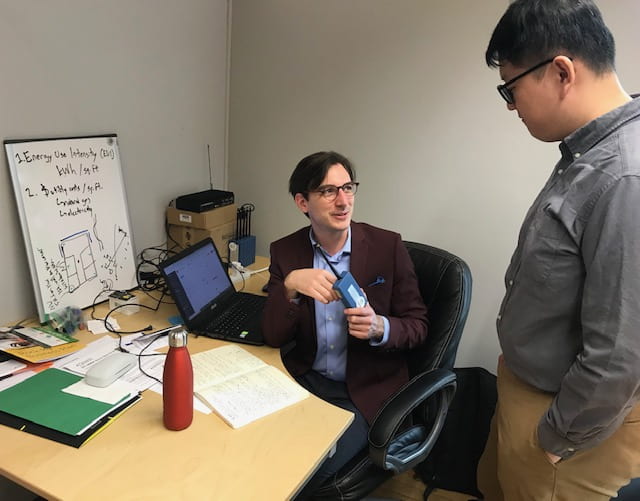
Matt Schaubroeck and Xinxin Wei work on the software behind ioAirFlow

ioAirFlow takes the concept of residential smart thermostats and applies it to commercial-industrial buildings. The goal is to make big buildings smarter and greener, with a technology that’s as accessible as possible.

The idea occurred to Schaubroeck when he was working on his MBA in a tech commercialization program. After meeting industry leaders and talking about his idea of a smart thermostat for commercial buildings, Schaubroeck realized there was a real need for the product.

“Everyone wants to save money on energy bills,” he says. “We want to save the planet at the same time.”

The big idea was there. Two years of research and development were in the books – including working with RRC’s Building Envelope Technology Access Centre (BETAC) last year, heating up a trailer behind the Notre Dame Campus in order to track temperature and humidity.

Schaubroeck worked alongside Steve Lawrence, Coordinator of the ACE Project Space, on the research proposal. Lawrence is also working as the academic supervisor/advisor for the project.
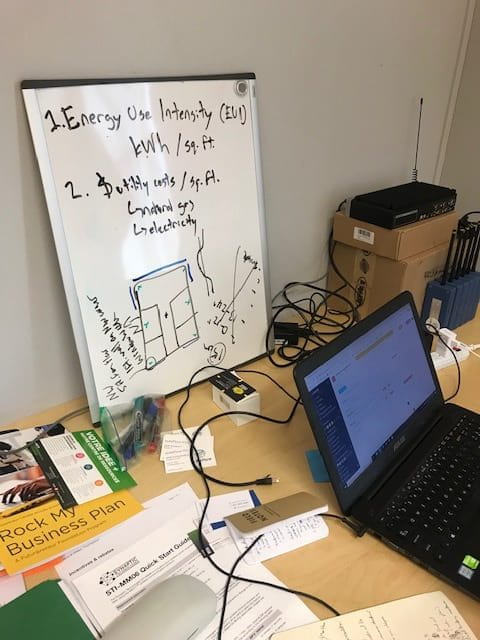
Earlier this month, the time finally came to put the idea into action. That’s where the ACE Project Space and funding from Mitacs came in, making this the first Mitacs-funded project at RRC.

“We’re thrilled to be the first Mitacs-funded project at ACE Project Space. Mitacs presented themselves as a great option to allow us to get into a space like this,” says Schaubroeck. “It’s such a great opportunity. We wouldn’t be here without their help.”

Mitacs is a national not-for-profit research network that has traditionally funded applied research collaborations at Canadian universities. Last year they began funding colleges, and with former RRC research manager Brent Wennekes taking the lead for Mitacs in Manitoba, RRC was one of the first colleges to sign on as a Mitacs partner institution.

“Mitacs is very pleased to be able to support this partnership with ioAirFlow with funding for their talented research intern,” says Wennekes. “RRC has been a national college leader in applied research for many years, and ACE Project Space has established itself as a key player in Winnipeg’s start-up community. Our program is perfect for start-up companies and with ACE, you get not only talent, but office space as well!”
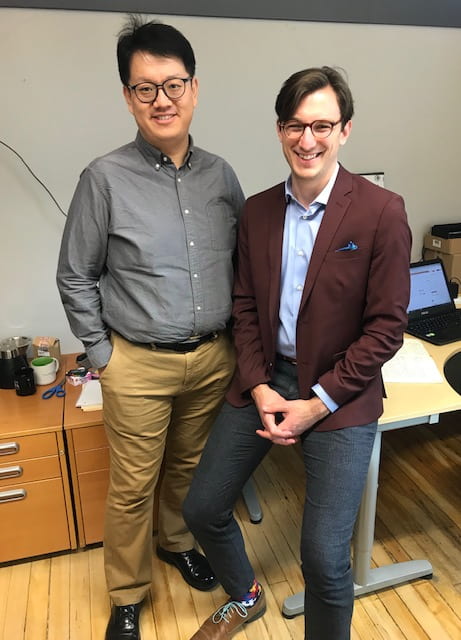
Along with Xinxin Wei, a Business Information Technology (BIT) student from RRC, and the third member of their team, Amanda San Filippo, Schaubroeck is now working on the software, crunching the numbers on the program’s back-end.

“The big problem with energy efficiency is you have to be an expert to use it. The front end of this system is going to make it as easy to understand as possible,” he says. “We’re working with building owners to understand what they care about and how it’s going to make a difference.”

While the whole team had to face the challenge of learning the complicated technical language of the software programming, Xinxin Wei had to face the additional challenges of honing his English language skills and navigating a new country. The international student has just finished his first year of the BIT program and is thrilled to be working on ioAirFlow.

“I don’t have any experience in Canada,” says Wei. “The most important part for me is working with a real Canadian employer. I’ve been learning how to work with others, and the whole experience is very great.”

The team hopes to have the program off the ground by this fall. For more information on ioAirFlow, please visit their website.
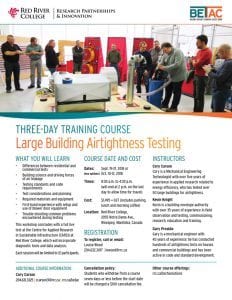
Three-Day Training Course: Large Building Airtightness Testing

March 5, 2019

What You Will Learn

  • Differences between residential and commercial tests
  • Building science and driving forces of air leakage
  • Testing standards and code requirements
  • Test considerations and planning
  • Required materials and equipment
  • First-hand experience with setup and use of blower door equipment
  • Troubleshooting common problems encountered during testing

This workshop concludes with a full live test at the Centre for Applied Research in Sustainable Infrastructure (CARSI) at Red River College, which will incorporate diagnostic tools and data analysis.

Each session will be limited to 12 participants.

Course Dates and Cost

Dates: April 24-26, 2019 (spots available)

Times: 8:30am to 4:30pm (will end at 2pm on the last day to allow time for travel)

Cost: $1,495 + GST (includes parking, lunch and morning coffee)

Location: Red River College, 2055 Notre Dame Ave., Winnipeg, Manitoba, Canada

Registration

To register, call or email:

Sheila Allarie
sallarie@rrc.ca
204-632-2038

Cancellation policy: Students who withdraw from a course seven days or less before the start date will be charged a $100 cancellation fee.

Instructors

Cory Carson
Cory is a Mechanical Engineering Technologist with over five years of experience in applied research related to energy efficiency, who has tested over 50 large buildings for airtightness.

Kevin Knight
Kevin is a building envelope authority with over 35 years of experience in field observation and testing, commissioning, research, education and training.

Gary Proskiw
Gary is a mechanical engineer with 40 years of experience; he has conducted hundreds of airtightness tests on houses and commercial buildings and has been active in code and standard development.

Additional Course Information

Cory Carson
204.631.3325 | ccarson31@rrc.ca

Other course offerings can be found at rrc.ca/techsolutions.

BETAC in the news: Journal of Commerce

February 13, 2019

Red River College’s Building Envelope Technology Access Centre (BETAC) was in the news this week, with a mention in the Journal of Commerce by ConstructConnect. The article highlights BETAC’s partnership with SMT Research Ltd. to monitor the health of the Skilled Trades and Technology Centre as it was being built.

“SMT partnered with Red River College’s (RRC) Building Envelope Technology Access Centre (BETAC) to monitor the structural health of the Skilled Trades and Technology Centre (STTC) as it was being built on the RRC Notre Dame campus in Winnipeg.

Structural health monitoring helps to ensure that new buildings are energy-efficient, durable and perform as expected.

BETAC and SMT installed a wide network of sensors throughout the building as it was under construction.

A total of seven different building envelope types were instrumented throughout the exterior building envelope, as well as the roof and green roof assemblies.

The effectiveness of the STTC’s building envelope, which helps protect its occupants from the extremes of Winnipeg’s climate, will continue to be monitored in real time.”

Read the full article here.

Lunch and Learn: Starting Out and Scaling Up with Federal Support

May 1, 2018

Join industry, business, and applied research leaders for this Lunch and Learn to explore how federal support can bring your work to the next level.

Get a practical snapshot of the spectrum of federal programming available from exploratory applied research, to pre-commercialization, and support for late-stage procurement and testing.

Date: Thursday, May 10, 2018
Time:
12:00 – 1:30 p.m.
Location: Prairie Lights, Notre Dame Campus, Red River College

This event is being organized by the Research Partnerships & Innovation office at Red River College in collaboration with the Natural Sciences and Engineering Research Council of Canada and Public Services and Procurement Canada.

Register for the event today

Register Now! Level II Advanced Infrared Thermography

February 27, 2018

This course from April 17 to April 20 will teach advanced theory and applications of infrared thermography in the preventive maintenance, quality assurance, condition monitoring and non-destructive testing of materials, with an emphasis on building envelope components such as wall assemblies and roofs. Read More →

Research on thermally broken concrete balcony underway

February 1, 2018

The Building Envelope Technology Access Centre (BETAC) team has partnered with the University of Manitoba and consulting firm Crosier Kilgour and Partners to develop a new thermal break, or barrier, to help reduce significant heat loss that occurs in high rise buildings with large concrete balconies.
“Commercial alternatives of thermal breaks are available but prohibitively expensive,” said researcher Dagmar Svecova in ResearchLIFE, a University of Manitoba magazine. Read More →

Sensor Installation in Skilled Trades and Technology Centre

January 31, 2018

A team of researchers at the Building Envelope and Technology Access Centre (BETAC) partnered with SMT Research to monitor the structural health of the Skilled Trades and Technology Centre (STTC) being built at Red River College.

A paper on their work was presented at the 8th International Conference on Structural Health Monitoring of Intelligent Infrastructure in Brisbane, Australia, in December, 2017.

Structural Health Monitoring (SHM) of bridges and heritage buildings are essential to ensure modern rehabilitation techniques and materials continue to perform as expected. SHM systems also play a key role to ensure new buildings perform as expected with respect to energy efficiency and durability.

Their paper focused on the application of advanced sensor networks and data visualization techniques on a building instrumented as a ‘living lab’ located in Winnipeg, Canada.

The BETAC and SMT Research team installed a substantial network of sensors embedded throughout the new STTC.
A total of seven different building envelope types have been instrumented throughout the exterior building envelope as well as the roof and green roof assemblies.

The measurements from these sensors can be compared to controlled tests performed on mock-up test walls in the Dual Environment Test Chamber located in the Centre for Applied Research in Sustainable Infrastructure (CARSI) at Red River College.

Field analysis will be performed in real-time during normal building occupancy throughout the temperature extremes inherent to Winnipeg.

View the full research paper HERE.

Sensor Installation in Skilled Trades and Technology Centre (2017-18)

December 14, 2017

A team of researchers at the Building Envelope and Technology Access Centre (BETAC) partnered with SMT Research to monitor the structural health of the Skilled Trades and Technology Centre (STTC) being built at Red River College.

Background

Structural Health Monitoring (SHM) of bridges and heritage buildings are essential to ensure modern rehabilitation techniques and materials continue to perform as expected. SHM systems also play a key role to ensure new buildings perform as expected with respect to energy efficiency and durability.

Our Research

  • The BETAC and SMT Research team installed a substantial network of sensors embedded throughout the new STTC.
  • A total of seven different building envelope types have been instrumented throughout the exterior building envelope as well as the roof and green roof assemblies.
  • The measurements from these sensors can be compared to controlled tests performed on mock-up test walls in the Dual Environment Test Chamber located in the Centre for Applied Research in Sustainable Infrastructure (CARSI) at Red River College.
  • Field analysis will be performed in real-time during normal building occupancy throughout the temperature extremes inherent to Winnipeg.

Results

A paper on our work was presented at the 8th International Conference on Structural Health Monitoring of Intelligent Infrastructure in Brisbane, Australia, in December, 2017.

The paper focused on the application of advanced sensor networks and data visualization techniques on a building instrumented as a ‘living lab’ located in Winnipeg, Canada.

CANCELLED: Register Now for Two-Day WUFI Workshop

December 7, 2017

CANCELLED: This workshop has been cancelled due to an unforeseen scheduling conflict with the instructor, and due to low enrolment.

Join expert Manfred Kehrer for a two-day workshop this February, 2018, hosted by Red River College’s Building Envelope & Technology Access Centre (BETAC).

WUFI® is an acronym for Wärme Und Feuchte Instationär, which, translated, means heat and moisture transiency. Read More →

RRC Polytech campuses are located on the lands of the Anishinaabeg, Ininiwak, Anishininwak, Dakota Oyate, and Denésuline, and the National Homeland of the Red River Métis.

We recognize and honour Treaty 3 Territory Shoal Lake 40 First Nation, the source of Winnipeg’s clean drinking water. In addition, we acknowledge Treaty Territories which provide us with access to electricity we use in both our personal and professional lives.