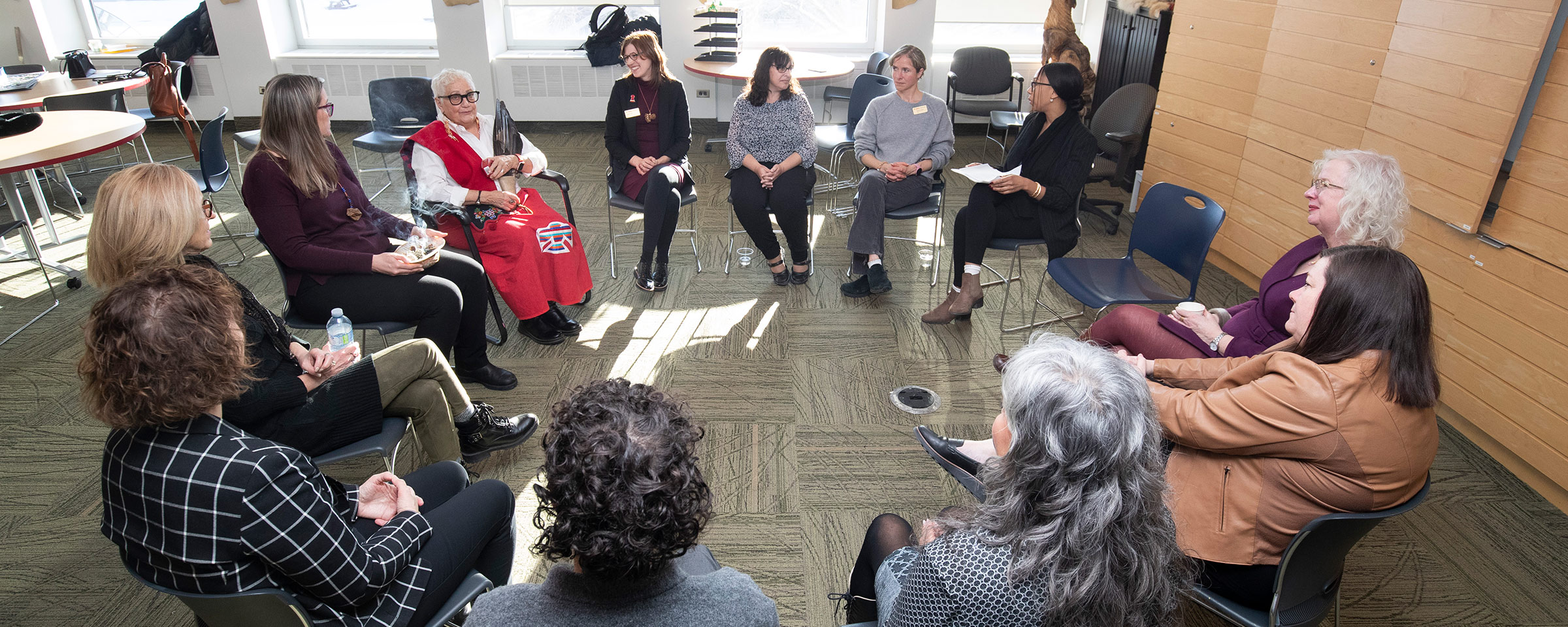
People sitting in a circle

Truth and Reconciliation and Community Engagement

Commitment in Action: Advancing Truth and Reconciliation in Collective Bargaining

Overview

RRC Polytech and the Manitoba Government and General Employees’ Union (MGEU) Local 73 have built a collaborative partnership to advance Truth and Reconciliation through the review of RRC Polytech’s Collective Agreement. This partnership reflects a commitment to ensuring that the Collective Agreement embodies shared values of advancing Truth and Reconciliation (TRC) and equity, diversity, inclusion, and accessibility (EDIA).

This collaboration — the first of its kind — represents a new and transformative approach to advancing the Truth and Reconciliation Commission of Canada’s Calls to Action within labour relations and the collective bargaining process. What sets it apart is the intentional approach rooted in Indigenous knowledge and ways of being, guided by a Knowledge Keeper, and supported by both RRC Polytech and MGEU.

Timeline

2021

  • RRC Polytech management proposes, and MGEU agrees to, an interest-based discussion for collective bargaining.

2022

  • May: Both parties engage in interest-based dialogue focused on Truth and Reconciliation and Equity, Diversity, and Inclusion.
  • Joint Letter of Intent: “Advancing Truth and Reconciliation” letter put forward, outlining recommendations to the Labour Management Committee.

2023

  • August: Union members ratify terms of settlement for the renewal of the collective agreement.
  • September: RRC Polytech launches the joint Truth and Reconciliation Working Group to review the collective agreement and suggest improvements.
  • Working Group membership is established with representatives from both RRC Polytech and MGEU.

2024

  • Consultation regarding management bargaining proposals.
  • RRC Polytech sent notice to begin bargaining; Truth and Reconciliation Working Group presented recommendations.

2025

  • March: Truth and Reconciliation Working Group tabled their report.
  • April: Exchange of proposals and start of weekly full day bargaining sessions.
  • September: Tentative agreement reached Sept 17; ratification voting closed Sept 29.
Group photo

TRC Working Group

Membership

  • Dayna Graham, Student Case Manager – Co-Chair
  • Monica Lytwyn, Educational Developer – Co-Chair
  • Carleigh Freisen, Academic Chair
  • Cindy Benoit, Instructor
  • Gerald Sereda, Educational Developer
  • Maxine Fehr, Instructor
  • Nora Sobel, Instructor
  • Sharon Shewchuk (participated until April 2024)

Facilitators

  • Kookum Barbara Bruce, Elder and member of Knowledge Keepers’ Council at RRC Polytech
  • Carla Kematch, Director, Truth and Reconciliation (Executive Sponsor)
  • Eucharia Ogoms, Indigenous Recruitment Consultant

Executive Sponsors

  • Jamie Wilson, Vice President, Indigenous Strategy, Research and Business Development
  • Melanie Gudmundson, Chief Human Resource Officer
  • Wade Park, Indigenous Student Recruiter
  • JP LaPointe, Instructor and staff representative for MGEU
  • Matt Fontaine, Instructor and staff representative for MGEU

Process and Elder Acknowledgement

The working group is grateful to be guided by Kookum Barbara Bruce (Flies High Thunderbird and Truth Talker), ensuring that the efforts to advance Truth and Reconciliation was completed in a good way. This process stands out across Canada, setting a precedent for other post-secondary institutions by aligning with Truth and Reconciliation and Community Engagement (TRCE) and Equity, Diversity and Inclusion (EDI), honouring Indigenous Knowledge Protocols, and fostering leadership, mentorship, and systemic change at RRC Polytech.

Kookum Barbara led meetings with a smudge and prayer, sharing teaching throughout the process that connected to the work.

Through priority setting and Design Thinking – a non-linear, iterative process that demonstrates true Indigenous engagement processes – the TRC Working developed recommendations for RRC Polytech’s Collective Agreement.

Recommendations and Impact

The TRC Working Group identified areas of priority for their recommendations, aligning with Principles of Truth and Reconciliation, the Truth and Reconciliation Commission of Canada’s Calls to Action, and the United Nations Declaration on the Rights of Indigenous Peoples (UNDRIP).

Twenty-one recommendations were presented to RRC Polytech’s Labour Management Committee and brought to the collective bargaining table. These recommendations all fell under the themes of inclusive language, family, leaves, and sickness and health. There were additional themes that will be pursued for future negotiations.

This work led to meaningful, tangible, and lasting improvements in the 2025–2028 Collective Agreement, nearly all of which were formally adopted—an achievement that is unprecedented in typical bargaining processes.

Actions to advance Truth and Reconciliation in RRC Polytech’s 2025-28 Collective Agreement

Inclusive and Gender Affirming Language

  1. Remove feminine/masculine pronouns in the agreement (he/him, she/her).
  2. Remove binary pronouns (she/her/he/him)
  3. Remove binary parental language (“mother,” “father”) in all leave policies.
  4. Provide gender affirming medical leave (15 days) separate from sick leave.

Expanded and Inclusive Definition of Family

  1. Introduce an inclusive definition of family, reflecting diverse cultural practices, including Indigenous kinship structures.

Caregiving, Cultural, Spiritual, and Religious Leaves

  1. Rename Family Related Leave to Care Leave to better reflect caregiving needs.
  2. Remove restrictive wording (“real, immediate and unavoidable”) from leave eligibility.
  3. Separate Care Leave from Religious Leave to honour distinct purposes.
  4. Rename Religious Leave to Ceremonial, Cultural, Religious and Spiritual Leave.
  5. Establish dedicated days for ceremonial, cultural, spiritual, or religious practices, not pulled from sick time. (Two new working days implemented)

Bereavement Leave

  1. Expand bereavement leave to recognize relationships defined by the employee, rather than colonial/Eurocentric norms.

Sick Leave

  1. Revise sick leave language to acknowledge mental and physical health holistically.
  2. Reduce sick leave accumulation period to 2 years.
  3. Prorate sick leave for new employees so no sick leave is lost.
  4. Eliminate the requirement for doctor’s notes for short absences.
  5. Broaden medical appointments to include holistic health related appointments.

Wellness

  1. Introduce wellness days to support preventive health practices. (Two wellness days implemented.)

Training for Management

  1. Provide Truth and Reconciliation informed training for managers and staff to ensure new articles are applied with goodwill and understanding. (Training is under development.)

Recommitment to Reviewing the Collective Agreement by TRC Working Group

  1. Recommit to the continuation of the Truth and Reconciliation Working Group’s efforts, as outlined in a Memorandum of Agreement attached to the Collective Agreement.

RRC Polytech campuses are located on the lands of the Anishinaabeg, Ininiwak, Anishininwak, Dakota Oyate, and Denésuline, and the National Homeland of the Red River Métis.

We recognize and honour Treaty 3 Territory Shoal Lake 40 First Nation, the source of Winnipeg’s clean drinking water. In addition, we acknowledge Treaty Territories which provide us with access to electricity we use in both our personal and professional lives.