Threading Connection: How Beadwork Becomes Bridge
A reflection on “We Are All Connected” and the journey from separation to synthesis
Connected by the river between Deshkan Ziibing and Western classrooms,
I learned to translate myself across imposed boundaries,
my body remembering what curriculums demanded I forget.
Years beneath a Nordic winter light, I witnessed a partner’s spirit
dance with her Sámi heritage, I recognized my mother’s rhythms—
separate melodies carried on the same human breath.
Under Oaxaca’s brilliant sun, I felt ancestral whispers
in Zapotec ceremonies that echoed my grandmother’s teachings,
revealing a resonation within my soul:
Indigeneity flows beneath the categories
colonial knowledge requires to maintain itself.
Now, returning to Red River’s evolving halls, I witness
how far we’ve come—Indigenous buildings open to all,
diverse programs flourishing under one institutional sky.
Yet still I see us gathered in familiar circles,
celebrating culture while dwelling in separate spaces—
progress and distance coexisting under the same roof.
This beadwork invites us to thread what was never truly separate:
each letter, each language, each story
forming a constellation that has always been whole,
even when our eyes were taught not to see it.
I’ve been thinking about translation lately—not just between languages, but between worlds. How do we carry meaning across the boundaries that history has drawn between us?
These questions live in my body. Growing up status First Nations from Chippewas of the Thames, I received early teachings about being related to all things. Yet as I moved through five provinces over a decade, I discovered how easy it becomes to forget what you’ve always known. The further I traveled from home, the more I translated myself into languages that had no words for the wholeness I once understood.
The Awakening That Changes Everything
Two winters ago in Oaxaca, privilege revealed itself through scarcity. I’d gone seeking Indigenous culture that was celebrated rather than hidden—and found it pulsing through Zapotec ceremonies and daily life. But when our water ran out and we received a refill in 24 hours while local families waited 40 days, I finally understood. Every drop I consumed came from somewhere, from someone. Every resource that seemed infinite to me was desperately finite for others.
That awakening followed me home to Manitoba, transforming how I understood the water flowing from Shoal Lake 40 First Nation, the electricity powered by Treaty territory resources. The question became: how do we move from recognition to genuine reciprocity? This question lived in me as I developed “We Are All Connected”—how could we create opportunities for others to experience this shift from knowing about connection to feeling it in their bones, not through scarcity and crisis, but through collective creation?
Beadwork as Knowledge System
When I discovered that Indigenous scholars describe beadwork as “knowledge mobilization and translation,” something clicked. The Anishinaabemowin word for beading, manidoominens, contains manidoo (spirit) at its root. Every bead becomes prayer, every pattern becomes teaching.
This isn’t uniquely Indigenous—from Sámi duodji to West African kente, humans have always encoded meaning through material creation. The act of creating together builds relationships that transcend verbal communication. Our hands remember what our minds might forget.
The Initiative as Living Practice
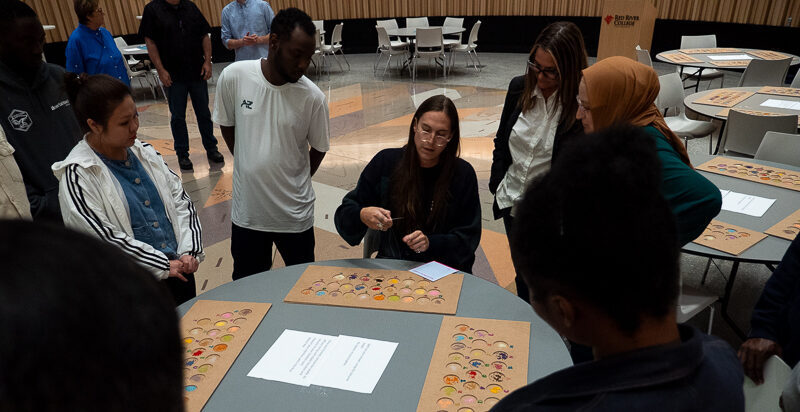
“We Are All Connected” emerges from this understanding. Throughout the academic year at RRC Polytech, anyone can pick up a card featuring one of seven reflective questions based on the Seven Grandfather Teachings. They write their response in any language—Tagalog, Punjabi, Mandarin, Ojibwe, English. Later, at beading stations across campus, they translate their words into colored beads, each letter assigned its own hue. These individual contributions join together in a growing installation that physically manifests our interconnection.
This embodies what Mi’kmaq Elder Albert Marshall calls Two-Eyed Seeing—”learning to see from one eye with the strengths of Indigenous knowledges and from the other eye with the strengths of Western knowledges.” We’re creating space where both can coexist without hierarchy.
When someone writes “respect” in English or “ᑭᔅᑌᔨᐦᑕᒧᐏᐣ” (kisteyihtamowin) in Cree, they’re recognizing that every language carries its own understanding of universal concepts. Transforming these words into beads, they participate in Indigenous methodology that understands knowledge as something we create through relationship, not consume in isolation.
Nobody is teaching about reconciliation here—we’re practicing it. When diverse backgrounds contribute their truths to a shared creation, when those contributions are valued equally regardless of language, when the process honors Indigenous methodology while welcoming all participants—that’s the difference between performance and transformation.
What Changes When We Thread Connection
For years, I saw being “the hyphen between worlds” as burden—always translating, never fully belonging. But through this initiative, I’m discovering that those of us who live between worlds carry special gifts. We know what it feels like when connection breaks. We understand viscerally what’s lost when we forget our relations.
When participants engage, something shifts. A student from India might write about respect through touching elders’ feet, while someone from Norway describes it through personal space. Both truths matter. The beading itself becomes meditation, ceremony, prayer—whatever the participant needs. You can’t bead someone else’s truth; you must sit with your own. You can’t rush the process; relationship takes time.
Creating Tomorrow’s Memory
By year’s end, our installation will contain hundreds of contributions in dozens of languages. But the physical artifact isn’t the point. Transformation happens in the moments when someone realizes their grandmother’s teaching echoes across cultures, when they see their mother tongue valued equally, when they understand that reconciliation isn’t about helping “others” but recognizing ourselves in each other.
This installation will grow beyond this year, potentially adding new sections annually. Imagine entering RRC Polytech in five years and seeing layers of connection, generations of truth-telling woven together.
If you’re reading this and feeling something stir, know that this is the beginning of remembering. We all carry ancestral knowledge of connection, even buried under generations of separation. “We Are All Connected” isn’t teaching this truth—it’s creating space to remember and practice it. When you pick up that card, select those beads, you’re not participating in someone else’s culture. You’re reclaiming your birthright as a human being: the right to connection, to creativity, to contribution.
The river connecting my childhood territory to Western classrooms flows through all of us. Your grandmother’s wisdom—whatever tradition she carried—points toward the same truth: we are related to everything and everyone, and this relationship requires our conscious participation.
So come. Bring your language, your questions, your uncertainties. Bring your grandmother’s teachings and your children’s dreams. There’s a place for all of it in this weaving.
Because underneath the categories colonial knowledge requires, beneath the boundaries we’ve been taught to maintain, flows something that’s always been whole. We just need to thread it back into visibility, one bead, one truth, one connection at a time.
We are all connected. We always have been. Now we’re making it visible.
How to Join the Weaving
- Keep an eye on student and staff news for beading station locations and times as they move across campuses throughout the year
- Pick up intention cards at any beading station (take as many as you wish—there’s no limit on contributions)
- Write your response to any of the Seven Grandfather Teaching questions in whatever language speaks to you
- Return to a beading station to translate your own words into beads—you can bead your entire answer or choose certain words and phrases to emphasize—this personal act of creation is part of the practice
- Your completed beadwork and card will be added to our growing collective installation
If you have any questions, contact Craig Fisher cfisher34@rrc.ca.